
The Core Contenders in 2026
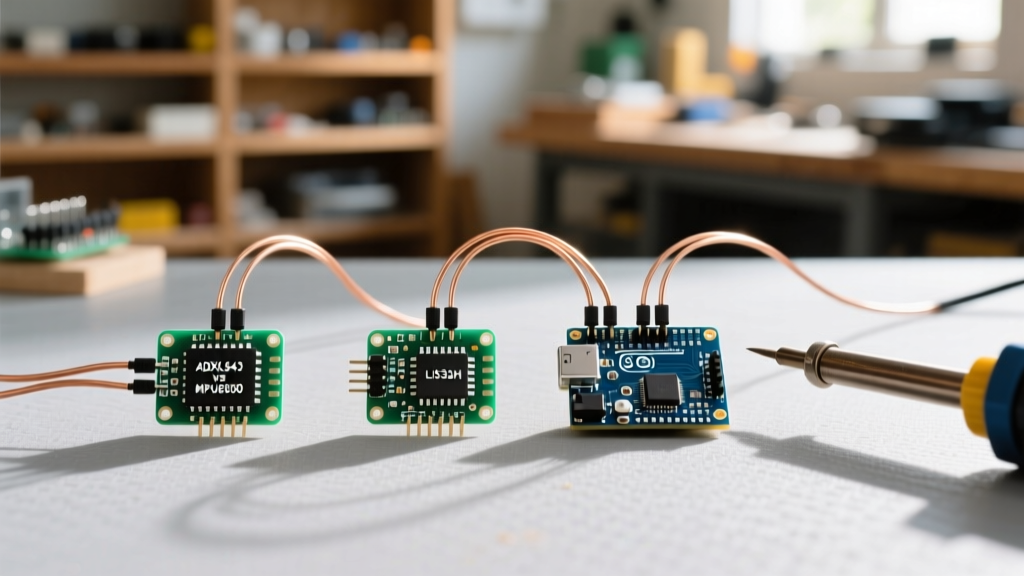
When selecting an accelerometer for Arduino projects, the sheer volume of breakout boards on the market can be paralyzing. Whether you are building a self-balancing robot, a battery-powered wearable, or a seismic vibration monitor, the sensor you choose dictates your power budget, processing overhead, and ultimate reliability. In 2026, three silicon chips continue to dominate the hobbyist and prototyping space: the Analog Devices ADXL345, the TDK InvenSense MPU6050, and the STMicroelectronics LIS3DH.
This component comparison cuts through the marketing fluff. We will examine exact specifications, real-world pricing, I2C/SPI wiring pitfalls, and the specific edge cases that cause these sensors to fail in the field.
Analog Devices ADXL345: The Low-Power Specialist
The Analog Devices ADXL345 is a 13-bit digital accelerometer capable of measuring up to ±16g. It is renowned for its ultra-low power consumption, drawing just 140 µA in measurement mode and a mere 0.1 µA in standby. This makes it the premier choice for battery-operated Arduino projects like pedometers or tilt-sensing alarms.
- Resolution: 13-bit (4 mg/LSB scale factor)
- Interface: I2C (up to 400 kHz) and SPI (up to 5 MHz)
- 2026 Pricing: ~$17.50 for the official Adafruit breakout; ~$2.50 for generic bare-bones I2C modules.
- Standout Feature: Built-in tap/double-tap detection and free-fall interrupt pins (INT1/INT2), allowing the Arduino to sleep while the sensor monitors for physical events.
TDK InvenSense MPU6050: The 6-Axis Workhorse
If your project requires spatial orientation, the TDK InvenSense MPU6050 is the undisputed king of the hobbyist workbench. Technically a 6-axis IMU (Inertial Measurement Unit), it combines a 3-axis accelerometer with a 3-axis gyroscope. Its secret weapon is the onboard Digital Motion Processor (DMP), which offloads complex sensor fusion mathematics from your Arduino's ATmega328P chip.
- Resolution: 16-bit ADCs (programmable from ±2g to ±16g)
- Interface: I2C (up to 400 kHz) and SPI (Note: SPI is often disabled on cheap GY-521 clones).
- 2026 Pricing: ~$12.00 for branded breakouts; ~$1.80 for the ubiquitous GY-521 clone modules.
- Standout Feature: The DMP outputs quaternions directly, eliminating the need for heavy floating-point math on the microcontroller.
STMicroelectronics LIS3DH: The Wearable Champion
The STMicroelectronics LIS3DH is a 12-bit, 3-axis accelerometer designed specifically for extreme power constraints. While it lacks the gyroscope of the MPU6050, it includes a built-in auxiliary ADC and operates at an astonishingly low 2 µA in low-power mode. It is the ideal accelerometer for Arduino wearables, smart jewelry, and wildlife tracking tags.
- Resolution: 12-bit (dynamically scaled based on g-range)
- Interface: I2C and SPI
- 2026 Pricing: ~$9.95 for the Adafruit Flora/Feather breakouts; ~$2.00 for generic modules.
- Standout Feature: 'Wake-on-motion' capability and an internal FIFO buffer that stores up to 32 samples, allowing the microcontroller to batch-read data and save power.
Head-to-Head Specification Matrix
| Feature | ADXL345 | MPU6050 | LIS3DH |
|---|---|---|---|
| Axes | 3 (Accel only) | 6 (Accel + Gyro) | 3 (Accel only) |
| Active Current | 140 µA | 3.9 mA | 2 µA (Low Power) |
| Standby Current | 0.1 µA | 5 µA | 0.5 µA |
| Max G-Range | ±16g | ±16g | ±16g |
| Onboard Temp Sensor | No | Yes | No |
| FIFO Buffer | 32 levels | 1024 bytes | 32 levels |
| Best Use Case | Tilt, Pedometers | Drones, Balancing Robots | Battery Wearables |
Critical Hardware Integration Pitfalls
The 5V Logic Trap: All three of these sensors operate at 3.3V logic levels. Connecting the SDA and SCL pins of an ADXL345 or MPU6050 directly to a 5V Arduino Uno or Mega without a bidirectional logic level shifter (like the BSS138) will eventually degrade the sensor's internal pull-up resistors or permanently fry the I/O pins. While some 2026 breakout boards include onboard level shifting, the ultra-cheap $1.80 generic modules do not. Always use a level shifter or a 3.3V native board like the Arduino Nano 33 IoT.
I2C Address Conflicts
When integrating multiple sensors on the same I2C bus, address collisions are a common failure point.
- ADXL345: Default address is
0x53. Pulling the SDO/ALT ADDRESS pin HIGH shifts it to0x1D. - MPU6050: Default address is
0x68. Pulling the AD0 pin HIGH shifts it to0x69. - LIS3DH: Default address is
0x18(SA0 LOW) or0x19(SA0 HIGH). Note that 0x18 conflicts with the popular SHT31 temperature sensor on some breakout boards.
Real-World Failure Modes and Edge Cases
Beyond basic wiring, experienced engineers must account for silicon-level quirks that rarely make it into beginner tutorials:
- MPU6050 I2C Bus Lockup: If your Arduino resets or loses power while the MPU6050 is actively driving the SDA line LOW, the I2C bus will lock up upon reboot. Fix: Implement a software I2C recovery routine in your
setup()function that toggles the SCL pin 9 times to force the sensor to release the bus. - ADXL345 SPI Mode Failures on Clones: The ADXL345 supports high-speed SPI, but many sub-$3 generic modules hardwire the SDO pin to GND internally to save manufacturing costs. This forces the chip into I2C mode, rendering the SPI headers useless. If your project requires SPI to avoid I2C bus capacitance issues, buy a verified branded breakout.
- LIS3DH FIFO Overflow: If you rely on the LIS3DH's hardware interrupt to wake the Arduino from sleep, ensure your I2C clock speed is fast enough to drain the 32-sample FIFO buffer before it overwrites old data during high-vibration events.
Software Library Ecosystem
The software overhead required to extract meaningful data varies wildly between these chips. The MPU6050 relies heavily on the MPU6050_tockn or the official InvenSense DMP libraries. While the DMP provides excellent quaternion data, the library footprint can consume up to 40% of the ATmega328P's 32KB flash memory, leaving little room for complex application logic.
Conversely, the ADXL345 and LIS3DH are straightforward register-read devices. Using Adafruit's unified sensor libraries, you can pull raw XYZ data in under 10 lines of code with minimal flash overhead. For the LIS3DH, the Adafruit_LIS3DH library natively supports the built-in ADC pins, allowing you to read analog sensors (like thermistors) through the accelerometer's I2C connection, saving precious analog pins on your microcontroller.
Final Verdict: Which Accelerometer for Arduino Should You Buy?
There is no universal 'best' sensor; the correct choice is dictated by your project's physical and computational constraints.
- Buy the MPU6050 (GY-521) if you are building a drone flight controller, a gimbal, or a two-wheeled balancing robot. The integrated gyroscope and DMP are mandatory for high-frequency sensor fusion, and the $1.80 price point is unbeatable for robotics.
- Buy the ADXL345 if you are building a drop-test logger, a CNC vibration monitor, or a tilt-compensated compass. Its robust tap-detection interrupts and wide SPI/I2C support make it the most versatile pure accelerometer on the market.
- Buy the LIS3DH if your project runs on a coin cell battery or LiPo for months at a time. Its 2 µA low-power mode and wake-on-motion features are essential for IoT wearables and remote environmental sensors.
By matching the silicon capabilities to your specific mechanical and power requirements, you ensure your Arduino project remains responsive, efficient, and reliable in the field.