
The 28BYJ-48 in 2026: Legacy Hardware, Modern Control
Despite the proliferation of brushless DC motors and closed-loop NEMA 17 steppers, the 28BYJ-48 stepper motor Arduino ecosystem remains a cornerstone of rapid prototyping, automated home blinds, and low-torque IoT valve control. Priced between $2.50 and $4.00 USD for a complete motor and driver kit in 2026, its cost-to-functionality ratio is unmatched for hobbyists and educational labs. However, treating the 28BYJ-48 like a standard bipolar stepper leads to missed steps, overheated driver boards, and stalled projects. This guide dissects the exact mechanical realities of the 28BYJ-48, maps out safe ULN2003 wiring practices, and provides production-ready code using modern non-blocking libraries.
Hardware Teardown: Motor Specs and the ULN2003 Driver
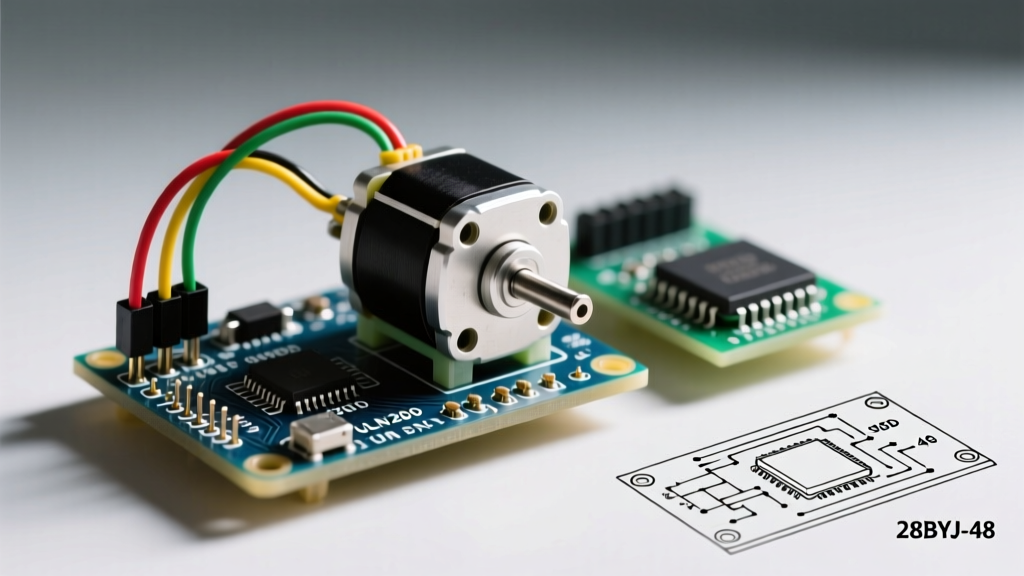
The 28BYJ-48 is a 5-phase, unipolar stepper motor equipped with an internal planetary gear train. Unlike standard steppers that map directly to a 1:1 step ratio, the 28BYJ-48 relies on a complex gear reduction that fundamentally alters how you program its step counts.
| Parameter | Specification | Engineering Notes |
|---|---|---|
| Operating Voltage | 5V DC (12V variant exists) | Verify your motor label; 12V versions will barely turn on 5V logic. |
| Phase Resistance | 50 Ω ± 7% (per half-phase) | Draws ~100mA per phase, ~200mA max simultaneous. |
| Stride Angle | 5.625° / 64 | Base motor step before gear reduction. |
| Gear Reduction Ratio | 1 : 63.68395 | Often rounded to 1:64, but the exact math is 32/9 × 22/11 × 26/9 × 31/10. |
| Steps per Revolution | 2048 (Full Step) / 4096 (Half Step) | Calculated as (64 / 5.625) * 63.68395. |
| Pull-In Torque | 34.3 mN·m | Extremely low; do not use for heavy vertical lifting. |
The Gear Ratio Myth: Many legacy tutorials instruct you to use 2038 or 2048 steps per revolution. While 2048 is close enough for basic 360-degree rotations, precision applications (like camera sliders or dials) will accumulate a 0.5-degree error per revolution due to the actual 63.68395 ratio. For high-precision positioning, use 4096 steps in half-step mode.
The ULN2003A Darlington Array
Because the Arduino's GPIO pins can only source ~20mA (on older AVR boards) to ~40mA (on newer R4/ARM boards), they cannot directly drive the motor's 100mA+ phase requirements. The included ULN2003A driver board uses a Darlington transistor array to act as a high-current switch. According to the Texas Instruments ULN2003A datasheet, each channel can handle up to 500mA peak, making it perfectly suited for the 28BYJ-48's current draw, provided you manage heat dissipation.
Wiring the 28BYJ-48 to Arduino (Uno R4 & Nano)
Proper wiring is critical to preventing brownouts on your microcontroller. The most common point of failure in 28BYJ-48 stepper motor Arduino projects is attempting to power the motor directly from the Arduino's 5V regulator.
Pinout Mapping
- IN1 to Arduino Digital Pin 8
- IN2 to Arduino Digital Pin 9
- IN3 to Arduino Digital Pin 10
- IN4 to Arduino Digital Pin 11
- GND (Driver) to Arduino GND and External Power Supply GND (Common Ground is mandatory)
- VCC (Driver) to External 5V Power Supply (Minimum 1A capacity)
Library Showdown: Stepper.h vs. AccelStepper
When programming the 28BYJ-48 stepper motor Arduino setup, developers typically choose between the native Arduino Stepper.h library and Mike McCauley's AccelStepper library. Here is how they compare for this specific hardware:
| Feature | Native Stepper.h | AccelStepper (Recommended) |
|---|---|---|
| Execution Type | Blocking (halts all other code) | Non-blocking (runs in background loop) |
| Acceleration Profiles | None (instant start/stop) | Linear acceleration & deceleration |
| Half-Step Support | Limited / Clunky | Native and highly optimized |
| Multi-Motor Sync | Impossible | Supported via AccelStepper MultiStepper |
Implementing AccelStepper: Non-Blocking Code
The 28BYJ-48 suffers from severe torque loss at high speeds due to its high inductance and internal gear friction. If you command it to instantly jump to 20 RPM, it will stall and vibrate. AccelStepper solves this by ramping up the speed. Below is a production-ready, non-blocking implementation tailored to the motor's physical limits.
#include <AccelStepper.h>

// Define the motor interface type (8 = half-step mode for 28BYJ-48)
#define HALFSTEP 8

// Pin definitions matching the wiring guide
#define motorPin1 8  // IN1
#define motorPin2 9  // IN2
#define motorPin3 10 // IN3
#define motorPin4 11 // IN4

// Initialize AccelStepper using half-step sequence
AccelStepper stepper(HALFSTEP, motorPin1, motorPin3, motorPin2, motorPin4);

void setup() {
  Serial.begin(115200);

  // Max speed for 28BYJ-48 is ~15 RPM (approx 1000 steps/sec in half-step)
  // Pushing beyond 1200 steps/sec usually results in stalling.
  stepper.setMaxSpeed(1000.0);

  // Set acceleration to prevent gear stripping and missed steps
  stepper.setAcceleration(300.0);

  // Minimum pulse width required for ULN2003 switching times
  stepper.setMinPulseWidth(200);

  // Target 1 full revolution (4096 half-steps)
  stepper.moveTo(4096);
}

void loop() {
  // Non-blocking movement call
  stepper.run();

  // Add your other IoT sensor reads or Wi-Fi tasks here
  // They will not be interrupted by motor movement
  if (stepper.distanceToGo() == 0) {
    delay(2000);
    // Reverse direction
    stepper.moveTo(-stepper.currentPosition());
  }
}
Why Pin Order Matters in AccelStepper
Notice the initialization: AccelStepper stepper(HALFSTEP, motorPin1, motorPin3, motorPin2, motorPin4);. The standard Arduino Stepper.h library expects pins in the order 1-2-3-4. However, AccelStepper requires the alternating coil phase order (1-3-2-4) to generate the correct half-step sequence. If you wire it 1-2-3-4 in AccelStepper, the motor will stutter, draw excessive current, and fail to rotate.
Troubleshooting Edge Cases & Failure Modes
Even with perfect wiring, the 28BYJ-48 presents unique mechanical and electrical quirks. Use this diagnostic matrix to resolve common field issues:
- The Motor Vibrates but Doesn't Turn
Cause: Acceleration is set too high, or max speed exceeds the pull-out torque threshold.
Fix: LowersetAccelerationto 200.0 andsetMaxSpeedto 800.0. Ensure the mechanical load does not exceed 34 mN·m. - ULN2003 Board is Hot to the Touch
Cause: Continuous energization of coils when the motor is idle.
Fix: The ULN2003 lacks an auto-sleep feature. Implement a software disable by setting all 4 Arduino pins toLOWwhen the motor reaches its target position to cut coil current and save power. - Positional Drift Over Multiple Cycles
Cause: The 28BYJ-48 uses cheap sintered bushings, not ball bearings. Backlash in the gear train is typically 1 to 2 degrees.
Fix: Always approach your target position from the same direction in software. If you need to move to 90 degrees, overshoot to 95 degrees, then reverse to 90 degrees to eliminate gear backlash slack. - Random Missed Steps During Wi-Fi Transmission (ESP8266/ESP32)
Cause: Wi-Fi interrupts pause theloop(), starvingstepper.run()of timely execution.
Fix: Move the stepper execution to a dedicated hardware timer interrupt or use the ESP32's secondary core (Core 0) exclusively for motion control.
Summary
Mastering the 28BYJ-48 stepper motor Arduino integration requires respecting its physical limitations. By utilizing an external power supply, acknowledging the exact 63.68395 gear ratio, and leveraging the non-blocking acceleration profiles of AccelStepper, you can extract reliable, repeatable motion from this budget-friendly actuator. Whether you are building an automated pet feeder or a precision camera pan-tilt head, these driver and library strategies ensure your peripheral hardware performs flawlessly in 2026 and beyond.