
The Shift to Edge AI: Rethinking the Voice Detection Arduino Pipeline
Integrating voice detection Arduino systems into commercial or advanced maker projects requires moving beyond simple threshold-based sound sensors. In 2026, the standard for reliable wake-word detection and acoustic event classification relies on TinyML (Tiny Machine Learning). However, many developers fall into the trap of treating edge audio pipelines like cloud-based speech-to-text workflows, leading to bloated firmware, high latency, and excessive power draw.
Workflow optimization in this context means streamlining the path from raw I2S microphone data to quantized neural network inference. By standardizing your data acquisition, optimizing Digital Signal Processing (DSP) blocks, and selecting the right silicon, you can reduce development cycles from weeks to days. This guide outlines a highly optimized workflow for deploying voice detection on modern Arduino architectures.
Hardware Selection Matrix: Matching Silicon to the Workflow
Before writing a single line of code, optimizing your workflow requires selecting hardware that natively supports audio DSP and neural inference. Using a standard ATmega328P for voice detection is a workflow anti-pattern; it lacks the clock speed and RAM for Mel-Frequency Cepstral Coefficients (MFCC) extraction.
| Board Model | Core Processor / Accelerator | Onboard Audio Hardware | Approx. Price (2026) | Best Workflow Use-Case |
|---|---|---|---|---|
| Arduino Nicla Voice | Cortex-M33 + Syntiant NDP120 | Bottom-port PDM Mic | $65.00 | Ultra-low power always-on wake-word detection (<1mW). |
| Nano 33 BLE Sense Rev2 | nRF52840 (Cortex-M4F @ 64MHz) | MP34DT05 PDM Mic | $42.00 | Rapid prototyping, multi-sensor fusion, Edge Impulse integration. |
| Portenta H7 + Vision Shield | STM32H747XI (Dual Cortex-M7/M4) | External I2S/PDM via Shield | $115.00+ | Complex multi-modal AI (voice + vision), high-sample-rate DSP. |
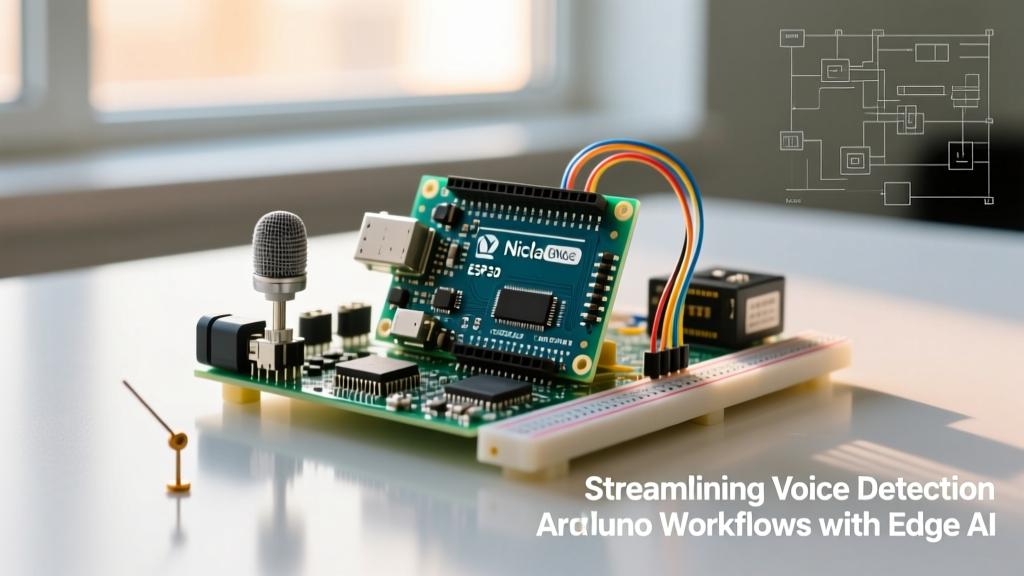
For a pure, optimized voice detection workflow, the Arduino Nicla Voice is currently the industry benchmark. The Syntiant NDP120 neural decision processor handles the inference pipeline in hardware, freeing the main Cortex-M33 MCU to handle application logic and BLE communication. As detailed in the official Arduino Edge AI announcements, this architecture reduces inference power consumption to microwatts, fundamentally changing battery-life calculations for IoT nodes.
Phase 1: Optimizing Data Acquisition and Ingestion
The most time-consuming phase of any voice detection Arduino project is dataset collection. A poorly structured ingestion workflow will bottleneck your training phase.
The 16kHz / 16-bit / Mono Standard
Do not capture audio at 44.1kHz or 48kHz. Human speech and environmental acoustic events relevant to edge AI (like glass breaking or specific wake words) contain almost zero actionable feature data above 8kHz. According to the Nyquist-Shannon sampling theorem, a 16kHz sample rate is sufficient. Capturing at 16-bit depth in mono reduces your payload size by 75% compared to CD-quality audio, drastically speeding up Edge Impulse uploads and browser-based DSP processing.
Automating Ingestion via CLI
Stop manually uploading WAV files through the web interface. Optimize your workflow by using the Edge Impulse CLI data forwarder.
edge-impulse-daemon --clean --frequency 16000By scripting this daemon to run on a Raspberry Pi connected to your Arduino via USB, you can trigger 1-second audio captures directly from the serial monitor, automatically labeling and pushing them to your cloud project. This reduces data ingestion time from roughly 45 seconds per sample to under 3 seconds.
Phase 2: DSP Tuning for Acoustic Features
Raw audio waveforms are too noisy and high-dimensional for microcontroller neural networks. You must convert the audio into a spectrogram using MFCC or MFE (Mel-Filterbank Energy) processing blocks. Tuning these parameters is where most developers lose weeks to trial and error.
Recommended DSP Parameters for Wake-Word Detection
- Window Size: 30ms to 40ms. (Captures the phonetic structure of short commands like "Hey Flux").
- Stride (Hop Length): 10ms to 20ms. (Provides enough temporal overlap for the CNN to detect transient consonants).
- Filter Bank Count: 40 to 64. (Going above 64 yields diminishing returns on Cortex-M4 architectures and bloats the input tensor size).
- Noise Floor: -52dB. (Crucial for filtering out HVAC hum and PCB switching noise before it reaches the feature extraction stage).
Workflow Pro-Tip: Always enable the "Remove silence" DSP toggle when training for continuous acoustic anomaly detection, but disable it when training for fixed-length wake-words. Fixed-length models require the temporal padding of silence to learn the exact onset timing of the command.
Phase 3: Model Architecture and Quantization
Once your spectrograms are generated, the neural network architecture must be chosen based on your target hardware's memory constraints. The TensorFlow Lite for Microcontrollers framework remains the backbone for Arduino deployments, but how you build the model dictates your success.
Choosing the Right Topology
- 1D Convolutional Neural Networks (CNN): Best for the Nano 33 BLE Sense. A simple architecture with two Conv1D layers (16 and 32 filters) followed by Global Average Pooling and a Dense softmax layer will typically fit under 40KB of Flash and require less than 10KB of RAM.
- Syntiant NDP120 Custom Architecture: If using the Nicla Voice, you do not use standard TFLite. Instead, you export the dataset from Edge Impulse and use the Syntiant SDK to train a specialized decision tree/neural net hybrid that runs exclusively on the NDP120 hardware accelerator.
The Quantization Imperative
Floating-point (FP32) models are virtually unusable on standard Arduino MCUs due to the lack of hardware Floating Point Units (FPUs) on lower-end chips, resulting in massive latency spikes. You must apply Int8 Quantization during the build phase.
Int8 quantization reduces model size by 75% and accelerates inference by up to 3x on Cortex-M processors with DSP extensions. The trade-off is a potential 1% to 3% drop in validation accuracy. To mitigate this, ensure your training dataset includes a "noise" class containing at least 15 minutes of the specific background noise (server racks, street traffic, fan hum) the device will encounter in the real world.
Phase 4: Deployment and Inference Profiling
The final step in the optimized workflow is profiling the deployed C++ library. Do not rely on cloud-based estimations; profile directly on the silicon.
Memory and Latency Profiling Matrix
Use the ei_run_classifier.h profiling functions to measure real-world performance. Below is a benchmark matrix for a standard 1-second wake-word model (Int8 quantized) running on the Nano 33 BLE Sense Rev2:
| Metric | FP32 (Unoptimized) | Int8 (Optimized) | Acceptable Edge Threshold |
|---|---|---|---|
| Flash Footprint | 142 KB | 38 KB | < 250 KB (Bootloader safe) |
| RAM Peak Usage | 34 KB | 11 KB | < 64 KB (Avoids stack overflow) |
| Inference Time | 185 ms | 42 ms | < 50 ms (Real-time continuous) |
| DSP Processing Time | 110 ms | 110 ms | < 150 ms |
Notice that DSP processing time remains largely unaffected by model quantization. If your total pipeline (DSP + Inference) exceeds the audio window length (e.g., takes 1.2 seconds to process a 1-second audio clip), your system will drop audio frames, resulting in missed wake-words. If you hit this bottleneck, reduce the MFCC filter bank count or lower the image stride before attempting to optimize the neural network layers.
Troubleshooting Common Edge Failure Modes
Even with an optimized workflow, hardware-level edge cases will disrupt voice detection Arduino deployments. Anticipate and mitigate these specific failure modes:
- I2S Bus Contention: If you are reading from a PDM microphone and writing to an external SPI flash chip simultaneously, DMA (Direct Memory Access) interrupts can cause audio buffer underruns. Solution: Implement double-buffering (ping-pong buffers) in your C++ audio ingestion loop to ensure the neural network processes Buffer A while the I2S peripheral fills Buffer B.
- Acoustic Clipping from PCB Resonance: Mounting a PDM mic directly over a switching voltage regulator (like the AP2112K) introduces high-frequency whine that MFCC algorithms interpret as speech features. Solution: Use acoustic cavity tuning or physical foam gaskets to isolate the mic port from PCB vibrations, and route analog ground planes separately from digital switching nodes.
- False Positives from Broadband Transients: Doors slamming or dropping tools can trigger wake-word models that lack temporal context. Solution: Implement a secondary "anomaly rejection" algorithm that checks the zero-crossing rate (ZCR) of the raw audio before passing it to the neural network. Transients have a drastically different ZCR profile than human phonemes.
Conclusion
Building a reliable voice detection Arduino system is no longer about brute-forcing cloud APIs or relying on outdated FFT thresholding. By adopting a structured Edge AI workflow—standardizing 16kHz data ingestion, rigorously tuning MFCC DSP blocks, enforcing Int8 quantization, and profiling memory at the register level—you transform an unpredictable science project into a deterministic, deployable product. Whether utilizing the Cortex-M4F on the Nano 33 BLE Sense or the dedicated Syntiant NDP120 on the Nicla Voice, respecting the constraints of edge silicon is the key to unlocking seamless, privacy-preserving acoustic interfaces.