
The End of an Era: Why Migrate from the MPU-6050?
For over a decade, the MPU-6050 has been the undisputed king of budget motion tracking in the maker community. Housed on the ubiquitous GY-521 breakout board, this 6-axis IMU (Inertial Measurement Unit) powered countless balancing robots, drones, and motion-capture gloves. However, as we navigate the hardware landscape of 2026, the limitations of the MPU-6050 have become glaringly apparent. TDK InvenSense officially discontinued the original MPU-6000/6050 silicon years ago, leaving the market flooded with counterfeit clones, recycled dies, and noisy third-party replicas.
If your Arduino project relies on the MPU-6050 for precision orientation, you are likely battling severe gyroscope drift, temperature-induced bias instability, and mysterious I2C bus lockups. Migrating your Arduino and MPU6050 setups to modern, production-grade IMUs is no longer just an optional upgrade—it is a necessity for reliable sensor fusion, lower power consumption, and native quaternion output.
The Clone Silicon Lottery and Hardware Failures
Before diving into upgrade paths, it is critical to understand why your current GY-521 board might be failing. The original MPU-6050 operates on a strict VDD voltage range of 2.375V to 3.46V. To accommodate 5V Arduino Unos, clone manufacturers added a surface-mount LDO (Low Dropout Regulator) to the GY-521 board.
Unfortunately, cost-cutting measures in the clone supply chain mean these LDOs frequently fail or drift, passing 4.2V or higher directly into the IMU silicon. This causes thermal throttling, accelerated gyroscope noise, and eventual I2C address corruption. Furthermore, clone silicon lacks the factory-calibrated MEMS trimming of genuine InvenSense chips, resulting in a Z-axis gyro bias instability that can exceed 5 degrees per second within minutes of power-on.
IMU Upgrade Matrix: Choosing Your Successor
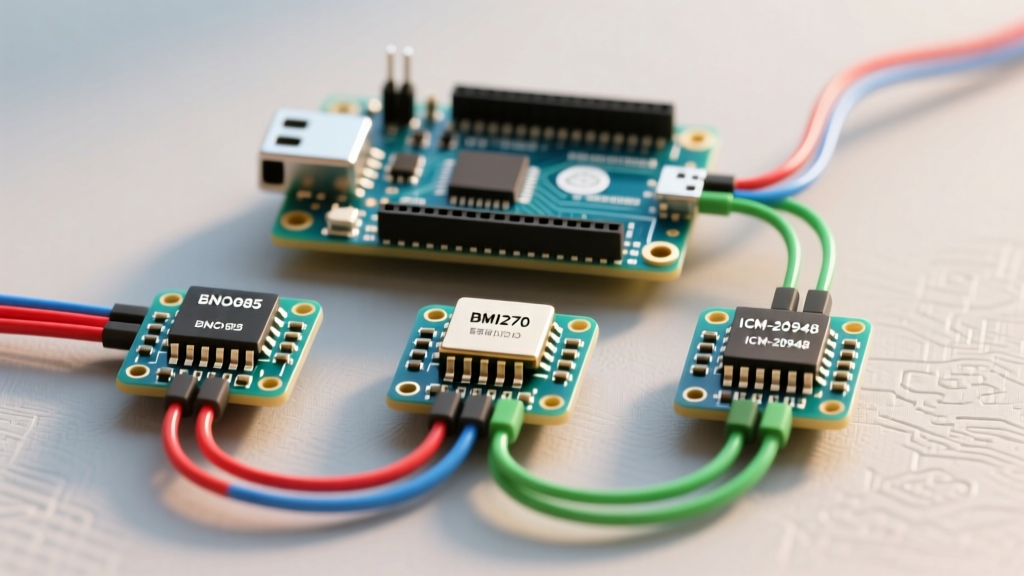
When migrating away from the MPU-6050, you must select a sensor that matches your project's computational and environmental requirements. Below is a comparison of the top three modern IMUs dominating the maker and prosumer robotics space today.
| Sensor Model | Axes | Onboard Sensor Fusion | Approx. Price (2026) | Best Use Case |
|---|---|---|---|---|
| BNO085 / BNO086 (CEVA/Hillcrest) | 9-Axis | Yes (SHARC Core) | $24.00 - $28.00 | VR headsets, robotics, absolute heading |
| BMI270 (Bosch Sensortec) | 6-Axis | Partial (Step/Gesture) | $15.00 - $19.00 | Wearables, low-power IoT, step counting |
| ICM-20948 (TDK) | 9-Axis | No (Requires MCU DMP) | $18.00 - $22.00 | Drones, GPS-denied navigation |
| MPU-6050 (Clone) | 6-Axis | No (Hackable DMP) | $2.00 - $4.00 | Legacy toys, basic tilt detection |
Hardware Migration: Rewiring and Logic Levels
Transitioning from a GY-521 to a modern breakout board like the Adafruit BNO085 or the SparkFun BMI270 requires careful attention to I2C bus physics and logic level shifting.
Solving the 5V Logic Level Trap
The MPU-6050 was somewhat tolerant of 5V I2C lines when powered via the GY-521's onboard LDO, but modern IMUs like the BNO085 and BMI270 are strictly 3.3V devices on both VDD and VDDIO. If you are using a 5V Arduino Uno or Mega, you must implement a bidirectional logic level shifter (such as a BSS138 MOSFET-based shifter or a CD4050 buffer) on the SDA and SCL lines. Connecting 5V logic directly to a BNO085 will instantly destroy the I2C transceiver gates.
Pro-Tip: If possible, migrate your main controller to a native 3.3V architecture like the Arduino Nano 33 IoT, ESP32-S3, or Adafruit Feather series. This eliminates the need for level shifters, reduces I2C capacitance, and drastically improves signal integrity at higher clock speeds.
The Pull-Up Resistor Trap
Most GY-521 clone boards include 4.7kΩ pull-up resistors tied to the 3.3V rail. When you remove the MPU-6050 and add a modern breakout board (which also features its own 10kΩ pull-ups), you might be tempted to leave multiple sensors on the same bus for testing. The parallel combination of these resistors drops the total pull-up resistance below 2kΩ. This violates the I2C specification (which limits sink current to 3mA) and will cause the BNO085 to fail its initialization handshake. Always ensure only one set of pull-ups is active on your I2C bus.
Software Migration: From Euler Angles to Quaternions
The most significant software hurdle when upgrading Arduino and MPU6050 projects is abandoning Euler angles (Pitch, Roll, Yaw) in favor of Quaternions. The MPU-6050 required heavy third-party libraries like I2Cdevlib to extract data from its undocumented Digital Motion Processor (DMP), or forced the MCU to run computationally expensive Mahony or Madgwick filters in software.
Adopting Native Sensor Fusion
Modern IMUs handle sensor fusion internally. The BNO085/BNO086, for instance, features a dedicated ARM Cortex-M0+ core running CEVA's SHARC sensor fusion algorithms. Instead of polling raw accelerometer and gyroscope data, your Arduino simply requests a gameRotationVector or rotationVector.
Expert Architecture Note: Do not use software delay() loops to poll modern IMUs. The BNO085 outputs fusion data at up to 100Hz. Use the sensor's INT (Interrupt) pin wired to a hardware interrupt on your Arduino. This allows the MCU to sleep or process other tasks, waking only when a new quaternion packet is ready in the sensor's FIFO buffer.
When migrating your code, replace your old mpu.getMotion6() calls with the Adafruit BNO08x library's quaternion parsing methods. You can then convert these quaternions to Euler angles locally only when needed for display or PID control inputs, completely eliminating the Gimbal Lock issues inherent to raw MPU-6050 Euler calculations.
Real-World Failure Modes and Edge Cases
Even with premium hardware, migration introduces new edge cases. Be prepared to troubleshoot the following scenarios:
- ESP32 I2C Clock Stretching Bug: The BNO085 occasionally holds the SCL line low to process complex fusion algorithms (clock stretching). The hardware I2C peripheral on older ESP32 chips has a known bug that causes it to hang indefinitely during long stretch events. Solution: Use the ESP32's software I2C implementation, or switch the BNO085 to SPI mode by toggling the PS0/PS1 pins on the breakout board.
- Magnetometer Saturation: If you upgrade to a 9-axis IMU (like the BNO085 or ICM-20948) and mount it near brushless DC motors or neodymium magnets, the onboard magnetometer will saturate, corrupting the absolute yaw heading. Solution: Switch your fusion algorithm from
rotationVector(which uses the magnetometer) togameRotationVector(which relies only on the gyro and accelerometer), accepting that you will lose absolute North referencing. - Vibration Aliasing: The BMI270 is incredibly sensitive. If mounted directly to a chassis with high-frequency motor vibrations without dampening, the accelerometer will alias, causing the sensor fusion to "think" the board is constantly accelerating. Solution: Enable the BMI270's internal hardware low-pass filter (set to roughly 1/6th of your sampling rate) via the configuration registers before initializing the fusion engine.
Frequently Asked Questions
Can I use the exact same I2C address for the BNO085 as the MPU-6050?
No. The MPU-6050 defaults to 0x68 (or 0x69 if the AD0 pin is pulled high). The BNO085 defaults to 0x4A or 0x4B. You must update your Arduino sketch's initialization macros to reflect the new hexadecimal addresses.
Is the BMI270 a good replacement for drone flight controllers?
While the Bosch BMI270 offers phenomenal noise density and low power consumption, it lacks an onboard magnetometer. For drones requiring absolute yaw stability in GPS-denied environments, a 9-axis sensor like the ICM-20948 or BNO086 is a superior choice. The BMI270 is better suited for indoor rovers, wearables, and camera gimbals.
Do I still need to calibrate my IMU after upgrading?
Modern sensor fusion chips like the BNO085 perform continuous background calibration. However, you must still perform a physical "figure-8" motion routine upon first boot to calibrate the magnetometer. The sensor's calibration status registers will report a value from 0 to 3; you should inhibit your robot's movement or PID loops until the calibration status reaches 3 (Fully Calibrated).
Conclusion
Clinging to the MPU-6050 in 2026 is a false economy. The hours spent debugging I2C lockups, writing custom Kalman filters, and replacing fried clone boards far outweigh the $20 investment in a modern IMU. By migrating your Arduino and MPU6050 projects to a BNO085 or BMI270, you offload complex mathematics to dedicated silicon, eliminate Gimbal Lock, and achieve the sub-degree precision required for modern robotics and interactive electronics.