
The Convergence of Maker Boards and Industrial Automation
The term PLC Arduino represents a critical evolution in control systems engineering, bridging the gap between accessible open-source microcontrollers and rugged Programmable Logic Controllers (PLCs). Historically, engineers faced a binary choice: use an Arduino for rapid, low-cost prototyping, or deploy a traditional PLC (like an Allen-Bradley CompactLogix or Siemens S7-1200) for production environments. Today, the PLC Arduino ecosystem eliminates this compromise. By integrating 32-bit ARM architectures, galvanic isolation, and IEC 61131-3 programming standards into DIN-rail-mountable form factors, modern hybrid systems allow developers to leverage the Arduino IDE while meeting stringent industrial reliability metrics.
This guide deconstructs the architecture of PLC Arduino hybrids, analyzes leading hardware platforms available in 2026, and details the specific electrical failure modes that destroy standard microcontrollers in industrial cabinets.
The Core Concept: What Defines a PLC Arduino System?
A true PLC Arduino system is not merely a standard development board zip-tied to a DIN rail. It is a purpose-built industrial controller that merges the software ecosystem of Arduino with the hardware resilience of a PLC. To qualify as an industrial hybrid, the architecture must satisfy three primary engineering requirements:
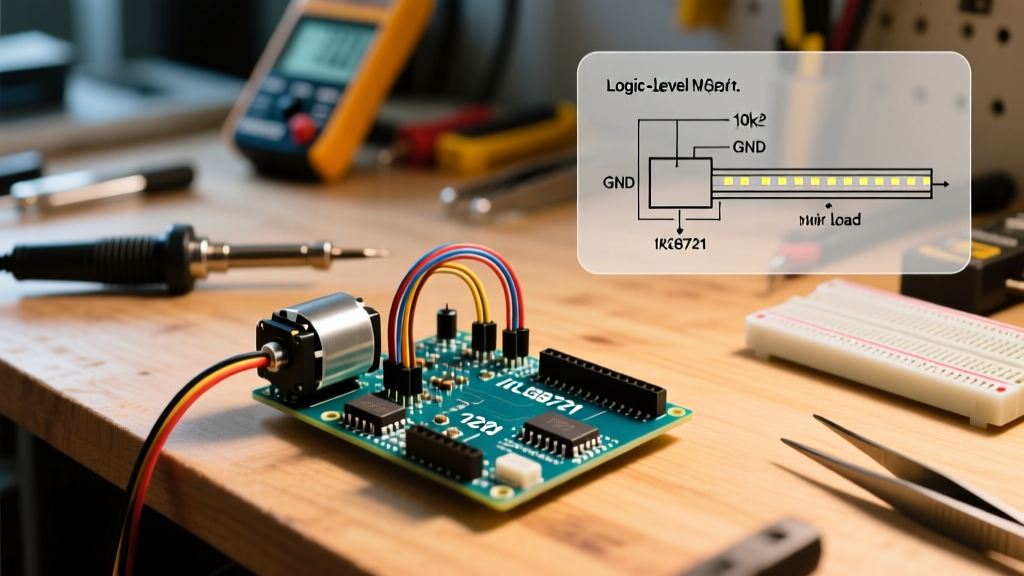
- Voltage Tolerance and Isolation: Standard Arduinos operate on 5V or 3.3V logic. Industrial sensors (such as Omron E2E proximity switches or Sick photoelectric sensors) operate on 24VDC. A PLC Arduino features built-in optoisolation and voltage step-down circuitry to safely interface with 24V I/O without external level shifters.
- Electromagnetic Compatibility (EMC): Industrial environments are plagued by electromagnetic interference (EMI) from Variable Frequency Drives (VFDs) and heavy contactors. PLC Arduinos utilize isolated power supplies, common-mode chokes on communication lines, and shielded enclosures (IP20 to IP67 ratings) to prevent brownouts and logic faults.
- IEC 61131-3 Compliance: While C++ is excellent for algorithmic processing, industrial maintenance teams require standardized languages. Modern PLC Arduino platforms support the IEC 61131-3 standard, enabling programming in Ladder Diagram (LD), Function Block Diagram (FBD), and Structured Text (ST) alongside traditional Arduino sketches.
Hardware Deep Dive: Leading PLC Arduino Platforms
The market for industrial-grade Arduino-compatible controllers has matured significantly. Below is an analysis of the dominant platforms utilized in manufacturing and building automation today.
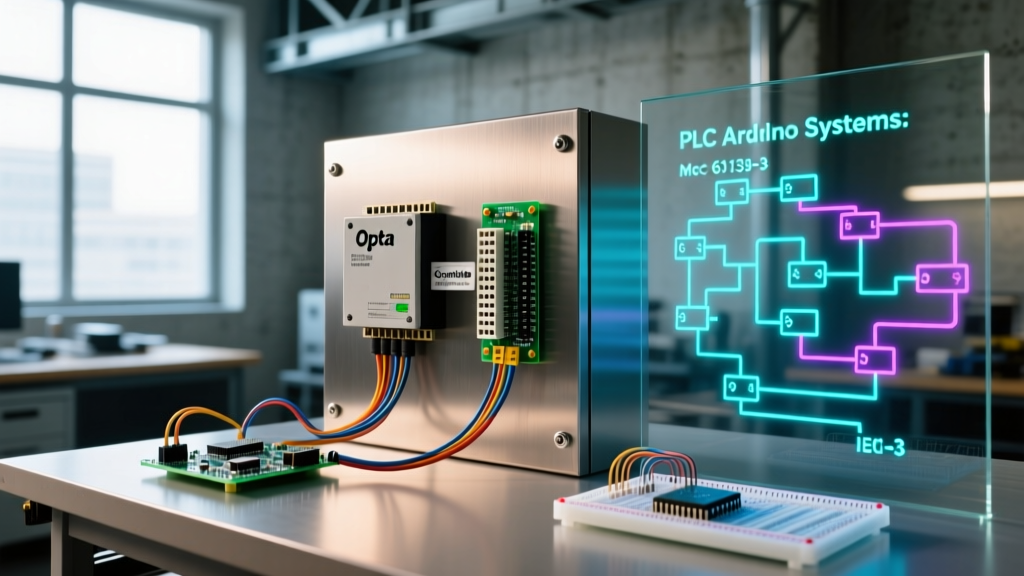
1. Arduino Opta (The Flagship Hybrid)
The Arduino Opta is a micro PLC designed in partnership with Finder. It is powered by a dual-core STM32H747XI processor (Arm Cortex-M7 at 480MHz and Cortex-M4 at 240MHz), offering immense computational headroom for edge computing and IoT protocols like OPC UA and MQTT.
- I/O Configuration: 8 analog inputs (configurable for 0-10V, 0-20mA, or 4-20mA) and 14 digital I/O pins.
- Output Stage: 4 electromechanical relays rated for 2A at 250VAC, complete with integrated flyback diode protection.
- Connectivity: Gigabit Ethernet (W5500 controller with magnetics) and optional Wi-Fi/Bluetooth via the Murata Type 1DX module.
- 2026 Pricing: Approximately $189 for the Opta Lite (Ethernet only) and $229 for the Opta WiFi variant.
2. Controllino MAXI (The Legacy Bridge)
For engineers who require the exact pinout and bootloader of the Arduino Mega 2560 but need industrial hardening, the Controllino MAXI remains a staple. It utilizes the 8-bit ATmega2560 microcontroller but wraps it in a robust 24V-tolerant shell.
- I/O Configuration: 24 digital inputs (optoisolated), 16 relay outputs, and 12 transistor outputs.
- Power Supply: Integrated 24VDC industrial power supply with reverse polarity and overvoltage protection.
- 2026 Pricing: Retails around $385, reflecting the cost of extensive discrete isolation components.
3. Industrial Shields (M-Duino Family)
Industrial Shields takes a modular approach, offering PLC Arduino units based on the ESP32, Arduino Mega, and Arduino Leonardo architectures. Their ESP32-based PLCs are particularly notable for high-speed dual-core processing and native wireless capabilities, making them ideal for retrofitting legacy machines with IIoT telemetry.
Comparison Matrix: Standard Arduino vs. PLC Arduino Hybrids
Understanding the hardware divergence is critical for system architects. The following matrix contrasts a standard Arduino Uno R4 WiFi with a dedicated PLC Arduino hybrid like the Arduino Opta.
| Specification | Standard Arduino Uno R4 WiFi | PLC Arduino Hybrid (Arduino Opta) |
|---|---|---|
| Logic Voltage | 5V (Not 24V tolerant) | 24VDC Industrial Standard (Isolated) |
| Input Protection | None (Direct to MCU) | Optoisolation & TVS Diodes |
| Output Stage | Low-side GPIO (Max 20mA) | Electromechanical Relays (2A @ 250VAC) |
| Programming | C++ (Arduino IDE) | C++, Ladder (LD), FBD, ST (PLC IDE) |
| Enclosure/Mounting | PCB / 3D Printed Case | DIN-Rail Mount, IP20 Finger-Safe Terminals |
| Operating Temp | -40°C to 85°C (Silicon limit) | -20°C to 60°C (System certified limit) |
Real-World Failure Modes: Why Standard Arduinos Fail in PLC Environments
Deploying a standard $25 development board in a factory setting almost guarantees catastrophic failure. Understanding these electrical failure modes highlights the necessity of the PLC Arduino architecture.
Ground Loops and Common-Mode Voltage
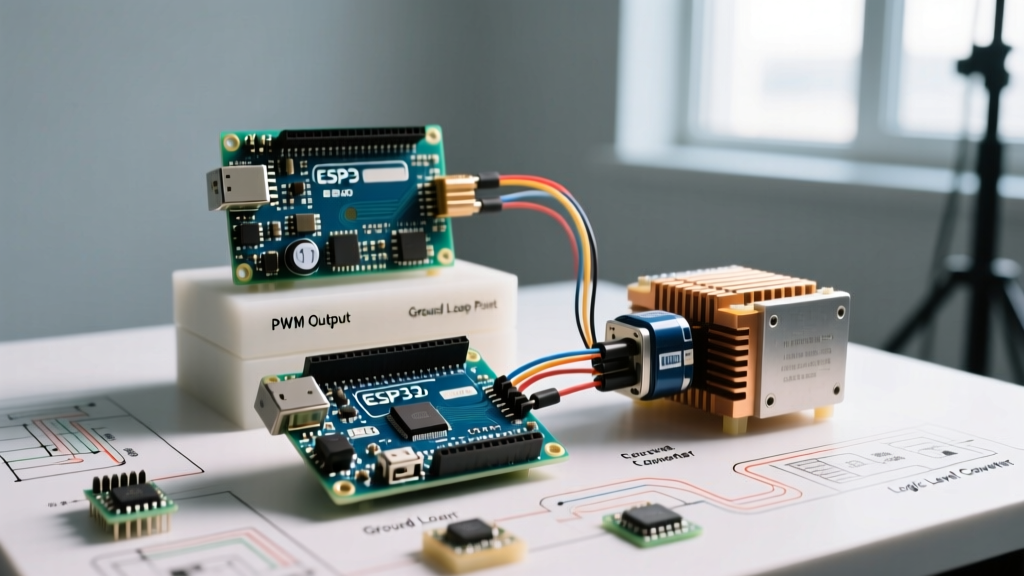
In a factory, the ground potential at a motor control center (MCC) can differ from the ground potential at a sensor junction box by several volts due to heavy current returns. If a standard Arduino is powered via a USB cable connected to a laptop, while simultaneously reading a 24V sensor referenced to the factory ground, a ground loop forms. This drives lethal currents through the Arduino's USB-to-UART bridge (like the ATmega16U2), instantly vaporizing internal silicon traces. PLC Arduinos utilize isolated DC-DC converters to break these ground loops.
Inductive Kickback from Solenoids and Contactors
When a microcontroller switches off an inductive load (such as a pneumatic solenoid valve), the collapsing magnetic field generates a high-voltage reverse spike (inductive kickback). Without hardware flyback diodes and snubber circuits integrated directly into the output terminals, this spike arcs across the transistor junction, destroying the GPIO pin. Dedicated PLC Arduino outputs feature hardened relay contacts and integrated RC snubber networks to absorb these transients safely.
EMI-Induced Brownouts via USB and Serial Lines
Variable Frequency Drives (VFDs) switching at 10kHz to 20kHz radiate massive amounts of high-frequency noise. Standard unshielded USB and jumper wires act as perfect antennas for this EMI. The noise couples into the microcontroller's clock lines or reset pins, causing spontaneous reboots, corrupted EEPROM data, and erratic actuator behavior. Industrial hybrids enforce strict PCB layout rules, utilizing solid ground planes, differential signaling (RS-485), and shielded Ethernet magnetics to reject common-mode noise.
Software Ecosystem: Arduino PLC IDE and IEC 61131-3
The hardware is only half the equation. The Arduino PLC IDE represents a paradigm shift for developers transitioning from the standard Arduino IDE. While the traditional IDE relies on sequential C++ execution (the setup() and loop() paradigm), the PLC IDE enforces a cyclic scan architecture typical of industrial controllers.
In a cyclic scan, the controller reads all physical inputs into an image table, executes the logic (Ladder, FBD, or Structured Text), and then writes the image table to the physical outputs. This deterministic execution ensures that a safety interlock evaluated at the beginning of the scan cannot be bypassed by a delayed software interrupt later in the cycle. Furthermore, the PLC IDE includes built-in simulation tools, allowing engineers to test complex state machines and PID control loops against virtual hardware before deploying to the physical Arduino Pro ecosystem.
Decision Framework: When to Deploy a PLC Arduino
Choosing between a traditional PLC, a standard microcontroller, and a PLC Arduino hybrid requires evaluating the specific constraints of your project. Use the following framework to guide your architecture decisions:
- Choose Standard Arduino When: You are building a benchtop prototype, a consumer IoT device, or an educational tool where 5V logic, low cost, and rapid iteration are prioritized over UL/CE industrial certifications.
- Choose Traditional PLCs (Siemens, Allen-Bradley) When: The application involves life-safety systems, SIL-2/SIL-3 rated emergency stops, or massive I/O counts (500+ points) requiring distributed I/O racks and redundant backplanes.
- Choose PLC Arduino Hybrids When: You need edge-computing capabilities (running machine learning models or complex JSON parsing via MQTT) that strain traditional PLC processors, but you still require 24V I/O, DIN-rail mounting, and deterministic scan cycles for machine control.
Engineering Insight: The true value of the PLC Arduino ecosystem in 2026 lies in its ability to collapse the IT/OT divide. By allowing OT (Operational Technology) engineers to wire 24V sensors safely, while enabling IT engineers to deploy advanced C++ networking stacks on the same STM32 silicon, these hybrids eliminate the need for intermediary gateway hardware in IIoT architectures.