
double data type is implemented as a 32-bit floating-point number, offering identical precision to the float type. However, on 32-bit boards like the Arduino Due, Arduino Portenta H7, or ESP32-based variants, double provides true 64-bit IEEE 754-2019 standard double-precision arithmetic. This guide is written for embedded systems engineers, robotics developers, and advanced hobbyists who need to deploy math-heavy algorithms across heterogeneous microcontroller fleets without encountering silent precision loss.
Key Takeaways: Arduino Double Precision
- On 8-bit AVR boards (Arduino Uno, Nano),
doubleis exactly 4 bytes and identical tofloat. - On 32-bit ARM and ESP32 boards,
doubleis 8 bytes, yielding 15 to 17 decimal digits of precision. - Cross-compiling code using
doublewithout architecture checks leads to silent truncation errors on 8-bit hardware. - Use fixed-point integer math or dedicated software libraries to achieve high precision on 8-bit microcontrollers.
Understanding Arduino Double Precision
To write portable firmware, engineers must understand how the C++ compiler handles floating-point variables across different instruction set architectures. The Arduino IDE uses GCC-based toolchains that map data types to hardware capabilities.
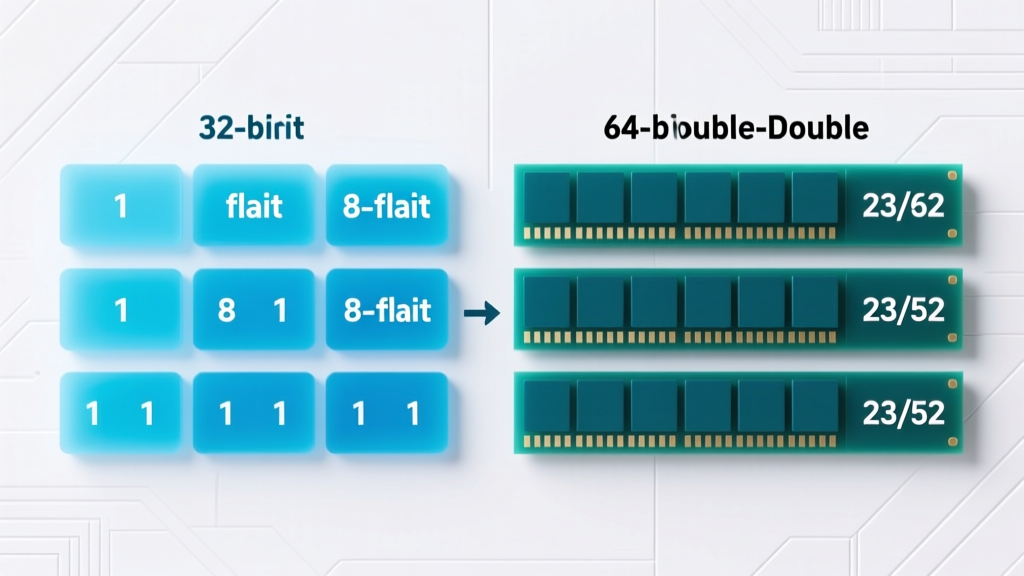
Definition: Double-Precision Floating-Point. Double-precision floating-point is a computer number format that occupies 8 bytes (64 bits) in memory, representing a wide dynamic range of numerical values by using a floating decimal point as defined by the IEEE 754 standard.
According to the official Arduino language reference, the implementation of the double type is strictly hardware-dependent. On 8-bit targets, the compiler aliases double to float, capping your precision at 6 to 7 significant decimal digits.
8-Bit vs 32-Bit Architecture: The Compatibility Gap
AVR Microcontrollers (8-Bit)
Definition: AVR Microcontroller. An AVR microcontroller is a family of 8-bit RISC single-chip microcontrollers developed by Alf-Egil Bogen and Vegard Wollan, later acquired by Microchip Technology, widely known for powering classic Arduino boards like the Uno and Nano.
Boards utilizing the Microchip ATmega328P or ATmega2560 lack a hardware Floating Point Unit (FPU). All floating-point operations are emulated in software using 32-bit registers. Allocating an 8-byte variable would waste the limited 2 KB SRAM available on the Arduino Uno, so the compiler enforces a 4-byte limit for both float and double.
ARM Cortex-M and ESP32 (32-Bit)
Modern 32-bit boards, such as the Arduino Due (SAM3X8E) and the Arduino Portenta H7 (STM32H747), feature dedicated hardware FPUs. These microcontrollers natively process 64-bit instructions. When you declare a double on these boards, the compiler allocates 8 bytes, granting 15 to 17 significant decimal digits of precision.
Cross-Board Compatibility Matrix
Use this decision framework to determine how your mathematical variables will compile across the current Arduino ecosystem.
| Microcontroller Board | Architecture | double Size | Precision (Decimal Digits) | Hardware FPU |
|---|---|---|---|---|
| Arduino Uno / Nano | 8-bit AVR | 4 bytes | 6 - 7 | No |
| Arduino Mega 2560 | 8-bit AVR | 4 bytes | 6 - 7 | No |
| Arduino Zero | 32-bit ARM Cortex-M0+ | 8 bytes | 15 - 17 | No (Software Emulated) |
| Arduino Due | 32-bit ARM Cortex-M3 | 8 bytes | 15 - 17 | No (Software Emulated) |
| Arduino Portenta H7 | 32-bit ARM Cortex-M7 | 8 bytes | 15 - 17 | Yes |
| ESP32 Dev Module | 32-bit Xtensa LX6 | 8 bytes | 15 - 17 | Yes |
Memory and Performance Costs
Upgrading from 32-bit floats to 64-bit doubles doubles your RAM consumption per variable. In a sensor fusion algorithm tracking 50 variables, this shifts the memory footprint from 200 bytes to 400 bytes. While negligible on an ESP32 with 520 KB of SRAM, this 200-byte increase represents 10% of the total available memory on an Arduino Uno.
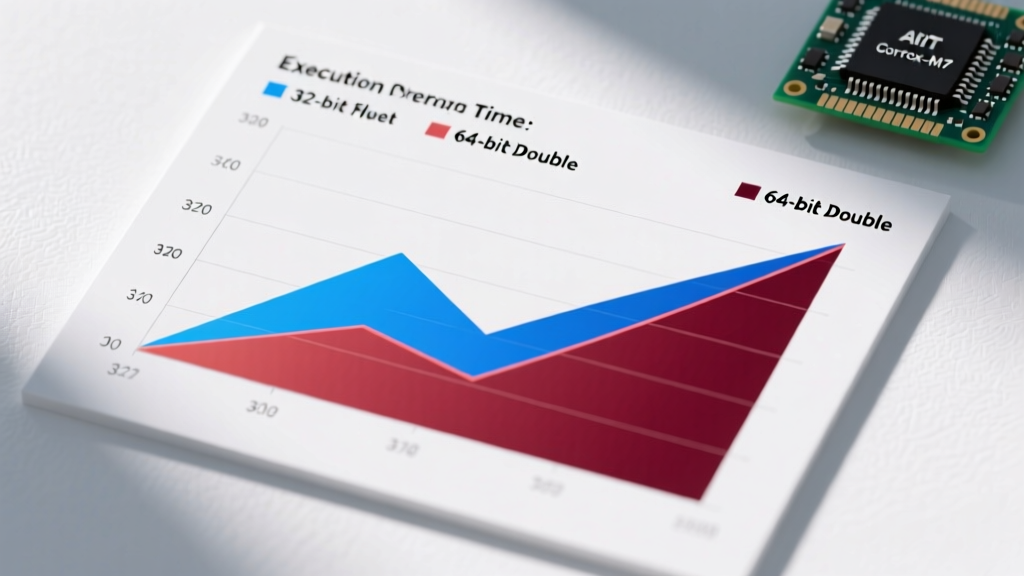
Execution time also scales with precision. Without a hardware FPU, a 64-bit software-emulated multiplication on an Arduino Zero can take up to 4 times longer than a 32-bit operation. Always profile your loop execution time before committing to 64-bit math on Cortex-M0+ or Cortex-M3 architectures.
Workarounds for High-Precision Math on 8-Bit Boards
If your project requires high precision but is constrained to an 8-bit AVR board, avoid floating-point types entirely. Instead, implement fixed-point arithmetic.
Fixed-point math uses 32-bit integers (long or int32_t) scaled by a constant factor. For example, to track GPS coordinates with 6 decimal places, multiply the raw value by 1,000,000 and store it as an integer. This provides exact precision without the rounding errors inherent to IEEE 754 floats, while executing significantly faster on the ATmega328P.
Alternatively, utilize software libraries like Arduino_Double or arbitrary-precision libraries, though these will severely impact loop execution speeds and consume heavy flash memory.
Frequently Asked Questions
Does Arduino support double precision?
Yes, but only on 32-bit microcontrollers. Boards based on ARM Cortex-M, ESP32, and Renesas architectures support true 64-bit double precision. Classic 8-bit AVR boards do not.
Why is my Arduino double acting like a float?
If you are compiling for an 8-bit board like the Arduino Uno, the avr-gcc compiler automatically aliases the double keyword to float to preserve memory and processing efficiency. Both types resolve to 4 bytes.
How to do double precision math on Arduino Uno?
You cannot use native double variables for 64-bit math on the Uno. You must use 64-bit integers (int64_t) for fixed-point math or include third-party software emulation libraries that handle 64-bit IEEE 754 operations via software routines.
Conclusion and Next Steps
Cross-board compatibility for double precision hinges entirely on the underlying microcontroller architecture. Assuming a double guarantees 15 digits of precision will result in catastrophic truncation errors when porting code from an Arduino Portenta H7 down to an Arduino Uno.
Next Step: Audit your current firmware codebase. Search for all instances of the double keyword. If your code targets 8-bit AVR hardware, refactor those variables to use scaled int32_t fixed-point math to guarantee precision and optimize execution speed.