
The Legacy and Limitations of the L293D
For over two decades, the pairing of the L293D and Arduino has been the undisputed starting point for robotics enthusiasts and STEM classrooms. The L293D is a dual H-bridge motor driver that allows microcontrollers to control the direction and speed of DC motors. However, as modern robotics demand higher efficiency, lower thermal footprints, and compatibility with low-voltage LiPo batteries, the L293D's underlying architecture has become a critical bottleneck.
The L293D relies on bipolar junction transistor (BJT) Darlington pairs to switch current. While robust and forgiving for beginners, this topology introduces a massive voltage drop (Vce saturation). At a mere 1A of continuous current, the L293D drops approximately 1.8V to 2V across the internal transistors. If you are powering a 6V motor from a 6V battery pack, your motor only receives ~4.2V, resulting in a 30% loss of available torque and speed. Furthermore, that missing 1.8V is dissipated as heat, often requiring bulky clip-on heatsinks to prevent thermal shutdown.
Why Migrate in 2026?
Migrating away from the L293D is no longer just about squeezing out extra performance; it is about adapting to the modern maker ecosystem. In 2026, 2S and 3S LiPo batteries (7.4V to 11.1V) and high-efficiency coreless DC motors are standard in competitive robotics and advanced DIY rovers. Losing 2V to an outdated H-bridge is unacceptable when modern MOSFET-based drivers can achieve near-zero voltage drops.
Expert Insight: If your Arduino robot struggles to climb inclines or your motors whine without spinning under load, the issue is rarely the motor itself. It is almost always the voltage starvation caused by the L293D's internal resistance combined with battery sag during stall conditions.
Top Modern Alternatives for Arduino
When upgrading your motor control stack, two MOSFET-based drivers dominate the modern landscape:
1. TB6612FNG (Toshiba)
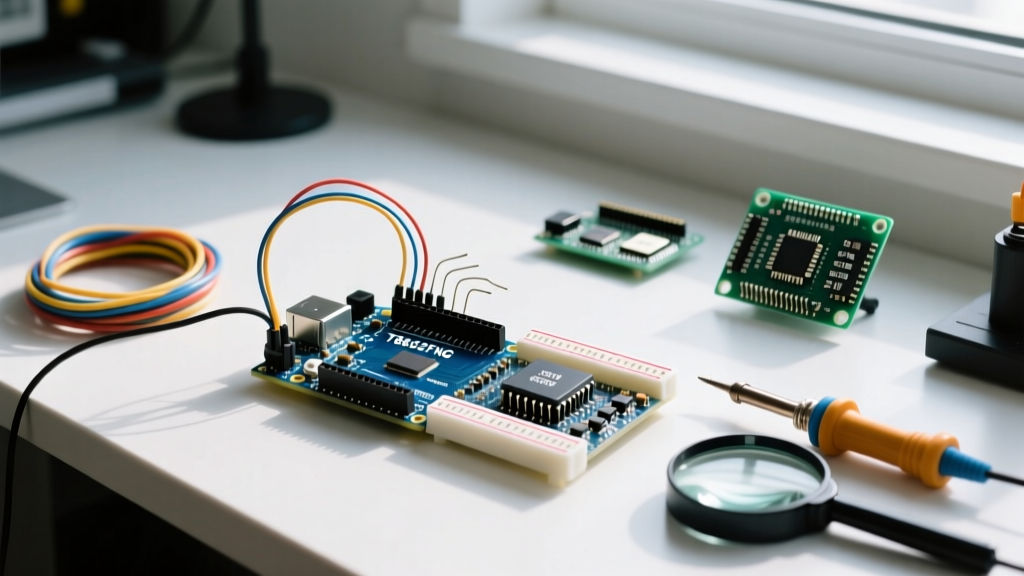
The TB6612FNG is the gold standard for L293D replacements. Utilizing N-channel and P-channel MOSFETs, it boasts a remarkably low voltage drop of just 0.5V at 1.2A. It supports continuous currents of 1.2A per channel (with peaks up to 3.2A) and handles PWM frequencies up to 100kHz, allowing for silent motor operation well above human hearing ranges. As of 2026, a standard TB6612FNG breakout board costs around $4.50, a modest premium over the $1.20 DIP-16 L293D chip.
2. DRV8833 (Texas Instruments)
For projects requiring slightly more continuous current, the Texas Instruments DRV8833 delivers 1.5A continuous per channel (2A peak). It features an ultra-low sleep mode current (under 2µA), making it ideal for battery-operated Arduino nodes that need to conserve power between movements. It also includes robust internal overcurrent and thermal shutdown protection.
Hardware Migration: Rewiring Your Breadboard
Migrating the physical wiring from an L293D to a TB6612FNG requires attention to pinout differences. The L293D uses shared Enable pins for PWM, whereas modern breakouts separate logic, power, and PWM routing.
- VMOT vs VCC: The TB6612FNG separates motor power (VMOT, up to 15V) from logic power (VCC, 2.7V-5.5V). Connect VMOT to your battery pack and VCC to the Arduino's 5V or 3.3V pin. The L293D uses VCC1 for logic and VCC2 for motors.
- The STBY (Standby) Pin: Unlike the L293D, the TB6612FNG features a Standby pin. This must be pulled HIGH (connected to VCC) for the driver to operate. If left floating or tied to GND, the H-bridge outputs will be disabled.
- Enable Pins vs PWM Pins: The L293D uses pins 1 and 9 (1,2EN and 3,4EN) for speed control. The TB6612FNG uses dedicated PWMA and PWMB pins for speed, while the IN1/IN2 and IN3/IN4 pins handle pure digital direction logic.
Software Migration: Adapting Your Arduino Sketch
The code migration is straightforward but requires shifting your mental model of how speed and direction are decoupled. In the L293D, you set direction with digital pins and speed with analogWrite() on the Enable pin. With the TB6612FNG, you set direction via the IN pins and apply analogWrite() directly to the PWMA/PWMB pins.
Below is a comparative code structure demonstrating the migration:
// --- LEGACY L293D APPROACH ---
// Pin 1,2EN (PWM), IN1 (Dir), IN2 (Dir)
void l293d_drive_forward(int speed) {
  digitalWrite(IN1, HIGH);
  digitalWrite(IN2, LOW);
  analogWrite(ENA, speed); // Speed on Enable pin
}

// --- MODERN TB6612FNG APPROACH ---
// PWMA (PWM), IN1 (Dir), IN2 (Dir), STBY (Always HIGH)
void tb6612_drive_forward(int speed) {
  digitalWrite(STBY, HIGH); // Ensure chip is active
  digitalWrite(IN1, HIGH);
  digitalWrite(IN2, LOW);
  analogWrite(PWMA, speed); // Speed on dedicated PWM pin
}
Comparative Performance Matrix
To visualize the exact gains you will achieve by retiring the L293D, review the 2026 specifications matrix below:
| Driver IC | Topology | Continuous Current | Voltage Drop (at 1A) | Max PWM Freq | Internal Flyback Diodes | Est. Breakout Price |
|---|---|---|---|---|---|---|
| L293D | Bipolar (Darlington) | 600 mA | ~1.8V | ~5 kHz | Yes | $1.50 |
| L298N | Bipolar (Darlington) | 2.0 A | ~2.0V | ~25 kHz | No (Requires external) | $3.00 |
| TB6612FNG | MOSFET | 1.2 A | ~0.5V | 100 kHz | Yes | $4.50 |
| DRV8833 | MOSFET | 1.5 A | ~0.6V | 50 kHz | Yes | $3.50 |
Edge Cases and Troubleshooting the Upgrade
While modern drivers are vastly superior, they introduce a few edge cases that L293D users rarely encountered:
1. Flyback Diode Verification
The L293D famously includes internal clamp diodes to protect against inductive kickback when motors stop. The TB6612FNG and DRV8833 also feature internal protection. However, if you are designing a custom PCB using raw ICs rather than buying a pre-made breakout board, always verify the datasheet. Some ultra-cheap, unbranded DRV8833 modules omit external Schottky diodes on the PCB traces, relying solely on the IC's internal body diodes, which can fail under heavy, repetitive stall conditions.
2. Motor Stall Current and Battery Sag
Because the TB6612FNG has such low internal resistance, it delivers significantly more torque to the motor. This means your motors will draw closer to their true stall current. If your battery pack cannot sustain high C-ratings (discharge rates), the voltage will sag, potentially triggering the Arduino's brownout detector and causing random resets. Always pair low-resistance motor drivers with high-discharge LiPo batteries or add a large decoupling capacitor (e.g., 470µF to 1000µF) across the VMOT and GND terminals.
3. Logic Level Thresholds
If you are migrating an Arduino project from a 5V ATmega328P (Uno) to a 3.3V ARM Cortex-M0+ (like the Arduino Nano 33 IoT), ensure your chosen driver supports 3.3V logic thresholds. The TB6612FNG natively supports 2.7V to 5.5V logic, making it perfectly compatible with modern 3.3V microcontrollers, whereas older L293D setups sometimes required level shifters to guarantee a reliable HIGH signal at 3.3V.
Conclusion
Continuing to use the L293D in 2026 is akin to using a linear voltage regulator for a high-draw LED array—it works, but the inefficiency is staggering. By migrating your Arduino projects to the TB6612FNG or DRV8833, you instantly reclaim lost voltage, eliminate the need for heatsinks, reduce battery drain, and unlock the ability to use ultrasonic PWM frequencies for whisper-quiet motor operation. The minimal rewiring and code adjustments required are a small price to pay for a massive leap in robotic performance.