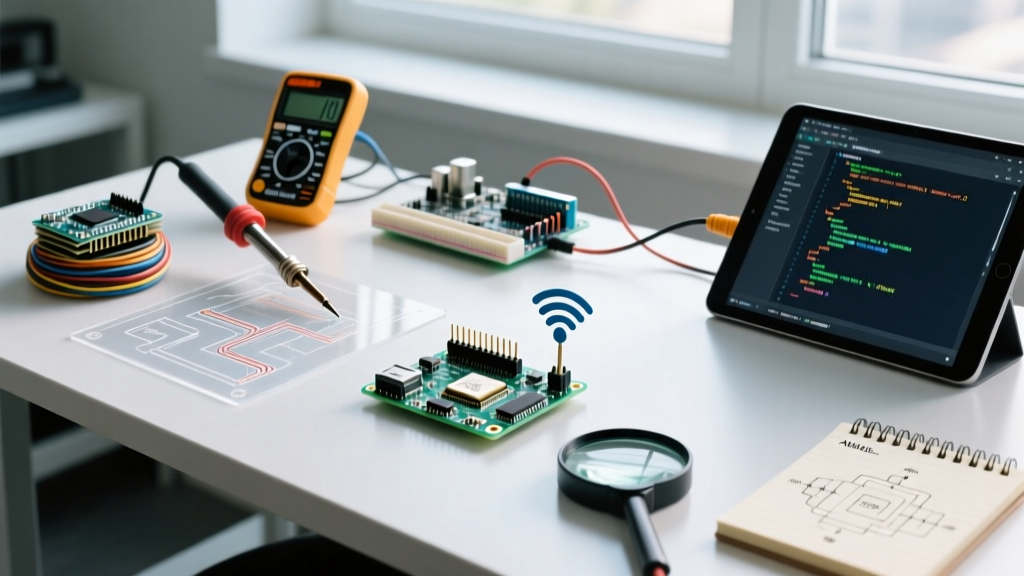

For over a decade, the standard Arduino definition was rigidly tied to a single image: a blue 8-bit ATmega328P microcontroller running at 16MHz with 5V logic. However, as we navigate the embedded development landscape in 2026, that legacy definition is no longer sufficient for modern maker and engineering projects. Today, the Arduino ecosystem encompasses 32-bit ARM Cortex-M chips, RISC-V architectures, and highly integrated Wi-Fi/Bluetooth SoCs.
This migration and upgrade guide explores how to transition from the classic 8-bit AVR paradigm to modern 32-bit architectures—specifically the Espressif ESP32 family and the Raspberry Pi RP2040—while utilizing the Arduino framework you already know.
The Legacy Arduino Definition vs. Modern Ecosystem Realities
When engineers refer to the traditional Arduino definition, they are usually describing the Arduino UNO R3. While excellent for learning, its hardware constraints become severe bottlenecks in production or advanced prototyping. Below is a structural comparison of the legacy baseline versus modern migration targets.
| Feature | Legacy Definition (UNO R3) | Migration Target A (ESP32-S3) | Migration Target B (RP2040) |
|---|---|---|---|
| Architecture | 8-bit AVR | 32-bit Xtensa LX7 (Dual-Core) | 32-bit ARM Cortex-M0+ (Dual-Core) |
| Clock Speed | 16 MHz | 240 MHz | 133 MHz (Overclockable to 250MHz+) |
| SRAM | 2 KB | 512 KB (Plus PSRAM up to 8MB) | 264 KB |
| Logic Level | 5V Tolerant | 3.3V (Strict) | 3.3V (Strict) |
| Typical Cost (2026) | $27 (Official) / $4 (Clone) | $4.50 - $7.00 | $0.80 (Chip) / $4.00 (Pico) |
Recognizing the Limits: When to Abandon the 8-Bit Definition
Migrating away from the classic hardware definition is usually forced by one of three edge cases:
- Heap Fragmentation and SRAM Limits: The ATmega328P's 2KB SRAM is easily exhausted by the
Stringclass or large sensor buffers. If your project requires parsing JSON payloads from an API or driving a high-resolution TFT display, 8-bit AVRs will suffer unpredictable resets due to stack collisions. - Interrupt Latency and Timing: AVRs lack advanced Nested Vectored Interrupt Controllers (NVIC). If you are reading high-frequency quadrature encoders or implementing software-based PWM on multiple pins simultaneously, the 16MHz AVR will drop ticks.
- Modern Sensor Incompatibility: Most 2026 I2C/SPI sensors (like the BME688 or BNO085) operate strictly at 3.3V. Interfacing them with a 5V AVR requires cumbersome level-shifting, adding parasitic capacitance that corrupts high-speed I2C buses.
Migration Path 1: The ESP32-S3 (IoT & High Compute)
If your expanded Arduino definition includes wireless connectivity and machine learning at the edge, the ESP32-S3 is the premier migration target. Unlike the original ESP32, the S3 variant includes vector instructions for AI acceleration and native USB OTG.
Hardware & Toolchain Adjustments
When migrating to the ESP32-S3-WROOM-1 module, you must abandon the Arduino IDE 1.x serial monitor workflow. The S3 requires the ESP32 board package in Arduino IDE 2.x or, preferably, PlatformIO. For projects demanding real-time multitasking, you will transition from simple loop() polling to FreeRTOS tasks, utilizing xTaskCreatePinnedToCore() to separate Wi-Fi stack management from your primary sensor polling logic.
Critical Warning: The ESP32-S3 GPIO pins are strictly 3.3V. Applying 5V to any pin (including those labeled "VIN" on some poorly regulated dev boards) will permanently destroy the silicon. Always use a multimeter to verify logic levels before connecting legacy 5V shields.
Migration Path 2: Raspberry Pi RP2040 (Deterministic I/O)
For makers migrating custom PCB designs away from the ATmega328P, the RP2040 has redefined the baseline hardware architecture. Its standout feature is the Programmable I/O (PIO) subsystem—eight state machines that can manipulate pins independently of the main CPU cores.
Replacing AVR Timers with PIO
In the legacy Arduino definition, generating custom waveforms (like WS2812B LED protocols or specific IR carrier frequencies) required hijacking hardware timers and disabling global interrupts (cli() and sei()). On the RP2040, you offload this to the PIO. The main Cortex-M0+ cores remain entirely free to handle serial communication and logic, completely eliminating the timing jitter that plagued 8-bit AVR NeoPixel libraries.
Code Porting: Breaking AVR-Specific Habits
The most painful part of expanding your Arduino definition is realizing how much "Arduino" code you wrote was actually "AVR-GCC" code. Direct register manipulation is the primary culprit.
Direct Register Access vs. Hardware Abstraction
Consider the classic AVR method for toggling an LED on Pin 13 (Port B, Bit 5):
// Legacy 8-bit AVR approach
DDRB |= (1 << DDB5);  // Set Pin 13 as OUTPUT
PORTB |= (1 << PB5);  // Set HIGH
This code will fail to compile on ESP32 or RP2040 boards because registers like DDRB and PORTB do not exist in ARM or Xtensa architectures. To maintain cross-platform compatibility during your migration, you must refactor to use the Arduino Hardware Abstraction Layer (HAL):
// Modern 32-bit compatible approach
pinMode(13, OUTPUT);
digitalWrite(13, HIGH);
Performance Note: While digitalWrite() is historically criticized for being slow on AVRs, modern 32-bit cores execute it in nanoseconds. If you require cycle-accurate pin toggling on the RP2040, use the gpio_put() function from the Pico SDK, which executes in a single clock cycle.
Hardware Migration Checklist: Power and Level Shifting
Upgrading your microcontroller definition requires a corresponding upgrade in your supporting circuitry. Use this checklist when redesigning your breadboard or custom PCB:
- Voltage Regulation: Replace the 7805 linear regulator (used for 5V AVRs) with a low-dropout (LDO) regulator like the AMS1117-3.3 or AP2112K-3.3. Ensure you include the required 10µF tantalum or ceramic capacitors on both input and output to prevent oscillation.
- Bidirectional Level Shifting: If you must interface a 3.3V ESP32 with legacy 5V modules (like an older relay board or 5V LCD), use a BSS138 MOSFET-based bidirectional level shifter. Avoid resistor-divider networks for I2C, as they do not actively drive the bus high and will fail at 400kHz Fast Mode.
- Boot Pin Strapping: Unlike the ATmega328P, both the ESP32-S3 and RP2040 rely on specific GPIO states during power-on to enter bootloader mode. Ensure pins like ESP32's GPIO0 or RP2040's GPIO15 have appropriate pull-up/pull-down resistors (typically 10kΩ) to prevent the MCU from hanging on startup.
Conclusion: Embracing the Modern Definition
The Arduino definition has evolved from a specific 8-bit development board into a universal, cross-architecture software framework. By migrating to 32-bit powerhouses like the ESP32-S3 and RP2040, you retain the rapid prototyping benefits of the Arduino IDE while unlocking the SRAM, clock speeds, and peripheral sophistication required for professional-grade 2026 embedded systems.