
The Illusion of Time in Microcontrollers
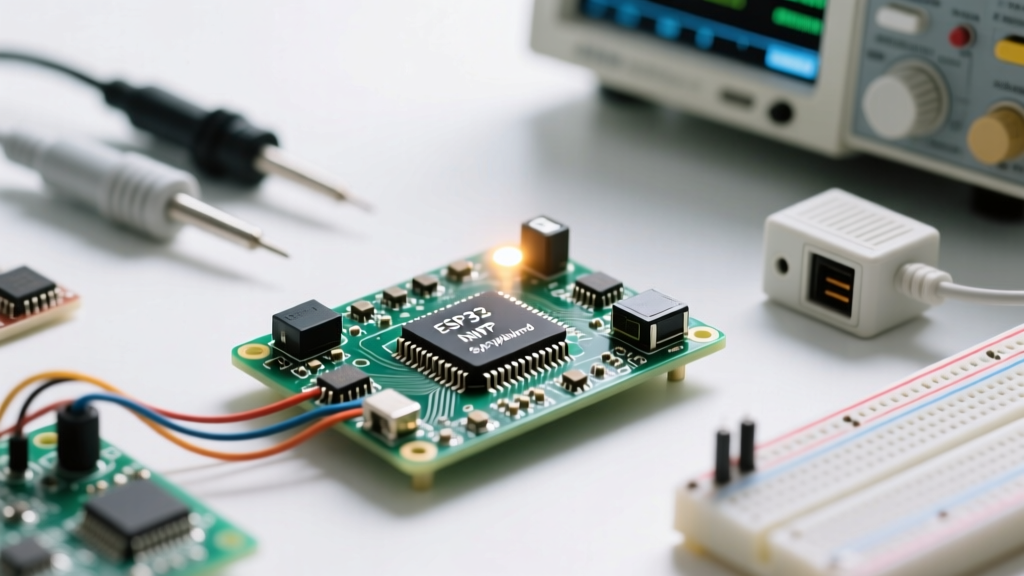
When you write a sketch for an Arduino Uno, time is merely a count of clock cycles. The millis() function tracks ticks since boot, but it has no concept of human calendars, leap years, or timezones. To bridge the gap between microcontroller ticks and real-world human time, makers traditionally relied on hardware Real-Time Clocks (RTCs) like the DS3231. However, the ESP32 changes the paradigm. By leveraging its built-in Wi-Fi radio, the ESP32 can fetch precise global time directly from the internet using ESP32 NTP time protocols, eliminating the need for external RTC hardware and the notorious CR1220 coin cell batteries.
But how does a microcontroller with a few hundred kilobytes of RAM negotiate with atomic clocks? Understanding the underlying mechanics of ESP32 NTP time is critical for building reliable IoT data loggers, smart home hubs, and scheduled automation systems.
NTP vs. SNTP: What the ESP32 Actually Uses
While the maker community universally refers to this process as "NTP" (Network Time Protocol), the ESP32 does not run a full NTP client. True NTP (defined in RFC 5905) is a complex, resource-heavy protocol designed for servers. It utilizes Marzullo's algorithm to poll multiple servers, calculate jitter, and maintain a continuous phase-locked loop (PLL) to discipline the local oscillator.
Instead, the ESP32's underlying network stack (lwIP) implements SNTP (Simple Network Time Protocol), as outlined in RFC 4330. SNTP is a stateless, lightweight subset of NTP. It does not continuously discipline the local clock; rather, it performs a periodic "step" adjustment. By default, the ESP-IDF and Arduino ESP32 core configure the SNTP client to poll the server exactly once every 3,600 seconds (one hour). Between these polls, the ESP32 relies on its internal hardware timers, which are subject to thermal drift.
The 48-Byte UDP Packet Anatomy
SNTP operates over UDP on port 123. When the ESP32 requests the time, it sends a minimal 48-byte payload. The most critical fields in this packet include:
- Leap Indicator (LI): A 2-bit field warning of an impending leap second.
- Version Number (VN): Typically set to 4 (SNTPv4).
- Mode: Set to 3 (Client) for the request, and 4 (Server) for the response.
- Stratum: Indicates the server's distance from the reference clock (Stratum 1 is a direct GPS/Atomic link; Stratum 2 syncs to Stratum 1).
- Transmit Timestamp: The exact 64-bit integer (seconds and fractions since Jan 1, 1900) when the server sent the reply.
The Math: Calculating Offset and Delay
Because network latency is asymmetrical (the time it takes for a packet to reach the server is rarely identical to the return trip), the ESP32 cannot simply adopt the server's timestamp. It must calculate the offset to adjust its local clock. The SNTP client records four distinct timestamps:
- T1: Originate Timestamp (when the ESP32 sent the request).
- T2: Receive Timestamp (when the server received the request).
- T3: Transmit Timestamp (when the server sent the reply).
- T4: Destination Timestamp (when the ESP32 received the reply).
The round-trip delay is calculated as: (T4 - T1) - (T3 - T2).
The clock offset is calculated as: ((T2 - T1) + (T3 - T4)) / 2.
The ESP32 applies this offset to its internal epoch counter, effectively "snapping" the local time to the network time.
Epoch Time and the POSIX Timezone Trap
Under the hood, the ESP32 only understands Unix Epoch Time—the number of seconds elapsed since January 1, 1970, at 00:00:00 UTC. It does not natively know what "Tuesday" or "EST" means. To convert Epoch time into human-readable local time, the C standard library uses the localtime() function, which relies on the POSIX TZ environment variable.
This is where 90% of ESP32 NTP time tutorials fail. Older tutorials suggest using raw integer offsets (e.g., -5 for EST). However, raw offsets cannot handle Daylight Saving Time (DST) transitions. If you use a raw offset, your ESP32 will report the wrong time for several months of the year.
The Sign Inversion Anomaly
To properly handle DST, you must pass a POSIX timezone string to the configTime() function. However, the POSIX standard features a baffling quirk: the sign of the UTC offset is inverted compared to ISO 8601.
For example, New York is UTC-5. In standard notation, this is -05:00. But in POSIX format, you must write it as a positive 5. A correct POSIX string for the US Eastern Time zone is:
EST5EDT,M3.2.0,M11.1.0
- EST: Standard time abbreviation.
- 5: Hours offset from UTC (Positive 5 means UTC-5).
- EDT: Daylight Saving Time abbreviation.
- M3.2.0: DST starts in Month 3 (March), Week 2, Day 0 (Sunday).
- M11.1.0: DST ends in Month 11 (November), Week 1, Day 0 (Sunday).
For a comprehensive list of standardized POSIX strings, refer to the Open Group Base Specifications for the TZ variable.
Implementing configTime() in Arduino IDE
In the Arduino ESP32 core, the bridge between the lwIP SNTP client and the C time library is the configTime() function. According to the Espressif System Time API documentation, the modern implementation looks like this:
configTime("CET-1CEST,M3.5.0,M10.5.0/3", "pool.ntp.org", "time.nist.gov");
Notice that we pass the POSIX string (CET-1CEST... for Central European Time) instead of raw integer offsets. Once configured, the ESP32 handles the DNS resolution, UDP handshake, and epoch adjustment in the background. You can then use the getLocalTime(&timeinfo) wrapper to populate a tm struct with human-readable variables like timeinfo.tm_hour and timeinfo.tm_wday.
Troubleshooting Matrix: Drift, Jitter, and Fails
When deploying ESP32 NTP time in production environments, you will inevitably encounter synchronization anomalies. Use this diagnostic matrix to identify and resolve them.
| Symptom | Root Cause | Engineering Solution |
|---|---|---|
| Time jumps backward by exactly 1 hour in Autumn/Spring. | Using legacy integer offsets instead of POSIX TZ strings; DST miscalculation. | Replace gmtOffset_sec with a valid POSIX string featuring M rules. |
| Time drifts by 2-5 seconds over a 24-hour period. | ESP32 internal RTC oscillator thermal drift; Wi-Fi modem sleep states disrupting tick counts. | Decrease the SNTP update interval using sntp_set_sync_interval(900000) to sync every 15 minutes. |
getLocalTime() returns false or hangs on boot. | DNS resolution failure for pool.ntp.org or UDP port 123 blocked by enterprise firewall. | Verify DNS. If behind a strict firewall, route NTP requests through a local gateway or Pi-hole. |
| Time is correct, but date is off by 1 day. | Timezone string offset is pushing the Epoch calculation past the UTC midnight boundary. | Double-check the POSIX sign inversion (e.g., ensure UTC+8 is written as -8). |
NTP Server Pool Selection Strategy
Expert Tip: Never hardcode a Stratum 1 NTP server (like time.apple.com or direct GPS reference clocks) into your ESP32 firmware. Stratum 1 servers are meant to serve Stratum 2 servers, not millions of IoT endpoints. Doing so violates the NTP abuse policy and may result in your IP being blacklisted.Always use the NTP Pool Project (pool.ntp.org). The pool uses DNS round-robin to direct your ESP32 to the nearest, least-congested Stratum 2 or 3 server. For regional optimization, use localized subdomains like north-america.pool.ntp.org or europe.pool.ntp.org.
If your IoT network consists of dozens of ESP32 nodes, querying external pools from every device is inefficient. The best architectural practice is to set up a local NTP server on your router, a Raspberry Pi, or a Home Assistant server. Point all your ESP32 devices to the local IP address. This reduces external DNS lookups, lowers UDP latency, and ensures your entire local mesh shares the exact same microsecond-level timebase, which is vital for synchronized relay switching and correlated data logging.