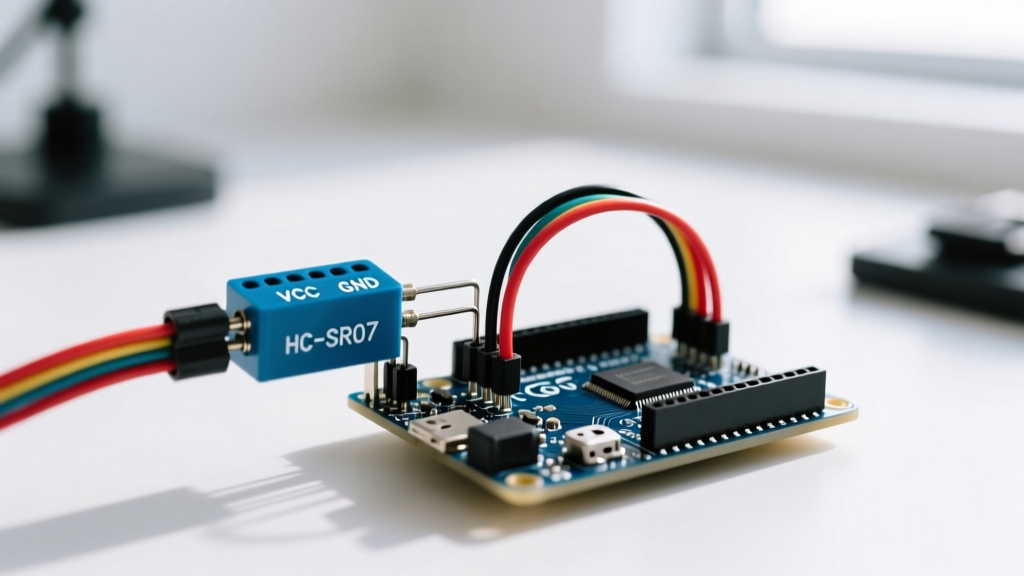

The Reality of the HC-SR04 in Modern Maker Projects
The HC-SR04 remains the most ubiquitous ultrasonic distance sensor in the DIY electronics ecosystem. At a street price of $0.80 to $1.50 for generic clones in 2026, it is the default choice for robotics, tank-level monitoring, and proximity alarms. However, connecting an HC-SR04 to Arduino boards frequently results in baffling behavior: frozen sketches, phantom 4000+ cm readings, or stubborn zero outputs.
Most basic tutorials treat the sensor as a flawless digital component. In reality, it is an analog acoustic transducer paired with a noisy, cost-optimized driver circuit. Diagnosing HC-SR04 errors requires understanding both the electrical limitations of the sensor's onboard ASIC and the acoustic physics of 40kHz sound waves. This guide provides a deep-dive diagnostic framework to isolate and resolve the most common hardware and software failures.
The Anatomy of an HC-SR04 Failure
Before troubleshooting, you must understand what happens when you trigger the sensor. The Arduino sends a 10-microsecond HIGH pulse to the Trigger pin. The sensor's internal controller responds by firing eight 40kHz acoustic bursts from the aluminum transmitter mesh. It then pulls the Echo pin HIGH and waits for the sound wave to bounce off a target and return to the receiver mesh. When the echo is detected, the Echo pin drops LOW. The distance is calculated by measuring the duration of the HIGH pulse.
According to the Components101 HC-SR04 datasheet, the sensor operates at 5V DC and draws a working current of 15mA. However, the instantaneous current spike during the 40kHz transmission can exceed 20mA. This transient load is the root cause of many electrical failures on shared power rails.
Diagnostic Matrix: Symptom vs. Root Cause
Use the following matrix to quickly identify the likely culprit based on your serial monitor output.
| Symptom | Electrical Root Cause | Acoustic Root Cause | Primary Fix |
|---|---|---|---|
| Always returns 0 | VCC sag, 3.3V logic mismatch | Absorptive target (foam/fabric) | Add 100µF capacitor, use level shifter |
| Always returns 4000+ cm | Echo pin disconnected/floating | Sound wave scattering (angled surface) | Check wiring, ensure perpendicular target |
| Random massive spikes | Power rail noise, missing decoupling | Acoustic crosstalk, side-lobe echoes | Median filtering, isolated power supply |
| Sketch freezes entirely | Blocking pulseIn() timeout |
No echo return (infinite wait) | Implement strict microsecond timeout |
Deep Dive: Fixing the "Always Returns 0" Error
If your serial monitor is flooded with zeros, the Arduino is failing to detect the Echo pin going HIGH, or the sensor is failing to transmit the 40kHz burst entirely.
1. The 3.3V Logic Level Trap
The standard HC-SR04 is strictly a 5V device. The Echo pin outputs a 5V HIGH signal when an echo is received. If you are wiring an HC-SR04 to Arduino boards that operate at 3.3V logic (such as the Arduino Due, Nano 33 IoT, or ESP32/RP2040-based clones), the 3.3V MCU may not reliably register the 5V Echo signal, or worse, the 5V signal may damage the GPIO pin over time.
Expert Fix: Do not rely on internal clamping diodes to drop the voltage. Use a simple bidirectional logic level converter (like the BSS138 MOSFET-based modules costing ~$1.00) or a resistor voltage divider (e.g., 1kΩ and 2kΩ) on the Echo pin to safely step the 5V signal down to 3.3V.
2. VCC Sag and the Missing Decoupling Capacitor
Cheap HC-SR04 clones often lack adequate onboard decoupling capacitors. When the sensor fires the 40kHz burst, it pulls a sharp current spike. If powered directly from the Arduino Uno's 5V USB pin, the inductance of the USB cable and the board's thin copper traces cause a momentary voltage droop. The sensor's internal brown-out detector resets the ASIC, aborting the measurement and returning 0.
The Fix: Solder a 100µF electrolytic capacitor directly across the VCC and GND pins on the back of the HC-SR04 PCB. This provides a local energy reservoir to handle the transient 20mA spike without dropping the rail voltage below the 4.5V minimum threshold.
Deep Dive: Fixing Random Spikes and Phantom Readings
As detailed in Adafruit's ultrasonic sensor guide, environmental noise and acoustic reflections frequently cause the sensor to report distances of 50cm when the actual distance is 150cm.
Acoustic Side-Lobes and Multipath Reflections
The HC-SR04 transducer does not emit a perfectly focused laser-like beam. It has a primary main lobe of roughly 15 degrees, but it also emits secondary "side-lobes" at wider angles. If your sensor is mounted near a breadboard, chassis wall, or table surface, the side-lobes will bounce off these nearby objects and return to the receiver faster than the main lobe bouncing off your intended target. The sensor blindly reports the first echo it receives, resulting in a falsely short distance.
The Fix: Mount the sensor with at least 2 inches of clearance from any adjacent surfaces. Alternatively, fashion a shroud out of acoustic dampening foam or heat-shrink tubing to physically block the side-lobes.
Implementing a Median Filter in C++
Averaging sensor readings (mean filter) is a common mistake. If you take 5 readings and one is a massive acoustic spike, the mean will be heavily skewed. Instead, use a median filter, which discards outliers and selects the middle value. This is critical for stable robotics navigation.
unsigned long readUltrasonicMedian(int trigPin, int echoPin) {
  unsigned long samples[5];
  for (int i = 0; i < 5; i++) {
    digitalWrite(trigPin, LOW);
    delayMicroseconds(2);
    digitalWrite(trigPin, HIGH);
    delayMicroseconds(10);
    digitalWrite(trigPin, LOW);
    // 30000us timeout prevents blocking
    samples[i] = pulseIn(echoPin, HIGH, 30000);
    delay(10); // Prevent acoustic crosstalk between samples
  }
  // Simple bubble sort for 5 elements
  for (int i = 0; i < 4; i++) {
    for (int j = 0; j < 4 - i; j++) {
      if (samples[j] > samples[j+1]) {
        unsigned long temp = samples[j];
        samples[j] = samples[j+1];
        samples[j+1] = temp;
      }
    }
  }
  return samples[2]; // Return the median value
}
The pulseIn() Trap: Why Your Sketch Freezes
The most common software error when wiring an HC-SR04 to Arduino is omitting the timeout parameter in the pulseIn() function. According to the official Arduino pulseIn() documentation, if no pulse is detected, the function will block execution for up to 1 second (the default timeout).
If your sensor is pointed out an open window, or aimed at a highly absorptive material like thick acoustic foam, the sound wave will never return. The Echo pin will never go HIGH. Your entire Arduino sketch will freeze for a full second per reading, causing PID control loops to destabilize and servo motors to stutter violently.
The Fix: Always define a strict timeout based on the maximum physical range of your enclosure. Sound travels at roughly 343 meters per second. A round trip of 4 meters (the sensor's theoretical max) takes about 23,000 microseconds. Set your timeout to 30000 (30ms). If no echo is received within 30ms, pulseIn returns 0, and your sketch immediately moves on to the next task.
Hardware Upgrades: When the HC-SR04 Isn't Enough
If you have applied all electrical and acoustic fixes and still experience failures, the environment may simply be incompatible with the standard HC-SR04. Consider these modern alternatives:
- HC-SR04P (3.3V Native): Unlike the standard 5V model, the 'P' variant uses a different driver IC that operates natively at 3.3V logic and power. It is ideal for ESP32 and Raspberry Pi Pico projects, eliminating the need for level shifters and external 5V regulators.
- JSN-SR04T (Waterproof): The standard HC-SR04 will fail rapidly in high humidity or outdoor environments due to moisture shorting the exposed PCB traces. The JSN-SR04T features a sealed, waterproof 40kHz transducer connected via a 2.5-meter shielded cable to a separate driver board. Note that it requires a slightly different trigger sequence and has a minimum blind spot of roughly 20cm.
- TF-Luna / TF-Mini LiDAR: For distances beyond 2 meters, or when dealing with soft, sound-absorbing targets, ultrasonic sensors fail. Time-of-Flight (ToF) infrared LiDAR modules have dropped to the $12-$15 range in 2026 and provide millimeter-accurate readings immune to acoustic noise and temperature variations.
Final Diagnostic Checklist
Before discarding a sensor that appears dead, verify your trigger pulse width. The HC-SR04 requires a minimum of 10 microseconds of HIGH time on the trigger pin to initiate a measurement. If your custom bit-banged code only holds the pin HIGH for 2 or 5 microseconds, the internal ASIC will ignore the request, and the Echo pin will remain LOW indefinitely. Always use delayMicroseconds(10) during the trigger phase to guarantee reliable initialization.