
The Evolution of Offline Voice Control in the Maker Community
Building voice commands Arduino projects has undergone a massive paradigm shift. A few years ago, makers were forced to route audio through Bluetooth to a smartphone app or rely on latency-heavy cloud APIs. Today, in 2026, the community has standardized around offline edge inference and dedicated UART/I2C voice ASICs. This roundup curates the most reliable hardware, GitHub repositories, and forum troubleshooting threads that professional makers and hobbyists are actively using to build responsive, offline voice interfaces.
The Hardware Shortlist: What the Community Actually Buys
When browsing r/arduino or Hackaday project logs, three distinct hardware approaches dominate the offline voice control space. The choice depends entirely on your vocabulary requirements, budget, and whether you need wake-word detection.
| Module / Board | Interface | Vocabulary Limit | Approx. Price (2026) | Best Use Case |
|---|---|---|---|---|
| Elechouse V3.1 | UART / I2C | 80 Commands | $19.00 - $22.00 | Simple home automation relays |
| Elecrow Voice Recognition V2 | UART | 500 Commands | $28.50 - $32.00 | Complex menus & multi-language |
| Arduino Nicla Voice | I2C / SPI | Unlimited (Edge AI) | $115.00 | Custom wake-words & noise rejection |
Deep Dive: Elechouse V3.1 vs. Elecrow V2
The Elechouse V3.1 remains the undisputed budget king for simple state-machine projects. You train it via serial terminal, and it outputs a simple hex byte when a phrase is recognized. However, the community has heavily documented its primary flaw: it is strictly a 5V logic device. If you are pairing it with an ESP32-S3 or Raspberry Pi Pico (which operate at 3.3V), you must use a bidirectional logic level shifter like the BSS138. Direct connection will eventually fry the MCU's GPIO pins or cause silent I2C bus lockups.
The Elecrow V2.0 solves the vocabulary limitation by utilizing a more advanced ASR (Automatic Speech Recognition) chip that supports up to 500 custom phrases and features built-in noise cancellation. It operates natively on both 3.3V and 5V, making it the preferred drop-in upgrade for modern 3.3V microcontrollers.
Essential GitHub Repositories & Edge AI Libraries
The days of writing custom FFT (Fast Fourier Transform) algorithms from scratch are over. The community relies on heavily optimized, pre-compiled libraries for audio processing.
- Elechouse Voice Recognition V3 GitHub Repository: The official driver library. While the documentation is sparse, the community-maintained forks include vital bug fixes for I2C timeout handling on AVR-based boards like the Arduino Mega 2560.
- Edge Impulse Arduino SDK: For makers using the Arduino Nicla Voice or Portenta H7, Edge Impulse is the gold standard. You train a TinyML model in the browser using MFCC (Mel-Frequency Cepstral Coefficients) blocks, and export it as a C++ library. The SDK handles the DSP (Digital Signal Processing) pipeline, allowing you to achieve inference times under 250ms on Cortex-M7 architectures.
- Vosk-Arduino (Community Port): For high-end setups using the Arduino Portenta X8, makers are porting the Vosk offline speech-to-text engine. It requires a minimum of 4MB RAM and an SD card for the language model, but it offers full dictation capabilities rather than just fixed keyword spotting.
Real-World Failure Modes (And How the Community Fixes Them)
Voice recognition in a quiet lab works perfectly. Voice recognition in a garage with a running air compressor is a different story. Here are the most common edge cases discussed on the Arduino Forum and their proven solutions.
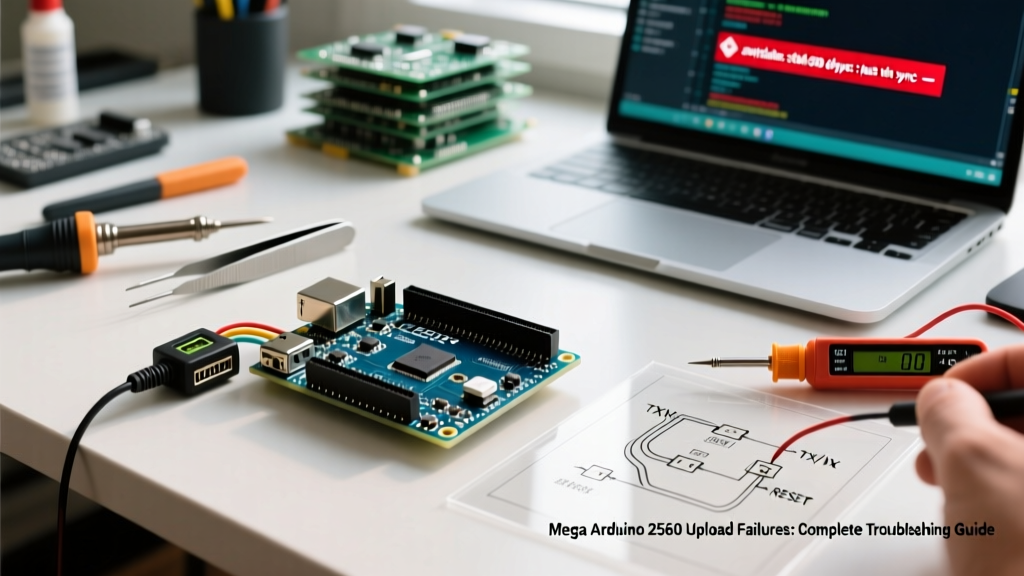
Failure Mode 1: I2C Bus Lockup on Long Wire RunsSymptom: The Elechouse module works on a breadboard but freezes when mounted 50cm away inside a 3D-printed enclosure.
Community Fix: I2C is not designed for long distances due to line capacitance. Makers solve this by either switching the module to UART mode (which handles long runs easily) or by adding an I2C bus extender IC like the P82B715. If you must use raw I2C, drop the clock speed to 50kHz in theWire.hlibrary and ensure you have external 4.7kΩ pull-up resistors on both SDA and SCL.
Failure Mode 2: False Triggers from Ambient NoiseSymptom: A TV or radio in the background accidentally triggers the 'Lights On' command.
Community Fix: Implement a two-stage pipeline. Use a low-power analog envelope detector to wake the MCU only when sustained audio is present, then run the Edge Impulse classifier. Alternatively, train a specific 'Background Noise' class in your TinyML model so the neural network learns to actively ignore television static and HVAC hum.
Microphone Selection: I2S vs. Analog
If you are building a custom PCB rather than buying an off-the-shelf ASR module, microphone selection is critical. The community has largely abandoned the MAX9814 analog amplifier for voice AI due to its susceptibility to EMI (Electromagnetic Interference) from nearby switching regulators.
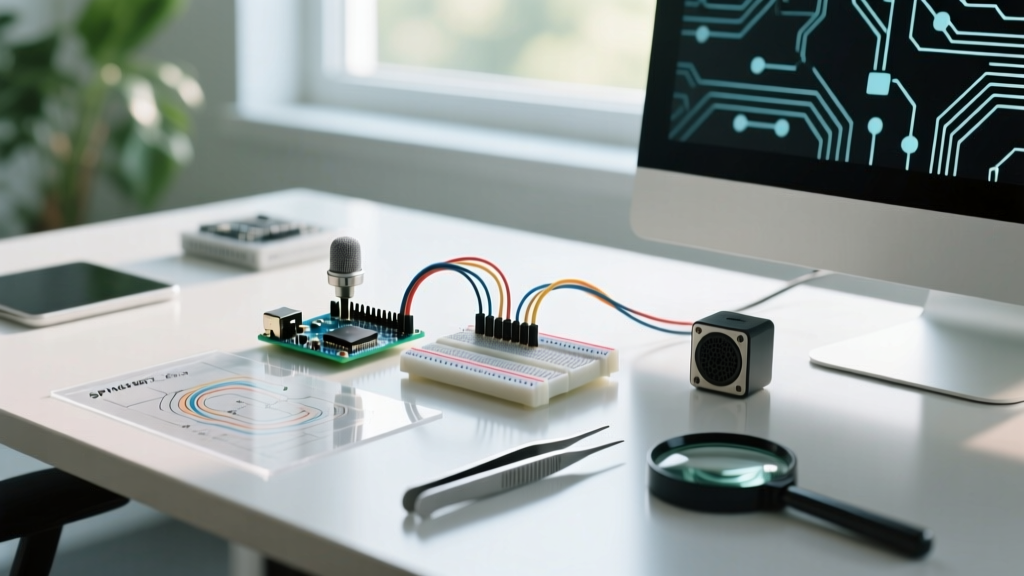
Instead, the INMP441 I2S MEMS microphone is the 2026 standard. It outputs a digital PDM/I2S stream directly into the MCU, bypassing the analog-to-digital conversion noise floor. When wiring the INMP441 to an ESP32-S3 or Arduino Nano RP2040 Connect, ensure the L/R (Left/Right) channel select pin is tied to GND for left-channel mono capture, which matches the expected input tensor shape of most Edge Impulse audio models.
Architecture Debate: Edge AI vs. Cloud APIs
Should you process voice locally or send it to the cloud? Here is the community consensus matrix for 2026:
| Factor | Offline Edge AI (Local) | Cloud API (AWS/Google) |
|---|---|---|
| Latency | 50ms - 300ms (Instant) | 800ms - 2000ms (Network dependent) |
| Privacy | 100% Local (No data leaves device) | Audio streamed to external servers |
| Vocabulary | Limited to trained keywords (10-50) | Unlimited natural language processing |
| Hardware Cost | High ($25 - $115 for ASICs/MCUs) | Low ($5 ESP32 + WiFi) + API subscription |
Where to Find Help: Top Community Hubs
When your code compiles but the module refuses to recognize your voice, these are the most active resources:
- Arduino Forum (Audio & AI Subforums): The official Arduino Nicla Voice Documentation is excellent, but the forum threads contain the real-world workarounds for Syntiant NDP120 firmware bugs.
- Edge Impulse Community Forum: The best place to get help with DSP block configuration, specifically tuning the frame length and hop size for custom wake-words.
- Hackaday.io 'Voice Control' Tag: Search for project logs tagged with 'ASR' or 'TinyML'. Makers frequently post their exact 3D-printed acoustic chamber STL files, which are crucial for directing sound into the MEMS microphone port and reducing reverberation.
Final Thoughts for Your Next Build
Integrating voice commands Arduino functionality is no longer a novelty; it is a robust, production-ready feature. If you need simple relay control, buy the Elecrow V2 and wire it via UART. If you are building a commercial product requiring custom wake-words and high noise immunity, invest the time into the Arduino Nicla Voice and the Edge Impulse pipeline. Leverage the community repositories, respect the 3.3V/5V logic boundaries, and always test your acoustic model in the actual physical environment where the device will live.