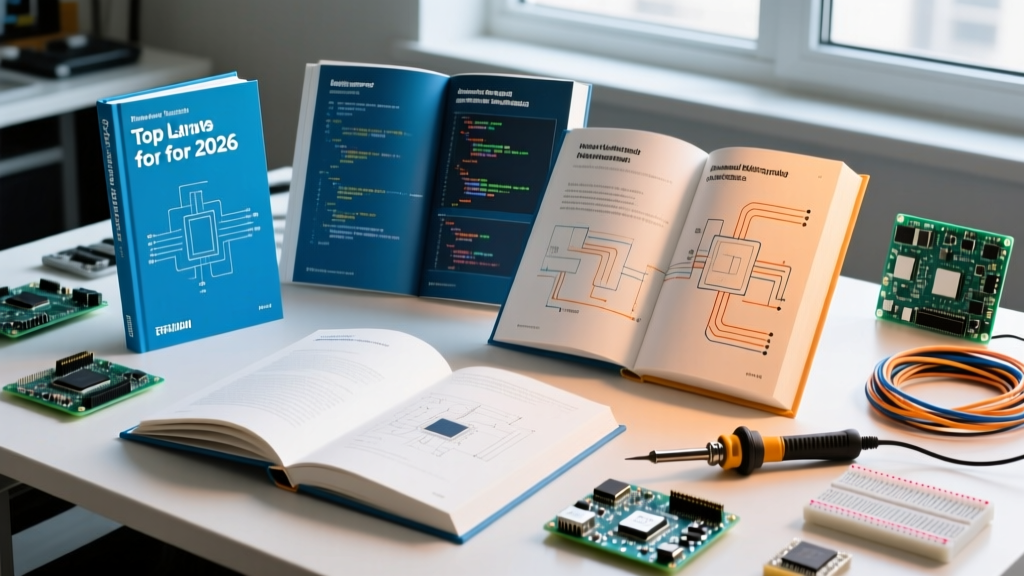

The 2026 Quick Reference Matrix: Top Arduino Books
Navigating the vast ecosystem of microcontroller literature can be overwhelming. Whether you are blinking your first LED on an UNO R4 WiFi or optimizing memory allocation on a custom ATmega328P PCB, selecting the right reference material is critical. Below is our quick-reference matrix of the most authoritative Arduino books available in 2026, categorized by skill level and core focus.
| Book Title & Edition | Author(s) | Target Audience | Core Focus | Avg. Price (Print) |
|---|---|---|---|---|
| Arduino Workshop (2nd Ed.) | John Boxall | Beginner to Intermediate | Project-based hardware integration | $39.95 |
| Programming Arduino (3rd Ed.) | Simon Monk | Beginner | C++ fundamentals & sketch logic | $29.99 |
| Arduino Cookbook (3rd Ed.) | Michael Margolis et al. | Intermediate to Advanced | Hardware/software recipe solutions | $49.99 |
| Make: Sensors | Rich Townsend et al. | Intermediate | Transducer & analog signal conditioning | $34.99 |
Deep Dive: Essential Books for Arduino Mastery
1. Arduino Workshop (2nd Edition) by John Boxall
Published by No Starch Press, this book remains the gold standard for makers who learn by doing. Boxall structures the book around 65 progressive projects. What sets this book apart is its meticulous attention to component-level wiring. For example, when building the digital thermometer project, Boxall doesn't just provide the code; he explains the voltage drop across the TMP36 sensor and how to calculate the analog-to-digital conversion (ADC) steps based on a 5V reference.
2026 Context: While the 2nd edition heavily features the classic AVR-based UNO R3, the circuit logic and C++ code are 100% applicable to the modern UNO R4 Minima and WiFi boards. The only adjustment required is mapping the physical pinouts for SPI and I2C, which the Arduino Official Documentation covers extensively for the Renesas RA4M1 architecture.
2. Programming Arduino: Getting Started with Sketches (3rd Edition) by Simon Monk
If your goal is to write robust, crash-free C++ code, Simon Monk’s O'Reilly publication is mandatory reading. Many beginners rely on the `delay()` function and the `String` class, which leads to catastrophic heap fragmentation on boards with limited SRAM. Monk dedicates entire chapters to memory management, teaching you how to use `char` arrays, pointers, and `strcpy()` to manipulate text without exhausting the 2KB SRAM on an ATmega328P.
Expert Insight: Monk’s chapter on pointers is vital. By passing arrays to functions via pointers rather than by value, you prevent the compiler from duplicating data in memory—a technique that scales perfectly when you upgrade to the 32KB SRAM on the UNO R4 or the 520KB SRAM on the ESP32-S3.
3. Arduino Cookbook (3rd Edition) by Michael Margolis
This is not a cover-to-cover read; it is a desk reference. Margolis uses a 'recipe' format, providing exact solutions to specific engineering problems. Need to debounce a mechanical switch without blocking the main loop? Recipe 5.4 covers it using `millis()` state machines. Need to interface with an I2C EEPROM like the AT25HP512? The book provides the exact wire library commands and timing delays required for the page-write buffer.
Frequently Asked Questions (FAQ)
Are older AVR-focused books obsolete with the dominance of the UNO R4 and ESP32 in 2026?
No. The Arduino IDE and its underlying Hardware Abstraction Layer (HAL) are designed specifically to make code portable. Functions like `digitalWrite()`, `analogRead()`, and the `Wire.h` library work identically across the 8-bit AVR and the 32-bit ARM Cortex-M4 chips. However, if a book teaches direct port manipulation (e.g., writing directly to `PORTD` or `DDRB` to toggle pins at high speeds), that specific code will fail on the UNO R4. For direct port access on the R4, you must consult the Renesas RA4M1 hardware manual, as the register maps are entirely different.
Which book is best for integrating IoT and wireless protocols?
Standard Arduino books touch upon Wi-Fi via shields, but the landscape has shifted. If you are using the UNO R4 WiFi or standalone ESP32 boards, you need resources that cover the `WiFiNINA` or `WiFi.h` libraries, MQTT protocols, and JSON parsing. While Margolis's Arduino Cookbook covers network fundamentals, we recommend supplementing it with the O'Reilly Media Catalog for specialized titles on ESP32 web servers and MQTT broker integration, as IoT standards evolve faster than print publication cycles.
Do I need a specific book to understand hardware interrupts?
Yes, and Arduino Cookbook handles this best. Hardware interrupts (using `attachInterrupt()`) are critical for reading rotary encoders or high-frequency pulse sensors without missing steps. Margolis explains the concept of Interrupt Service Routines (ISRs) and the vital rule of keeping ISRs as short as possible. Edge Case Warning: When using interrupts on the UNO R4 WiFi, be aware that the ESP32-S3 co-processor handles some background Wi-Fi tasks; ensure your ISR variables are declared with the `volatile` keyword to prevent compiler optimization errors.
Decision Framework: Matching Your Project to the Right Book
Use this quick diagnostic framework to choose your next purchase:
- The 'I want to build a robot' Maker: Buy Arduino Workshop. The motorized pinwheel and infrared remote projects provide the exact foundational logic needed for differential steering and sensor avoidance.
- The 'My code keeps crashing' Coder: Buy Programming Arduino. You will learn to eliminate memory leaks, optimize loop structures, and write modular C++ classes.
- The 'I need to interface an obscure I2C sensor' Engineer: Buy Arduino Cookbook. It provides the low-level bitwise operations required to read custom hex registers from unsupported datasheets.
A Note on I2C Pull-Up Resistors in Modern Literature
Many older books assume the internal pull-up resistors on the microcontroller are sufficient for I2C communication. On the classic UNO R3, these are roughly 20kΩ to 50kΩ. In 2026, when wiring high-speed 400kHz I2C sensors (like the BME280 or MPU6050) to modern boards, those internal pull-ups are often too weak, resulting in corrupted data packets. Always supplement your book learning with the physical practice of adding external 4.7kΩ pull-up resistors to both the SDA and SCL lines when connecting 3.3V sensors to 5V logic systems via level shifters.