
The Hidden Cost of Legacy Arduino If Chains
Every embedded systems maker begins their journey with the standard arduino if statement. It is intuitive, readable, and perfectly adequate for simple tasks like toggling an LED when a button is pressed. However, as projects scale into complex 2026 applications—such as managing 16-channel relay matrices, parsing high-speed NMEA GPS sentences, or handling multi-axis robotic kinematics—deeply nested if-else chains become a severe architectural bottleneck.
When you rely on long chains of conditional logic, the microcontroller must evaluate each condition sequentially. In a worst-case scenario, an input that matches the final else if block forces the CPU to execute every preceding comparison. On older 8-bit AVR chips, this linear evaluation wastes critical clock cycles. On modern 32-bit ARM and RISC-V architectures, poorly structured conditional logic can cause pipeline stalls and branch misprediction penalties, effectively neutering the high clock speeds of modern development boards.
This migration guide provides a structured, engineering-focused approach to upgrading your legacy conditional logic. We will explore how to transition from clunky if chains to highly optimized switch/case structures, zero-branch lookup tables, and deterministic state machines.
Hardware Execution Profiling: AVR vs ARM Cortex vs Xtensa
To understand why migration is necessary, we must examine how different microcontroller architectures handle branching. The legacy ATmega328P (Arduino Uno R3) lacks branch prediction; it simply fetches the next instruction sequentially. If an if condition evaluates to false, the CPU flushes the pipeline and jumps to the next block, costing a fixed number of cycles.
In contrast, modern boards dominating the 2026 maker space—like the Arduino Uno R4 Minima (Renesas RA4M1), the ESP32-S3 (Xtensa LX7), and the Teensy 4.1 (NXP i.MX RT1062)—utilize advanced branch prediction algorithms. These cores attempt to guess which way an if statement will resolve. If the guess is wrong, the pipeline flushes, causing a severe latency spike. By migrating to deterministic logic structures, we eliminate branch misprediction entirely.
| Development Board (2026 Pricing) | MCU Architecture | Clock Speed | Branch Prediction | 1000-Iteration Overhead (Worst Case) |
|---|---|---|---|---|
| Arduino Uno R3 (~$25.00) | 8-bit AVR (ATmega328P) | 16 MHz | None | ~4,500 Cycles |
| Arduino Uno R4 Minima (~$27.50) | 32-bit ARM Cortex-M4 (RA4M1) | 48 MHz | Basic Static | ~1,200 Cycles |
| ESP32-S3-DevKitC-1 (~$12.00) | 32-bit Xtensa LX7 (Dual-Core) | 240 MHz | Dynamic | ~450 Cycles (High Variance) |
| Teensy 4.1 (~$39.95) | ARM Cortex-M7 (i.MX RT1062) | 600 MHz | Advanced Dynamic | ~85 Cycles (Severe Pipeline Flush) |
Migration Strategy 1: Refactoring to Switch/Case
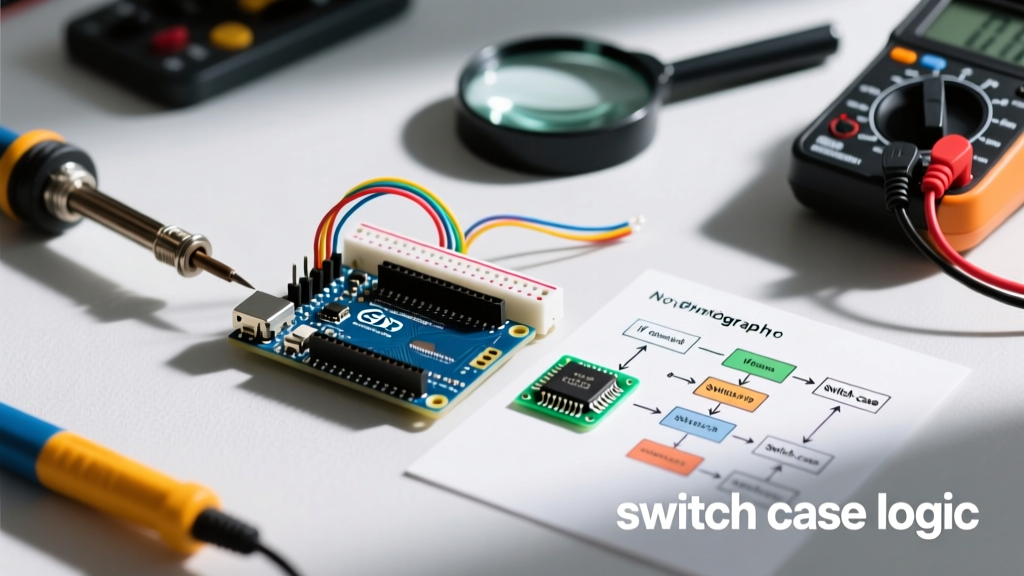
The most direct upgrade path for a multi-tiered arduino if chain evaluating a single integer or byte variable is the switch/case structure. When compiled with the GCC backend (standard in Arduino IDE 2.3.x), dense switch statements are not evaluated sequentially. Instead, the compiler generates a jump table.
A jump table is an array of memory addresses stored in Flash. When the switch variable is evaluated, the CPU calculates the memory offset and jumps directly to the correct code block in O(1) time complexity, completely bypassing the sequential evaluation penalty of if-else chains.
Compiler Optimization Flags
To ensure the Arduino IDE generates a jump table rather than falling back to sequential comparisons, your case values must be relatively dense. If you have cases 1, 2, 3, 4, 5, GCC will generate a jump table. If you have cases 1, 1000, 5000, the compiler will revert to a hidden if-else tree to save Flash memory. You can force aggressive optimization by modifying the platform.txt file in your board package, changing the compiler flag from -Os (optimize for size) to -O2 or -O3 (optimize for speed), as detailed in the GCC Optimize Options documentation.
// Legacy Approach: O(N) Sequential Evaluation
if (commandByte == 0x01) { startMotor(); }
else if (commandByte == 0x02) { stopMotor(); }
else if (commandByte == 0x03) { recalibrate(); }
else if (commandByte == 0x04) { sleepMode(); }

// Optimized Approach: O(1) Jump Table
switch (commandByte) {
  case 0x01: startMotor(); break;
  case 0x02: stopMotor(); break;
  case 0x03: recalibrate(); break;
  case 0x04: sleepMode(); break;
  default: handleError(); break;
}
Migration Strategy 2: PROGMEM Lookup Tables (Zero-Branch Logic)
When your if statements are used to map an input range to an output value (e.g., converting a thermistor ADC reading to a temperature, or mapping a joystick axis to a PWM signal), both if chains and switch cases are the wrong tool. The ultimate migration path is the Lookup Table (LUT).
By pre-calculating your mappings and storing them in Flash memory, you replace dozens of lines of conditional logic with a single array index operation. On 8-bit AVRs, this requires the PROGMEM directive to prevent the array from consuming precious SRAM. On 32-bit ESP32 and ARM boards, standard const arrays are automatically mapped to Flash memory.
Implementation Example: Sensor Mapping
// Store 16 mapping values in Flash memory (AVR)
const uint8_t pwmLUT[16] PROGMEM = {
  0, 15, 30, 45, 60, 80, 100, 120,
  140, 160, 180, 200, 220, 235, 245, 255
};

void setup() {
  pinMode(9, OUTPUT);
}

void loop() {
  // Read sensor and scale to 0-15 index
  int sensorVal = analogRead(A0);
  uint8_t index = map(sensorVal, 0, 1023, 0, 15);

  // Zero-branch execution: Direct memory fetch
  uint8_t pwmOut = pgm_read_byte(&pwmLUT[index]);
  analogWrite(9, pwmOut);
}
This migration completely eliminates branching. The CPU performs a basic arithmetic shift to find the array index and fetches the byte. Execution time drops from microseconds (in a long if chain) to mere nanoseconds, freeing up the MCU for high-frequency interrupt service routines (ISRs).
Migration Strategy 3: Enum-Based State Machines
A common anti-pattern in intermediate maker code is the use of boolean flags inside if statements to track system states (e.g., if (isArmed && !isFaulted && sensorReady)). This leads to 'spaghetti code' where conflicting flags can lock the system in an undefined state.
The professional migration path is the Finite State Machine (FSM) using C++ enum classes. This restricts your logic to a single, predictable switch evaluation per loop iteration.
enum class SystemState {
  IDLE,
  ARMING,
  ACTIVE,
  FAULT
};

SystemState currentState = SystemState::IDLE;

void loop() {
  switch (currentState) {
    case SystemState::IDLE:
      if (startButtonPressed()) currentState = SystemState::ARMING;
      break;
    case SystemState::ARMING:
      if (sensorsCalibrated()) currentState = SystemState::ACTIVE;
      else if (timeoutReached()) currentState = SystemState::FAULT;
      break;
    case SystemState::ACTIVE:
      runMainLogic();
      if (eStopTriggered()) currentState = SystemState::FAULT;
      break;
    case SystemState::FAULT:
      triggerAlarm();
      break;
  }
}
Critical Edge Cases: Floating Point and Volatile Traps
When migrating legacy code, you will inevitably encounter edge cases that cause silent failures if not handled correctly during the refactoring process.
The Floating-Point Equality Trap
Never use exact equality (==) for floating-point variables in an if condition. Due to IEEE 754 precision limits, a calculation that should equal 5.00 might resolve to 5.0000001, causing the branch to fail silently.
Migration Fix: Always use an epsilon comparison. Instead of if (voltage == 3.3), migrate to if (abs(voltage - 3.3) < 0.01). This is especially critical when upgrading from 8-bit AVRs (which use software-emulated 32-bit floats) to 32-bit ARM chips (which utilize hardware FPU instructions that may yield slightly different rounding artifacts).
The Volatile Keyword in ISRs
If your if statement checks a variable that is modified inside an Interrupt Service Routine (ISR), the GCC compiler's -O2 or -O3 optimization will likely cache the variable in a CPU register, completely ignoring the ISR update. You must declare the variable as volatile (e.g., volatile bool interruptFlag = false;) to force the compiler to fetch the value from SRAM on every if evaluation.
Summary Checklist for Code Migration
Before deploying your upgraded firmware to production hardware or complex DIY installations, run through this optimization checklist:
- Identify Sequential Bottlenecks: Use the Arduino IDE's compiler output to check Flash usage. If you have massive
if-elseblocks, consider if a lookup table can reduce both code size and execution time. - Enforce Dense Switch Cases: Ensure your
switchcases use sequential or near-sequential integers to guarantee the GCC compiler generates a jump table. - Offload to Flash: Move all static mapping arrays to
PROGMEM(AVR) orconst(ARM/ESP32) to preserve SRAM for dynamic buffers. - Audit Floating Point Logic: Search your codebase for
==operators applied tofloatordoubletypes and replace them with epsilon tolerance checks. - Verify ISR Variables: Ensure every variable shared between the main
loop()and an ISR is strictly typed with thevolatilekeyword.
By systematically migrating away from legacy arduino if chains and adopting modern C++ structural paradigms, you unlock the true processing potential of 2026's microcontroller hardware, ensuring your projects run with deterministic, professional-grade reliability.