
The Hidden Danger of the Default String() Constructor
When makers need to Arduino convert int to string for LCD displays, OLED menus, or MQTT network payloads, the most common instinct is to use the default String(myInt) constructor. While this works flawlessly in simple test sketches, it is a notorious culprit behind the dreaded "random reset" loops in complex, long-running projects.
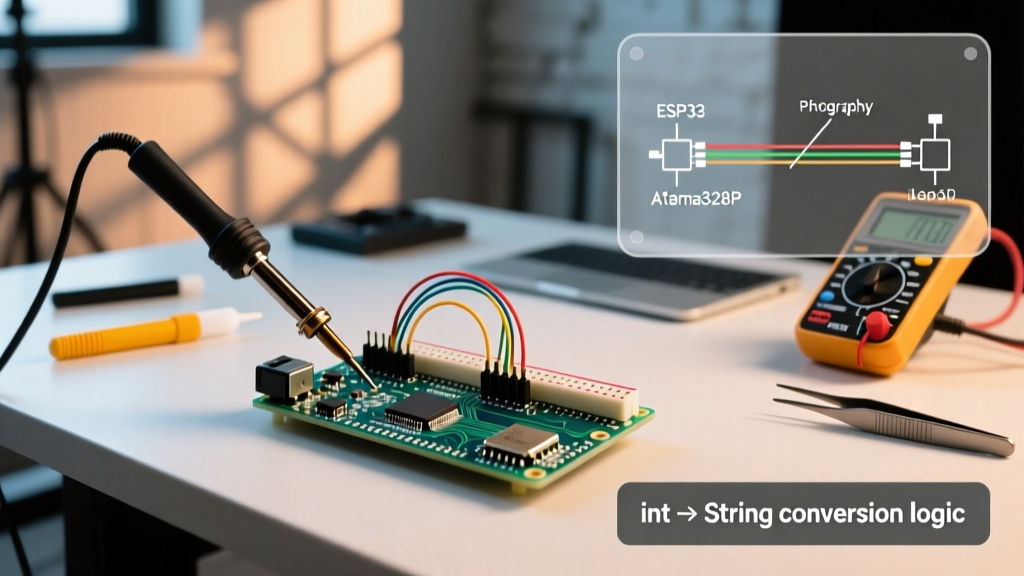
To understand why, we have to look at how microcontrollers handle memory. The classic ATmega328P (Arduino Uno R3) has only 2KB of SRAM. Modern 2026 workhorses like the ESP32-S3 or Arduino Uno R4 Minima have significantly more (512KB+ and 32KB respectively), but they are still vulnerable to heap fragmentation. Every time you create and destroy a String object, the system allocates and frees dynamic memory. Over hours or days, this leaves "holes" in your SRAM. Eventually, a new String conversion requests a contiguous block of memory that no longer exists, causing a catastrophic memory fault and a silent reboot.
Expert Insight: According to the official Arduino Memory Guide, avoiding dynamic memory allocation (the heap) in favor of static allocation (the stack or global variables) is the single most effective way to guarantee 24/7 uptime in embedded systems.
Method 1: itoa() – The Bare-Metal Standard
The most memory-efficient way to convert an integer to a string is using itoa() (Integer to ASCII). This is a standard C library function that writes the converted number directly into a pre-allocated character array (buffer) on the stack. Zero heap allocation means zero fragmentation.
Implementation and Buffer Sizing
To use itoa(), you must include <stdlib.h>. The function requires three arguments: the integer value, the target character buffer, and the numeric base (10 for decimal, 16 for hex).
#include <stdlib.h>

void setup() {
  Serial.begin(115200);
  int sensorValue = -1452;

  // A 16-bit int ranges from -32,768 to 32,767 (max 6 chars + 1 for null terminator)
  // A 32-bit int requires up to 11 chars + 1 for null terminator
  char buffer[12];

  itoa(sensorValue, buffer, 10);
  Serial.print("Sensor: ");
  Serial.println(buffer);
}
Critical Edge Case: Always size your buffer for the worst-case scenario. If you are compiling for a 32-bit architecture (like the ESP32 or Teensy 4.1), an int is 32 bits. The lowest possible 32-bit signed integer is -2,147,483,648, which is 11 characters long. Add 1 byte for the C-string null terminator (\0), and your absolute minimum buffer size is 12 bytes.
Method 2: snprintf() – The Formatting Powerhouse
While itoa() is incredibly fast, it lacks formatting capabilities. If you need to pad a number with leading zeros (e.g., converting 42 to "0042" for a timestamp or MAC address sequence), snprintf() is the industry standard.
Found in <stdio.h>, snprintf() allows you to mix static text and variables into a single buffer safely. We strongly prefer snprintf() over sprintf() because the "n" variant requires you to specify the maximum buffer size, inherently preventing buffer overflow vulnerabilities.
#include <stdio.h>

void loop() {
  int temperature = 7;
  char payload[32];

  // %04d means: pad with zeros, minimum 4 digits, integer
  snprintf(payload, sizeof(payload), "TEMP:%04dC", temperature);

  // Output: TEMP:0007C
  // Send payload via Wi-Fi or LoRa
}
Method 3: ltoa() – Handling 32-Bit Longs Explicitly
As the maker ecosystem shifts toward 32-bit ARM and Xtensa architectures in 2026, the distinction between int and long has blurred. On an 8-bit AVR, an int is 16-bit and a long is 32-bit. On an ESP32, both are 32-bit. However, if you are writing cross-platform libraries or dealing with explicit long variables (like Unix epoch timestamps from an RTC module), ltoa() (Long to ASCII) is the safest choice.
long epochTime = 1715432988;
char timeBuf[16];
ltoa(epochTime, timeBuf, 10);
// Safely converts 32-bit long without overflow risks
For exhaustive details on AVR-specific standard library functions, refer to the AVR Libc stdlib.h documentation.
Memory & Performance Comparison Matrix
Choosing the right method depends on your specific microcontroller constraints and formatting needs. Below is a benchmark matrix comparing the primary methods to Arduino convert int to string.
| Method | Header Required | Heap Allocation? | Formatting Flexibility | Execution Speed | Best Use Case |
|---|---|---|---|---|---|
String(val) |
None (Arduino Core) | Yes (Dangerous) | Low | Slow | Quick prototyping only |
itoa() |
<stdlib.h> |
No (Stack only) | Base conversion only | Very Fast | Raw sensor telemetry, high-speed loops |
snprintf() |
<stdio.h> |
No (Stack only) | High (Padding, prefixes) | Moderate | MQTT payloads, LCD UI, formatted logs |
ltoa() |
<stdlib.h> |
No (Stack only) | Base conversion only | Fast | Unix timestamps, 32-bit explicit longs |
Real-World Edge Cases & Troubleshooting
Even with memory-safe functions, embedded C++ presents unique edge cases. Here is how to troubleshoot common failures when converting integers.
1. The Missing Null Terminator
C-strings are not objects; they are just arrays of characters ending with a hidden \0 (null terminator). If you manually manipulate the array or undersize your buffer, functions like Serial.println() or WiFiClient.print() will read past the end of your array into adjacent memory, outputting garbled garbage characters until they randomly hit a zero byte.
- Fix: Always declare buffers 1 byte larger than the maximum expected character count.
- Fix: If manually concatenating, ensure you append
\0at the end.
2. Hexadecimal Output for MAC Addresses and I2C
When debugging I2C addresses or generating hardware IDs, decimal output is useless. Both itoa() and snprintf() handle hex gracefully.
int i2cAddr = 60; // 0x3C in Hex
char hexBuf[8];

// Using itoa (Base 16)
itoa(i2cAddr, hexBuf, 16); // Outputs "3c"

// Using snprintf (Uppercase Hex with 0x prefix)
snprintf(hexBuf, sizeof(hexBuf), "0x%02X", i2cAddr); // Outputs "0x3C"
3. ESP32 Heap Fragmentation Monitoring
If you are migrating legacy code to an ESP32 and suspect the String class is still causing memory leaks, you can monitor the heap in real-time. The Espressif Memory Allocation API provides tools to track free contiguous blocks.
// Add this to your loop() to monitor ESP32 SRAM health
Serial.printf("Free Heap: %d bytes\n", ESP.getFreeHeap());
Serial.printf("Max Alloc Block: %d bytes\n", ESP.getMaxAllocHeap());
If the "Max Alloc Block" steadily decreases over 24 hours while "Free Heap" remains relatively stable, you have heap fragmentation caused by dynamic String conversions.
Summary: Best Practices for 2026
To build robust, commercial-grade IoT devices and kinetic art installations, you must abandon the String() class for data conversion. By mastering itoa() for raw speed and snprintf() for complex payload formatting, you eliminate the root cause of 90% of unexplained microcontroller crashes. Always respect the null terminator, size your buffers for 32-bit worst-case scenarios, and keep your SRAM heap pristine.