
The Hidden Bottleneck: Why Migrate Your Arduino CLK?
In the embedded engineering and maker ecosystem of 2026, the term 'Arduino CLK' encompasses three distinct but deeply interconnected hardware concepts: the system clock source (F_CPU), the physical ICSP programming clock pin, and communication bus clocks (SPI/I2C). While default clock configurations are sufficient for blinking LEDs or reading slow analog sensors, they become a critical liability when projects mature from breadboard prototypes to deployed industrial IoT nodes, precision motor controllers, or high-speed data loggers.
Migrating your clock architecture is not merely about increasing speed; it is about guaranteeing timing determinism, reducing phase noise, and ensuring protocol compliance. This guide provides a comprehensive migration pathway for upgrading your Arduino CLK infrastructure, moving from legacy 8-bit AVR internal oscillators to precision external sources and modern 32-bit clock trees.
The Precision Deficit: Internal RC vs. External Crystals
The ubiquitous ATmega328P, the heart of the classic Arduino Uno, ships from the factory configured to use its internal 8MHz RC oscillator, divided by 8 to run at 1MHz (or fused for 16MHz with an external ceramic resonator on clones). According to the official Microchip ATmega328P specifications, the internal RC oscillator is factory-calibrated to ±10% accuracy at 25°C. However, across an industrial temperature range of -40°C to 85°C, this drift can expand to ±15%.
Critical Edge Case: The 115200 Baud Rate Trap
Many engineers assume a standard 16MHz quartz crystal guarantees flawless UART communication. It does not. When calculating the UBRR (UART Baud Rate Register) for 115200 baud on a 16MHz AVR using the U2X (Double Speed) mode, the mathematical divisor yields a fractional remainder. The resulting actual baud rate is approximately 117,647 baud. This creates a +2.1% error. Because standard UART receivers typically tolerate a maximum of ±2% timing error, this marginal overshoot causes intermittent frame errors and corrupted payloads in noisy environments. Upgrading to a 14.7456MHz or 20.000MHz CLK source provides integer divisors, reducing the baud rate error to 0.0%.
Hardware Migration Matrix: Selecting the Right CLK Source
When migrating away from basic quartz crystals or internal RC oscillators, you must evaluate the trade-offs between cost, jitter, and temperature stability. Below is a 2026 hardware selection matrix for precision timing upgrades.
| Clock Source | Accuracy (PPM) | Approx. Cost (USD) | Phase Jitter | Best Migration Use-Case |
|---|---|---|---|---|
| Internal RC (AVR) | ±10,000 to ±50,000 | $0.00 (Integrated) | High | Low-power sleep modes, simple LED control |
| Quartz Crystal (HC49) | ±20 to ±50 | $0.15 - $0.30 | Moderate | General UART, basic PWM motor control |
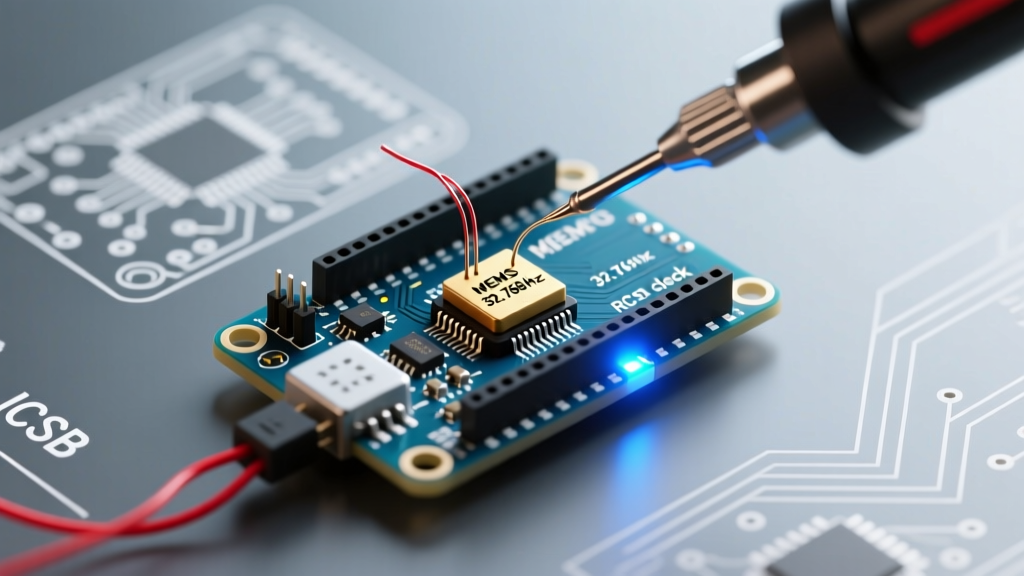
| MEMS Oscillator (e.g., SiT8008) | ±25 | $1.10 - $1.80 | Low | High-vibration environments, SMT automated assembly |
| TCXO (Temp Compensated) | ±0.5 to ±2.5 | $2.50 - $4.50 | Ultra-Low | GPS disciplined clocks, LoRaWAN WAN timing |
The ICSP CLK Pin: Programming Constraints During Migration
A frequent point of failure during hardware migration involves the physical CLK pin on the 2x3 ICSP (In-Circuit Serial Programming) header. Pin 3 of the ICSP header carries the serial clock signal from the programmer (e.g., USBasp, Atmel-ICE, or STK500v2) to the target MCU.
The Golden Rule of ISP Programming: The programmer's CLK frequency must be strictly less than or equal to one-quarter of the target MCU's system clock frequency (F_CPU / 4).
- Scenario A: You are migrating a legacy board running on the internal 1MHz clock (8MHz RC divided by 8). If your USBasp is hardcoded to output a 400kHz CLK signal, the programming attempt will fail silently or throw a 'signature mismatch' error because 400kHz > (1MHz / 4).
- Solution: You must use the slow-clock jumper on the USBasp or issue the
-B 32flag in AVRDude to artificially lower the programmer's CLK speed to ~30kHz for the initial connection. Once the fuse bits are migrated to use a 16MHz external crystal, you can remove the slow-clock jumper and program at full speed.
Architecture Migration: AVR to ARM/RP2040 Clock Trees
As the industry standard shifts toward 32-bit architectures, migrating from AVR to platforms like the Raspberry Pi RP2040 or ATSAMD21 fundamentally changes how the 'Arduino CLK' is managed. You are no longer simply toggling fuse bits; you are configuring complex Phase-Locked Loops (PLLs) and clock multiplexers.
According to the official RP2040 Datasheet, the chip does not run directly off the external crystal. Instead, a 12MHz XOSC (External Oscillator) feeds into the PLL SYS block. The PLL multiplies this base frequency using a feedback divider (FBDIV) and post-dividers to generate the core system clock (typically 125MHz or 133MHz).
Migration Checklist for 32-bit Clock Trees
- Identify the Base Reference: Confirm the exact frequency of the XOSC on your custom PCB (usually 12MHz or 16MHz). Using a 16MHz crystal with firmware hardcoded for a 12MHz PLL multiplier will result in an overclocked, unstable core.
- Configure the Watchdog Crystal (XOSC32K): For low-power sleep migrations, ensure a 32.768kHz tuning-fork crystal is routed to the dedicated RTC pins. Internal 32kHz RC oscillators drift too heavily for accurate calendar timekeeping over months of deployment.
- Peripheral Clock Gating: Unlike the AVR where all peripherals share the main prescaler, 32-bit MCUs allow individual clock gating. Disable the CLK signal to unused peripherals (like USB or ADC) at the register level to shave off milliamps of quiescent current.
Step-by-Step: Migrating AVR Fuses for External CLK
If you are upgrading an existing ATmega328P design from the internal RC oscillator to an external full-swing crystal, you must modify the Low Fuse byte. Warning: Performing this step without the physical crystal and load capacitors soldered to the board will instantly 'brick' the MCU, as it will have no clock signal to execute the programming instructions.
- Solder the Hardware: Install the quartz crystal and two 22pF load capacitors to ground on the XTAL1 and XTAL2 pins.
- Calculate Load Capacitance: Ensure the 22pF value matches the crystal's specified load capacitance (CL) using the formula: $C_{load} = \frac{C1 \times C2}{C1 + C2} + C_{stray}$.
- Read Current Fuses: Run
avrdude -c usbasp -p m328p -vto verify current settings (typically Low Fuse = 0x62 for internal 8MHz div 8). - Write New Fuses: Execute
avrdude -c usbasp -p m328p -U lfuse:w:0xFF:m. The 0xFF value disables the divide-by-8 prescaler and selects the External Crystal Oscillator (Full Swing) mode. - Verify Execution: Read the fuses back. If the MCU responds, the migration is successful, and your F_CPU is now dictated by the physical crystal.
Real-World Failure Modes & Troubleshooting
Even with the correct hardware and fuse bits, CLK migrations can fail due to subtle PCB layout and environmental factors. Watch for these specific edge cases:
- Cold-Start Failures: Quartz crystals require a minimum drive level to start oscillating. In freezing temperatures, the ESR (Equivalent Series Resistance) of the crystal increases. If your MCU's clock amplifier is set to 'Low Power' instead of 'Full Swing', the crystal may fail to start on power-up. Always use Full Swing fuse settings for industrial temperature ranges.
- Stray Capacitance on Breadboards: When prototyping CLK upgrades on a solderless breadboard, the inherent 2pF-5pF stray capacitance between traces can detune the crystal, causing the system clock to run slightly slow. This is why MEMS oscillators (which output a clean CMOS square wave and do not require load capacitors) are vastly superior for prototyping and high-vibration environments.
- SPI Bus CLK Overruns: When migrating the system clock from 8MHz to 16MHz, remember that the SPI hardware divider remains constant. Your SPI CLK pin frequency will instantly double. If you are communicating with an external sensor (like an SD card or an SPI Flash chip) rated for a maximum of 10MHz SPI CLK, the migration will cause silent data corruption. Always explicitly re-initialize your SPI prescaler registers after a system clock upgrade.
By treating the Arduino CLK not as a static afterthought, but as a dynamic, upgradeable subsystem, engineers can drastically improve the reliability, power efficiency, and communication integrity of their embedded designs.