
The Evolution of the VS Code Arduino Ecosystem
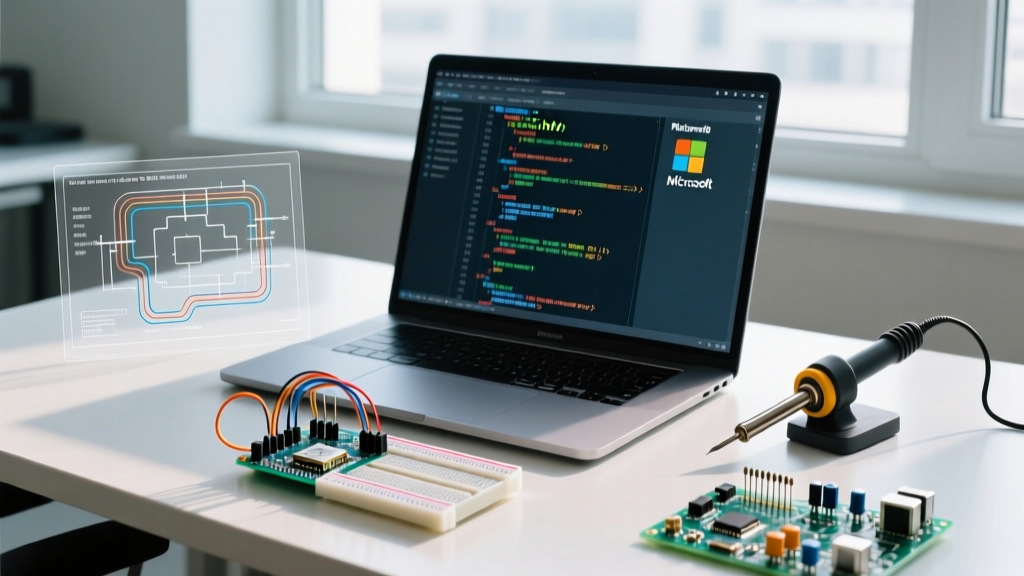
Transitioning from the traditional Arduino IDE to a professional VS Code Arduino workflow is a critical milestone for embedded developers. While the Arduino IDE 2.x has improved significantly by 2026, it still lacks the robust multi-file project management, advanced Git integration, and CI/CD pipeline capabilities required for production-grade firmware. Visual Studio Code bridges this gap, but developers face an immediate fork in the road: do you use the PlatformIO IDE extension or the official Microsoft Arduino extension?
This guide dissects the architectural differences, code patterns, and debugging best practices for both approaches, ensuring your microcontroller projects are scalable, maintainable, and optimized for modern hardware like the ESP32-S3, Teensy 4.1, and STM32H7 series.
Architectural Showdown: PlatformIO vs. Microsoft Arduino Extension
Before writing a single line of C++, you must choose your underlying build system. The choice dictates how dependencies are resolved and how hardware abstraction is handled.
| Feature | PlatformIO IDE | Microsoft Arduino Extension |
|---|---|---|
| Build System | Custom Python-based SCons engine | Wraps Arduino CLI / arduino-builder |
| Dependency Management | Automated via lib_deps in INI file |
Manual installation via IDE or CLI |
| Multi-Board Environments | Native support via [env] blocks |
Single active board configuration |
| IntelliSense Setup | Auto-generated c_cpp_properties.json |
Requires manual path mapping |
| Best For | Production firmware, CI/CD, complex architectures | Rapid prototyping, legacy .ino sketches |
PlatformIO: The Enterprise Standard for Arduino Frameworks
PlatformIO abstracts the underlying toolchains (AVR-GCC, Xtensa, ARM Cortex-M) into a unified configuration file: platformio.ini. As of 2026, relying on the Arduino framework via PlatformIO is the industry standard for commercial IoT devices.
Structuring platformio.ini for Multi-Board Deployments
A common failure mode in embedded projects is hardcoding board-specific parameters. Use PlatformIO's environment inheritance to maintain clean configurations across development and production hardware.
[env]
framework = arduino
monitor_speed = 115200
monitor_filters = esp32_exception_decoder, time
lib_deps =
    bblanchon/ArduinoJson@^7.2.0
    knolleary/PubSubClient@^2.8

[env:dev_esp32s3]
platform = espressif32
board = esp32-s3-devkitc-1
build_flags =
    -DCORE_DEBUG_LEVEL=4
    -DENVIRONMENT=\"DEV\"

[env:prod_custom_pcb]
platform = espressif32
board = esp32-s3-devkitc-1
build_flags =
    -DCORE_DEBUG_LEVEL=0
    -DENVIRONMENT=\"PROD\"
    -Os
Expert Insight: Notice the monitor_filters = esp32_exception_decoder. When an ESP32 experiences a panic (e.g., a stack overflow or null pointer dereference), this filter automatically translates the raw hex memory addresses in the serial output into human-readable file names and line numbers, saving hours of debugging.
Microsoft Arduino Extension: Mastering the Quick Prototype
If you are maintaining legacy .ino files or require strict compatibility with the official Arduino CLI, the Microsoft extension is viable. However, it requires manual intervention to achieve a frictionless coding experience.
Fixing the Dreaded IntelliSense Squiggles
The most frequent complaint with the native extension is false-positive IntelliSense errors (red squiggles under Serial, pinMode, or third-party libraries). This occurs because the default C/C++ extension does not know where the Arduino core headers are located.
To resolve this, you must configure your .vscode/c_cpp_properties.json to point to the exact compiler path and include directories.
{
    "configurations": [
        {
            "name": "Arduino-ESP32",
            "includePath": [
                "${workspaceFolder}/**",
                "~/.arduino15/packages/esp32/hardware/esp32/3.0.0/**"
            ],
            "forcedInclude": [
                "~/.arduino15/packages/esp32/hardware/esp32/3.0.0/cores/esp32/Arduino.h"
            ],
            "compilerPath": "~/.arduino15/packages/esp32/tools/xtensa-esp32-elf-gcc/esp-12.2.0_20230208/bin/xtensa-esp32-elf-gcc",
            "cStandard": "c17",
            "cppStandard": "c++17",
            "intelliSenseMode": "gcc-x64"
        }
    ],
    "version": 4
}
Code Patterns: Escaping the loop() Spaghetti
Regardless of the extension chosen, professional VS Code Arduino development demands abandoning monolithic loop() functions. Implement a non-blocking Finite State Machine (FSM) to handle concurrent tasks like sensor polling, WiFi management, and LED indication.
The Modular FSM Pattern
Separate your hardware abstraction layer (HAL) from your business logic. Create a dedicated class for state management.
// StateMachine.h
#pragma once
#include <Arduino.h>

enum class SystemState {
    INIT,
    CONNECTING_WIFI,
    SENSOR_POLLING,
    ERROR_STATE
};

class FirmwareFSM {
private:
    SystemState currentState;
    unsigned long lastTransitionTime;

public:
    FirmwareFSM() : currentState(SystemState::INIT), lastTransitionTime(0) {}

    void update() {
        switch (currentState) {
            case SystemState::INIT:
                if (initializeHardware()) transitionTo(SystemState::CONNECTING_WIFI);
                break;
            case SystemState::CONNECTING_WIFI:
                if (WiFi.status() == WL_CONNECTED) transitionTo(SystemState::SENSOR_POLLING);
                else if (millis() - lastTransitionTime > 10000) transitionTo(SystemState::ERROR_STATE);
                break;
            case SystemState::SENSOR_POLLING:
                readSensorsAndPublish();
                break;
            case SystemState::ERROR_STATE:
                handleSafeMode();
                break;
        }
    }

    void transitionTo(SystemState newState) {
        currentState = newState;
        lastTransitionTime = millis();
    }
};
Hardware Debugging: Beyond Serial.print()
True embedded engineering requires hardware debugging via SWD or JTAG. Using VS Code, you can integrate the Cortex-Debug extension to set breakpoints, inspect registers, and trace memory on ARM-based Arduino-compatible boards like the Adafruit Feather STM32 or Raspberry Pi Pico (RP2040).
Configuring launch.json for ST-Link
Add the following to your .vscode/launch.json to enable step-through debugging with an ST-Link V2 probe:
{
    "version": "0.2.0",
    "configurations": [
        {
            "name": "Cortex Debug (ST-Link)",
            "cwd": "${workspaceFolder}",
            "executable": "./.pio/build/teensy41/firmware.elf",
            "request": "launch",
            "type": "cortex-debug",
            "runToEntryPoint": "main",
            "servertype": "openocd",
            "device": "STM32F411CEUx",
            "svdFile": "${workspaceFolder}/svd/STM32F411.svd"
        }
    ]
}
Note: The SVD (System View Description) file is crucial. It allows VS Code to map raw memory addresses to human-readable peripheral registers (e.g., viewing the exact bits in the GPIO MODER register in real-time).
Common Failure Modes & Troubleshooting Matrix
Even with a perfect VS Code Arduino setup, environmental quirks can derail builds. Use this troubleshooting matrix to resolve edge cases rapidly.
- Build Cache Corruption: Symptom: Compiler throws undefined reference errors despite correct code. Fix: In PlatformIO, run the 'PlatformIO: Clean' task. For the Microsoft extension, delete the
buildfolder inside%TEMP%/arduino_build_*. - Library Version Collisions: Symptom: The compiler links an outdated system-wide library instead of your project-specific one. Fix: In PlatformIO, use
lib_archive = noin yourplatformio.inior explicitly define the repository URL inlib_depsrather than relying on the global registry. - USB Serial Port Locking: Symptom: 'Access Denied' when uploading or opening the serial monitor. Fix: Ensure no background processes (like Node-RED, Python scripts, or the VS Code serial monitor itself) are holding the COM port handle. On Linux, verify your user is in the
dialoutgroup viasudo usermod -a -G dialout $USER.
Final Recommendations for 2026 Workflows
For hobbyists flashing a quick sensor sketch, the Microsoft Arduino extension paired with the Arduino CLI provides a lightweight, familiar experience. However, for any project intended for deployment, commercialization, or collaborative team development, PlatformIO is the undisputed champion. Its deterministic dependency resolution, native unit testing framework (Unity), and seamless GitHub Actions integration make it the backbone of modern embedded firmware engineering.
By adopting modular FSM code patterns, leveraging hardware debugging via Cortex-Debug, and strictly managing your toolchain configurations, you transform VS Code from a simple text editor into a powerhouse IDE capable of rivaling Keil or IAR Embedded Workbench, entirely for free.