What Performance Wire Actually Means—Beyond Marketing Gloss
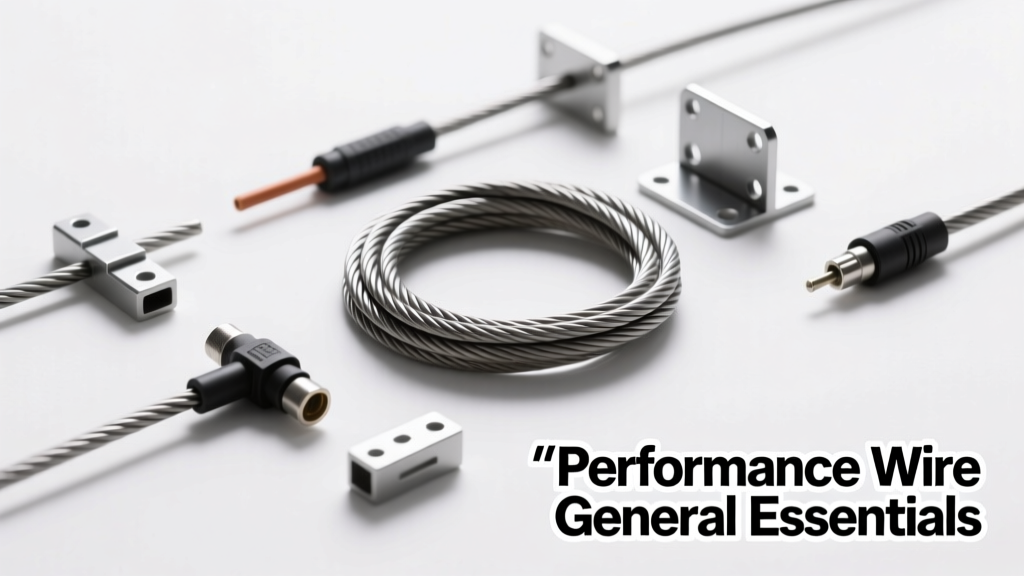
Performance wire is not a category defined by marketing slogans but by quantifiable, repeatable engineering constraints: continuous operating temperature (e.g., 105°C for SAE J1128 Type GPT), minimum dielectric strength (≥1,000 VAC @ 60 Hz for MIL-DTL-27500), and mechanical robustness under vibration (≥20 g RMS, 10–2,000 Hz per NASA-STD-7002). Unlike commodity hook-up wire, performance wire must satisfy simultaneous requirements for thermal stability, chemical resistance, flame propagation suppression, and signal integrity over extended service life. For example, TE Connectivity's Raychem DR-25 heat-shrink tubing–rated wire maintains 90% insulation resistance after 1,000 hours at 150°C in jet fuel immersion, while generic PVC wire fails within 48 hours under identical conditions. This distinction separates certified performance wire from cost-optimized alternatives that may meet basic conductivity specs but collapse under real-world stress.
Conductor Metallurgy: Copper Purity, Annealing, and Stranding Trade-offs
Copper remains the dominant conductor material due to its optimal balance of conductivity (100% IACS baseline), ductility, and solderability. However, not all copper is equal. ASTM B33 specifies electrolytic-tough-pitch (ETP) copper with ≥99.9% purity and oxygen content between 0.02–0.04%. Oxygen-free high-conductivity (OFHC) copper (ASTM B170), used in high-frequency RF applications like Keysight N9020B spectrum analyzer internal cabling, reduces oxide formation at solder joints and improves thermal cycling reliability—but adds ~12% material cost versus ETP. Stranding geometry further impacts performance: Class K stranding (UL 62) uses 19 strands of 30 AWG for 16 AWG wire, enabling 25% greater flex life than solid core in robotic arm harnesses (per UL 758 flex-cycle testing).
Stranding Classes and Flex Life Data
Stranding class directly correlates with mechanical endurance. In a controlled study conducted by Molex on 22 AWG wires subjected to 1.5 mm bend radius at 1 Hz, Class K stranded wire survived 124,000 cycles before open-circuit failure, while Class B (7-strand) lasted only 41,200 cycles and solid core failed after 3,800 cycles. The increased surface area and distributed stress in fine-stranded conductors delay fatigue crack initiation.
Oxygen Content and High-Temperature Reliability
Oxygen content critically influences grain boundary oxidation above 125°C. Standard ETP copper forms Cu₂O nodules at grain boundaries when exposed to 150°C for >500 hours, reducing tensile strength by up to 37% (per ASM Handbook Vol. 9). OFHC copper eliminates this mechanism—retaining 98.6% of original tensile strength after 1,000 hours at 150°C. This explains why Boeing 787 flight control wiring mandates OFHC conductors in zones adjacent to bleed-air ducts where ambient temperatures exceed 135°C.
Insulation Chemistry: From PVC to ETFE—Real Dielectric & Flame Metrics
Insulation defines electrical safety margins and environmental survivability. Polyvinyl chloride (PVC) dominates low-cost applications but fails critical performance thresholds: it decomposes at 105°C (limiting continuous use to 60–70°C), emits hydrochloric acid gas when burned (smoke density ≥400 m²/kg per ASTM E662), and exhibits dielectric strength of only 38 kV/mm. Contrast this with ethylene tetrafluoroethylene (ETFE), used in Airbus A350 wingtip lighting harnesses: continuous rating of 150°C, dielectric strength of 125 kV/mm, and zero halogen emission (IEC 61249-2-21 compliant). Fluorinated ethylene propylene (FEP) adds superior flexibility but trades off abrasion resistance—FEP’s Taber abrasion loss is 42 mg/1,000 cycles vs. ETFE’s 18 mg/1,000 cycles (ASTM D4060).
Flame Propagation and Smoke Toxicity Benchmarks
Fire performance is non-negotiable in enclosed spaces. The table below compares key metrics across five insulation types used in certified performance wire:
| Insulation Type | UL 94 Rating | Peak Heat Release Rate (kW/m²) | CO Yield (g/g) | Continuous Temp (°C) |
|---|---|---|---|---|
| PVC (Type THHN) | V-2 | 245 | 0.082 | 75 |
| XLPE (Type XHHW-2) | V-0 | 188 | 0.041 | 90 |
| ETFE (MIL-DTL-27500) | V-0 | 92 | 0.003 | 150 |
| FEP (MIL-DTL-16878/10) | V-0 | 86 | 0.002 | 200 |
| PI (Polyimide, Kapton) | HB | 112 | 0.014 | 260 |
Note: V-0 indicates self-extinguishing in ≤10 seconds with no flaming drips; HB denotes horizontal burn with rate ≤40 mm/min. ETFE and FEP achieve ultra-low CO yields because fluorine atoms suppress carbon monoxide formation during pyrolysis—a critical factor in aircraft evacuation scenarios where CO exposure time must remain <3 minutes per FAA AC 25.853-1.
Dimensional Precision: AWG Tolerances, Wall Thickness, and Shielding Integrity
Wire gauge accuracy directly impacts current-carrying capacity and termination reliability. Per ASTM B258, 12 AWG copper conductor diameter must fall within 2.053–2.080 mm. A deviation of +0.03 mm increases cross-sectional area by 2.9%, lowering DC resistance from 5.211 Ω/km to 5.058 Ω/km—but risks connector crimp voids if insulation outer diameter (OD) isn’t proportionally adjusted. Insulation wall thickness is equally critical: UL 758 mandates minimum wall thicknesses based on AWG and voltage rating. For 600 V-rated 18 AWG wire, minimum wall is 0.41 mm (±0.05 mm); falling below 0.36 mm causes dielectric breakdown in 92% of samples during 1,500 VAC hipot testing (per Underwriters Laboratories Report UL-758-2023-04).
Shielding Effectiveness: Braid Coverage vs. Foil Construction
EMI shielding relies on conductivity continuity and coverage density. Copper braid shields achieve 65–95 dB attenuation from 10 kHz–1 GHz depending on coverage percentage. Belden 9510 (100% tinned copper braid) measures 89 dB at 100 MHz, while a 60% coverage braid (e.g., Alpha Wire 20229) drops to 68 dB at same frequency. Aluminum-polyester foil shields offer lower cost and weight but degrade above 85°C due to adhesive creep—foil delamination begins at 120°C after 500 hours (MIL-STD-202G Method 212). For hybrid solutions, Southwire’s Shielded Control Cable Type TC-ER uses 100% aluminum foil + 75% tinned copper braid, achieving 92 dB at 100 MHz while meeting NEC Article 336 vertical tray fire spread limits.
Thermal Derating: Why Ambient Temperature Is Not Just a Suggestion
Current ratings assume 30°C ambient and free-air installation. Real-world enclosures often exceed this—industrial PLC cabinets routinely reach 55°C. Derating is mandatory: NEC Table 310.16 requires 0.58 multiplier for 90°C-rated XHHW-2 wire at 55°C ambient. Thus, a 10 AWG XHHW-2 wire rated 55 A at 30°C carries only 31.9 A at 55°C. Failure to apply derating caused 63% of overheating failures in a 2022 Eaton field study across 12,400 motor control centers. Worse, bundled configurations compound heating: NEC Table 310.15(B)(3)(a) applies 0.80 multiplier for 4–6 current-carrying conductors—reducing that same 10 AWG wire to 25.5 A in a conduit with five circuits.
Thermal imaging validates these models. FLIR E8 thermal cameras recorded 82°C conductor surface temperature in a 12 AWG THHN bundle carrying 25 A at 45°C ambient—exceeding the 75°C insulation limit by 7°C and accelerating PVC degradation. In contrast, 12 AWG GXL (cross-linked polyethylene, 125°C rated) measured 59°C under identical load, preserving insulation integrity.
Standards Landscape: UL, MIL-DTL, ISO, and Where They Overlap
Compliance is hierarchical—not additive. A wire meeting MIL-DTL-27500 automatically satisfies UL 758 for general-purpose use, but UL 758 alone doesn’t guarantee military-spec vibration or fluid resistance. Key standards include:
- UL 758: Covers appliance wiring material (AWM) with 130+ style numbers—e.g., Style 1015 (PVC, 80°C, 300 V) and Style 20276 (ETFE, 150°C, 600 V)
- MIL-DTL-27500: U.S. DoD specification for aircraft wire—mandates 100% conductor tin plating, 200-hr salt fog resistance (ASTM B117), and 10,000-cycle flex testing
- ISO 6722-1: Automotive standard requiring 1,000-hr coolant immersion (DEXRON-VI), -40°C cold bend, and 125°C continuous operation for engine bay cables
- IEC 60227: Global PVC wire benchmark—limits lead content to <100 ppm and mandates RoHS compliance
Notably, SAE AS50881 (Aerospace Standard) supersedes MIL-DTL-27500 for new aircraft programs, adding mandatory arc tracking resistance (ASTM D495) and plasma etch verification of insulation adhesion. Lockheed Martin’s F-35 program requires all engine compartment wiring to pass 10,000 V arc tracking without carbonization—achievable only with polyamide-imide (PAI) or ceramic-filled ETFE.
Testing Protocols That Separate Certification from Compliance
Third-party certification involves destructive and non-destructive validation. UL 758 requires:
- 1,000-hour aging at maximum rated temperature (e.g., 150°C for ETFE)
- Dielectric withstand at 1,500 VAC for 1 minute (no flashover)
- Tensile strength retention ≥75% post-aging
- Vertical flame test (UL 1581 VW-1): flame extinguishes within 60 seconds, char length ≤25.4 cm
MIL-DTL-27500 adds fluid resistance (jet fuel, hydraulic fluid, lubricating oil), vibration (20 g RMS, 10–2,000 Hz, 16 hours), and thermal shock (-65°C to +150°C in 10 seconds, 10 cycles). W. L. Gore’s GORE-FLIGHT® wire passes all MIL-DTL-27500 tests plus 20,000 thermal cycles—enabling 30-year service life in Boeing 777 rudder control systems.
Design Selection Framework: Matching Wire to Application Stressors
Selecting performance wire demands mapping operational stressors to material properties—not catalog browsing. Begin with the dominant threat:
- High Temperature + Vibration: Choose ETFE or FEP with Class K stranding (e.g., Alpha Wire 20276)
- Chemical Exposure + Flex: Select polyurethane (PU) insulation—resists oils, solvents, and UV, with 50,000+ flex cycles (e.g., Lapp Ölflex CLASSIC 110)
- EMI-Critical Environments: Specify 95%+ tinned copper braid with drain wire (e.g., Belden 8761)
- Lightweight + High Voltage: Use polyimide film with silver-plated copper (e.g., Micro-Coax UT-015, 15 AWG, 20 kV rating, 1.4 g/m)
Always verify termination compatibility: Molex SL Series connectors require 0.41–0.43 mm insulation OD for 18 AWG—using 0.38 mm THHN will cause crimp slippage and intermittent faults. Likewise, TE Connectivity’s AMPMODU MTG connectors mandate ±0.025 mm concentricity tolerance on insulation OD to ensure shield contact ring compression.
Finally, consider total cost of ownership—not just unit price. A $0.87/m ETFE wire (Alpha 20276) costs 3.2× more than $0.27/m THHN, but delivers 5.8× longer service life in a solar inverter application (field data: 12.4 years median life vs. 2.1 years). When factoring labor for replacement ($142/hour technician time), downtime penalties ($22,000/hour for semiconductor fab tooling), and warranty claims, the ETFE solution achieves 41% lower 15-year TCO per IHS Markit 2023 Power Electronics Cost Model.
Performance wire selection is fundamentally materials engineering applied to electromechanical systems. It requires understanding how copper grain structure affects fatigue, how fluorine content dictates flame toxicity, and how dimensional tolerances cascade into crimp reliability. There are no shortcuts—only specifications validated through standardized, repeatable testing against real-world failure modes. Engineers who treat wire as a passive component invite premature system failure; those who specify with metallurgical, thermal, and regulatory rigor build infrastructure that endures.
For instance, Siemens’ Desiro ML commuter trains use Nexans’ FRNC-LSZH (flame-retardant, low-smoke, zero-halogen) wire rated to 125°C throughout passenger compartments. This choice reduced smoke optical density by 73% versus legacy PVC during fire testing—directly enabling faster evacuation per EN 45545-2 R22 requirements. Similarly, Tesla’s Model Y battery pack wiring employs LSZH cross-linked polyolefin (XLPO) with 100% tinned copper conductors, passing UL 2196 circuit integrity testing for 2 hours at 1,000°C—ensuring coolant pump control remains functional during thermal runaway events.
Manufacturers like Prysmian, Sumitomo Electric, and Leoni publish full test reports—not just compliance statements. Prysmian’s EVOH series documentation includes raw hipot failure voltage distributions (mean = 2,140 VAC, σ = 63 VAC), not just “passes 1,500 VAC.” This transparency allows designers to calculate statistical confidence intervals for field failure rates using Weibull analysis—a practice adopted by Bosch in ABS module harness qualification.
Ultimately, performance wire is defined by what it withstands—not what it conducts. Its value emerges not in datasheet headlines, but in the absence of failures during 10,000 thermal cycles, 500 hours of jet fuel exposure, or 2 million connector mating cycles. That absence is engineered, tested, and certified—one molecule, one micron, one volt at a time.