
Beyond the Blink: Bridging the Gap Between Tutorials and Production
Completing a standard arduino programming course is a rite of passage for embedded systems enthusiasts. You learn to wire a breadboard, read a DHT11 temperature sensor, and toggle an LED using delay(). However, a significant gap exists between beginner coursework and production-grade firmware. When you transition from a controlled classroom environment to a real-world deployment—where a microcontroller must simultaneously manage a PWM motor, monitor a UART GPS module, and maintain a WiFi MQTT connection—the basic patterns taught in most tutorials quickly fall apart.
In 2026, with the proliferation of powerful boards like the $22 Arduino Nano ESP32 and the $110 Portenta H7, writing robust, non-blocking, and memory-efficient C++ is no longer optional. This guide explores the advanced code patterns, architectural decisions, and defensive programming techniques that most introductory courses completely miss.
The delay() Trap: Transitioning to Finite State Machines (FSM)
The most pervasive anti-pattern taught in beginner courses is the reliance on delay() for timing. Because delay() is a blocking function, it halts the CPU, preventing the microcontroller from reading sensors, clearing serial buffers, or maintaining network handshakes. In professional firmware, we replace sequential blocking logic with Finite State Machines (FSMs) driven by millis().
Architecting a Non-Blocking FSM
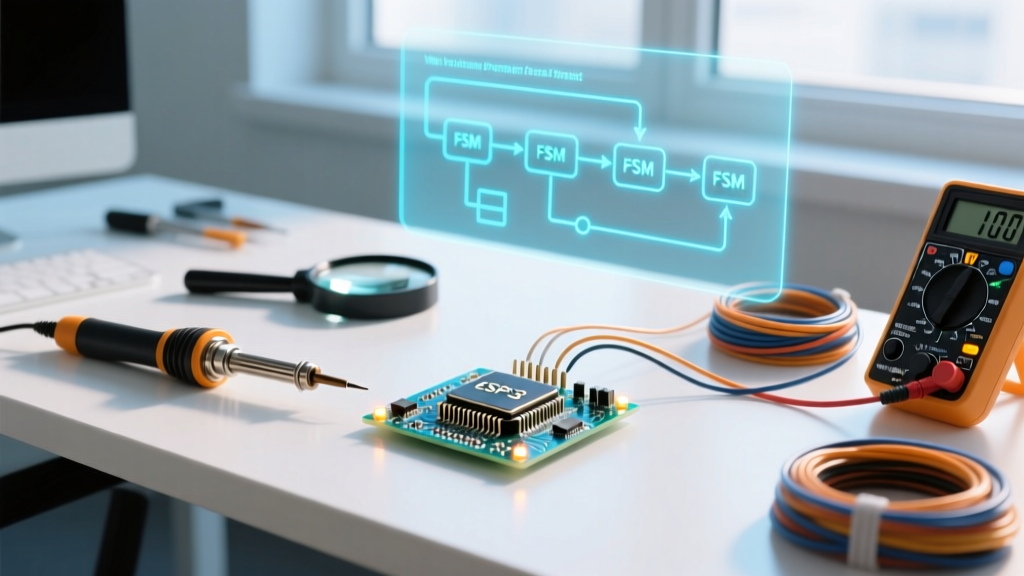
An FSM breaks your application logic into discrete states. Instead of waiting for time to pass, the loop() function continuously polls the current state and checks if a time threshold has been met. This ensures the main loop executes thousands of times per second, keeping I/O buffers clear.
- State Enumeration: Use an
enumto define states (e.g.,STATE_IDLE,STATE_SAMPLING,STATE_TRANSMITTING). This prevents 'magic numbers' in your code and improves readability. - Time Tracking: Store the last execution time in an
unsigned longvariable. Always use subtraction (currentMillis - previousMillis >= interval) to handle the 50-daymillis()rollover gracefully. - Switch-Case Execution: Use a
switchstatement to route execution. Keep the logic inside eachcaselean, delegating heavy processing to separate helper functions.
Expert Insight: Never put adelay()inside an FSM case. If a specific state requires a multi-second hardware settling time (like a relay coil energizing), transition to aSTATE_WAIT_SETTLEand use amillis()check to transition to the next state once the time elapses.
Memory Architecture: SRAM, Flash, and Heap Fragmentation
Introductory courses rarely discuss memory segmentation. On an AVR-based Arduino Uno R3 (ATmega328P), you are constrained to a mere 2 KB of SRAM. Mismanaging this leads to stack collisions and spontaneous reboots. Even on modern ARM Cortex-M or Xtensa architectures, understanding memory allocation is critical for long-term uptime.
The Danger of the Arduino String Class
The capitalized String object is a staple of beginner courses because it simplifies concatenation. However, it relies on dynamic heap allocation. On devices with limited SRAM, frequent creation and destruction of String objects causes heap fragmentation. Over days or weeks, the heap becomes Swiss cheese, and a request for a contiguous block of memory fails, crashing the device.
Best Practice: Abandon the String class in production firmware. Use fixed-size char arrays and standard C library functions like snprintf() to format payloads. This guarantees memory is allocated statically at compile time, entirely eliminating fragmentation risks.
Flash Storage and the F() Macro
When you write Serial.println("System Initialized");, the compiler copies that string literal from Flash memory into precious SRAM at boot. To prevent this, wrap string literals in the F() macro: Serial.println(F("System Initialized"));. This forces the microcontroller to read the string directly from PROGMEM. For complex data structures, refer to the official Arduino PROGMEM documentation to store lookup tables and large arrays in Flash.
Hardware Comparison: Matching Code Patterns to Silicon
The code patterns you employ must match the underlying silicon. A pattern that works on an 8-bit AVR will bottleneck a dual-core 32-bit ESP32.
| Microcontroller Board | Core Architecture | SRAM / Flash | Recommended Code Pattern | Typical 2026 Price |
|---|---|---|---|---|
| Arduino Uno R4 Minima | Renesas RA4M1 (ARM Cortex-M4) | 32 KB / 256 KB | Interrupt-driven I/O, DMA for ADC | $27.00 |
| Arduino Nano ESP32 | ESP32-S3 (Dual-core Xtensa) | 520 KB / 8 MB (PSRAM) | FreeRTOS Tasks, Queue-based IPC | $22.00 |
| Arduino Portenta H7 | STM32H747 (Dual Cortex-M7/M4) | 1 MB / 2 MB | Asymmetric Multicore (RPC), Edge AI | $110.00 |
| Legacy ATmega328P Clone | 8-bit AVR | 2 KB / 32 KB | Polling FSM, strict PROGMEM usage | $4.00 |
Interrupt Service Routines (ISRs) and Atomic Operations
Hardware interrupts are essential for capturing high-speed signals, such as rotary encoder pulses or anemometer wind speed clicks. However, courses often gloss over the strict rules governing Interrupt Service Routines (ISRs).
The Golden Rules of ISRs
- Keep it brief: An ISR should only set a flag or update a counter. Never use
Serial.print(),delay(), or I2C/Wire functions inside an ISR, as these rely on interrupts themselves and will cause a deadlock. - Use
volatile: Any variable modified inside an ISR and read in the main loop must be declared asvolatile. This tells the compiler not to cache the variable in a CPU register, ensuring the main loop always reads the latest value from SRAM. - Atomic Access: On 8-bit AVRs, reading a 16-bit or 32-bit
volatilevariable takes multiple clock cycles. If an interrupt fires mid-read, you will get corrupted data. Use theATOMIC_BLOCK(ATOMIC_RESTORESTATE)macro from the<util/atomic.h>library to temporarily disable interrupts while copying multi-byte variables into local scope.
Defensive Programming: Watchdog Timers (WDT)
In a laboratory setting, if your code hangs, you press the reset button. In a remote agricultural deployment monitoring soil moisture, a hung device means a truck roll costing hundreds of dollars. Production firmware must be self-healing.
Communication buses like I2C are notorious for locking up if a slave device experiences a voltage brownout and holds the SDA line low. To protect against this, implement a Watchdog Timer (WDT). The WDT is an independent hardware timer that will forcefully reset the microcontroller if it is not 'kicked' (reset) by your software within a specific timeframe.
Implementing a WDT Strategy
On AVR boards, you utilize the <avr/wdt.h> library, enabling a 2-second timeout (WDTO_2S). You then place wdt_reset() at the very end of your main loop(). If an I2C bus lockup causes the Wire library to enter an infinite while-loop, the WDT will trigger after 2 seconds, rebooting the system and clearing the fault.
For modern ESP32-based Arduino boards, the architecture relies on the ESP-IDF Task Watchdog Timer (TWDT), which monitors specific FreeRTOS tasks to ensure they are yielding properly, preventing a single runaway task from starving the system.
Modern Toolchains: Static Analysis and CI/CD
Finally, the way you write and compile code must evolve. The classic Arduino IDE is excellent for quick prototyping, but professional firmware development in 2026 relies on advanced toolchains like PlatformIO integrated into VS Code.
By adopting the Barr Group Embedded C Coding Standard, you can configure static analysis tools like Cppcheck or Clang-Tidy to run automatically before compilation. These tools catch implicit type conversions, uninitialized variables, and buffer overflows that the standard GCC compiler might only flag as warnings. Integrating this into a GitHub Actions CI/CD pipeline ensures that every commit to your repository is mathematically verified against embedded safety standards before it ever reaches the hardware.
Summary: The Mindset Shift
An introductory course teaches you how to make a microcontroller do something. Professional code patterns ensure the microcontroller keeps doing it, indefinitely, under adverse conditions. By abandoning blocking delays, respecting memory boundaries, utilizing atomic operations, and deploying hardware watchdogs, you elevate your projects from fragile classroom experiments to resilient, deployment-ready embedded systems.