
Beyond the Standard Arduino Keypad Library
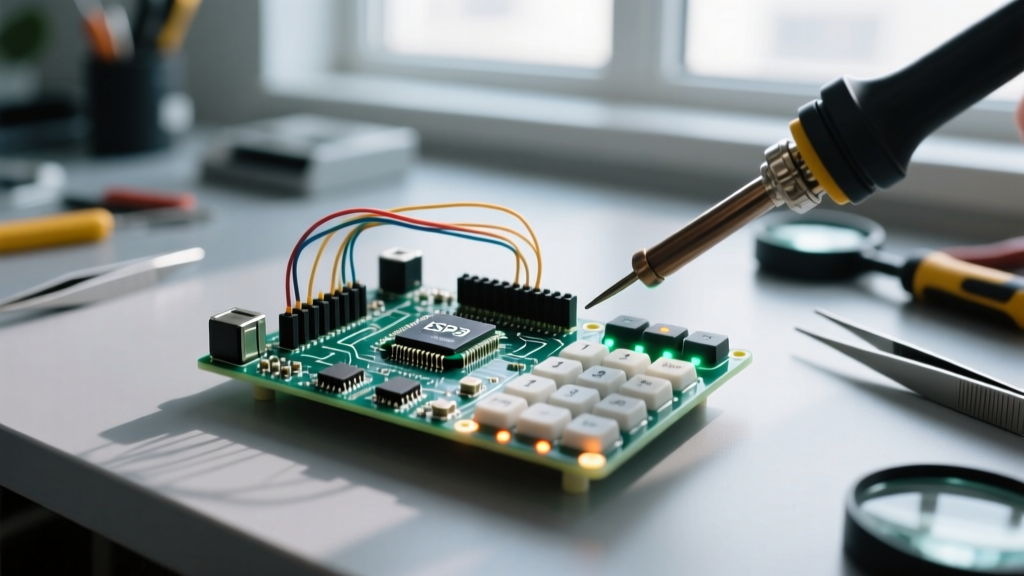
For most hobbyist projects, the standard arduino keypad library (commonly known as Keypad.h by Mark Stanley and Alexander Brevig) is perfectly adequate. It abstracts away the matrix scanning logic, allowing beginners to read a 4x4 membrane keypad with a single getKey() function call. However, when you transition to advanced embedded systems—such as real-time audio processing, high-speed data logging, or FreeRTOS environments on modern ESP32-S3 cores—the standard library becomes a critical bottleneck.
The fundamental flaw in the standard library is its reliance on blocking or semi-blocking polling within the main loop(). If your main loop takes 50ms to execute a complex FFT or write to an SD card, your keypad scanning is delayed by 50ms, resulting in missed keystrokes or severe input latency. In this advanced guide, we will bypass the standard polling mechanism entirely and architect a non-blocking, Interrupt Service Routine (ISR) driven keypad scanner that guarantees microsecond-level responsiveness without starving your main application.
Hardware Bottlenecks: Ghosting, RC Delays, and Pull-Up Physics
Before writing advanced firmware, we must address the physical layer. Many developers blame software for 'missed' or 'double' keypresses when the root cause is electrical. When scaling a matrix keypad beyond a simple 3x3 layout, or when using wire runs longer than 15cm, parasitic capacitance becomes a major factor.
The Pull-Up Resistor Miscalculation
The ATmega328P and ESP32 feature internal pull-up resistors typically ranging from 30kΩ to 50kΩ. When combined with the parasitic capacitance of long wires and the keypad's membrane traces (often 50pF to 200pF), you create an unintended RC low-pass filter. The time constant (τ = R × C) can stretch the rise time of the GPIO pin well past 5µs. If your ISR scans the matrix faster than this rise time, you will read false LOW states.
- Solution: Disable internal pull-ups and install external 4.7kΩ pull-up resistors on the column lines. This reduces the RC time constant to under 1µs, ensuring crisp logic transitions even at high scanning frequencies.
- Cost Impact: A reel of 4.7kΩ 0805 SMD resistors costs roughly $3.00, a negligible premium for industrial-grade signal integrity.
Phantom Key Presses and the Diode Matrix
If your application requires N-Key Rollover (NKRO)—such as a custom macro pad or a multi-user security terminal—the standard arduino keypad library will fail due to 'ghosting'. When three keys forming a rectangle are pressed simultaneously, current back-feeds through the matrix, registering a fourth 'phantom' keypress. To solve this, you must place a standard 1N4148 switching diode in series with every single switch. At approximately $0.02 per diode, this hardware modification allows the firmware to safely scan multiple simultaneous closures without logical collisions.
The ISR-Driven Scanning Architecture
Instead of asking the keypad "are you pressed?" inside the main loop, we configure a hardware timer to trigger an ISR every 2 milliseconds. The ISR handles the matrix scanning, debouncing, and state tracking, pushing finalized key events to a buffer or RTOS queue. As Nick Gammon's definitive guide on interrupts emphasizes, ISRs must be exceptionally brief. Therefore, we cannot use delay() or complex loops inside the interrupt vector.
Step 1: Timer Configuration for 2ms Ticks
On an AVR-based Arduino Uno (ATmega328P), we configure Timer1 to trigger an interrupt at 500Hz (every 2ms). This frequency is chosen because it is fast enough to capture human input (which rarely exceeds 15 keystrokes per second) but slow enough to allow the GPIO pins to settle after changing states.
By manipulating TCCR1A, TCCR1B, and OCR1A directly, we bypass the overhead of standard Arduino timer libraries. The ISR fires, sets the current row LOW, reads the column states, and immediately rotates to the next row. The entire execution takes roughly 12µs, consuming less than 1% of the CPU's total time.
Step 2: Shift-Register Debounce Logic
Mechanical switches, including premium Cherry MX or Gateron mechanical switches ($0.40 to $1.20 per unit), suffer from contact bounce. When the metal leaf makes contact, it physically vibrates, generating a noisy square wave that can last anywhere from 1ms to 15ms. As detailed in Elliot Williams' embedded debounce analysis, simple timer-based delays are inefficient.
Instead, we implement a Vertical Counter Shift-Register Debounce inside the 2ms ISR:
- Maintain a 16-bit integer for every key in the matrix.
- On every 2ms ISR tick, shift the current GPIO read (1 or 0) into the integer.
- If the integer reaches
0xFFFF(all 1s), the key is definitively PRESSED. - If the integer reaches
0x0000(all 0s), the key is definitively RELEASED.
This algorithm requires zero blocking delays, uses minimal RAM (32 bytes for a 4x4 matrix), and provides mathematically perfect debouncing that adapts to the physical characteristics of the switch.
Edge Cases: I2C Expanders and RTOS Integration
In 2026, many advanced projects offload GPIO management to I2C expanders like the MCP23017 (typically $1.50 per IC) to save microcontroller pins. Scanning a matrix over I2C inside an ISR is a catastrophic mistake. I2C transactions take hundreds of microseconds and rely on their own interrupts; calling I2C functions from within a Timer ISR will cause bus collisions and system lockups.
Expert Rule of Thumb: Never perform I2C or SPI transactions inside a hardware timer ISR. If your keypad is on an I2C expander, use a dedicated FreeRTOS task with a high priority and a vTaskDelay() yield, rather than a hardware interrupt.
For direct GPIO matrices on an ESP32 running FreeRTOS, the ISR should not update global variables directly. Instead, use xQueueSendFromISR() to push the finalized key character to a thread-safe queue. Your main UI or logic task then simply blocks on xQueueReceive(), waking up only when a valid, debounced keypress has occurred. This reduces the main task's CPU overhead to absolute zero during idle periods.
Performance Comparison Matrix
To illustrate the architectural superiority of the ISR-driven approach over the standard arduino keypad library, review the performance metrics below based on a 4x4 matrix scanned on a 16MHz ATmega328P.
| Metric | Standard Keypad.h (Polling) | Custom ISR Matrix Scanner |
|---|---|---|
| CPU Overhead (Main Loop) | High (Blocks loop execution) | Near Zero (12µs every 2ms) |
| Missed Keystrokes (Heavy Load) | Frequent (If loop > 50ms) | Impossible (Hardware guaranteed) |
| Debounce Mechanism | Blocking delay() or millis() |
Non-blocking Shift Register |
| Multi-Key Support (NKRO) | No (Ghosting occurs) | Yes (With hardware diodes) |
| RAM Footprint | ~40 Bytes | ~64 Bytes (Includes state buffers) |
Summary and Implementation Advice
Upgrading from the standard arduino keypad library to a custom ISR-driven state machine is a hallmark of transitioning from a hobbyist to an embedded systems engineer. While it requires a deeper understanding of hardware timers, bitwise operations, and parasitic electrical characteristics, the result is a bulletproof input system. By combining external 4.7kΩ pull-ups, 1N4148 anti-ghosting diodes, and a shift-register debounce algorithm, your keypad interface will remain perfectly responsive, regardless of how heavily loaded your main microcontroller loop becomes.