
The Role of an ISP Programmer in Arduino Development
While the Arduino Uno R3 is celebrated for its plug-and-play USB connectivity, relying solely on the onboard ATmega16U2 USB-to-Serial converter has distinct limitations. An external In-System Programmer (ISP) bypasses the serial bootloader entirely, communicating directly with the ATmega328P microcontroller via the SPI (Serial Peripheral Interface) protocol. This direct hardware connection is mandatory for burning bootloaders, modifying low-level AVR fuse bits, recovering bricked chips, and uploading raw hex files to reclaim the 1.5KB of flash memory typically reserved for the Optiboot bootloader.
When setting up an electronics lab in 2026, makers and engineers face a distinct fork in the road: the ultra-cheap clone market versus professional-grade debugging tools. This guide dissects the technical realities, failure modes, and long-term value of budget versus premium Arduino Uno programmer hardware.
The Budget Tier: Under $15 Solutions
The budget category is dominated by open-source hardware clones and clever repurposing of existing development boards. These tools are excellent for occasional bootloader burning but come with specific technical caveats.
USBasp V2.0 Clones
The USBasp is the undisputed king of the budget ISP world. Typically priced between $4 and $9 on global marketplaces, these green or blue PCBs utilize an internal ATmega8 or ATmega88 running custom firmware to act as a USB-to-SPI bridge.
- The Driver Nightmare: On modern Windows 11 environments, USBasp clones often require the Zadig utility to replace default HID drivers with
libusb-win32orWinUSB. Because these clone firmwares lack official digital signatures, users with Secure Boot enabled frequently encounter 'driver not recognized' errors, requiring tedious workaround steps. - The JP3 Slow-Clock Jumper: The ISP SCK (Serial Clock) speed must be strictly less than one-quarter of the target microcontroller's CPU frequency. If you are programming an ATmega328P configured for a 1MHz internal clock, the default 375kHz SCK of the USBasp will cause
avrdude: initialization failederrors. Authentic USBasps feature a JP3 jumper to drop the SCK to ~8kHz. Many ultra-cheap clones omit this jumper or fail to wire it to the microcontroller, rendering them useless for slow-clocked targets. - Voltage Intolerance: Standard USBasps output 5V logic. Connecting one directly to a 3.3V custom PCB without a level shifter will permanently damage the target silicon.
The 'Arduino as ISP' Method
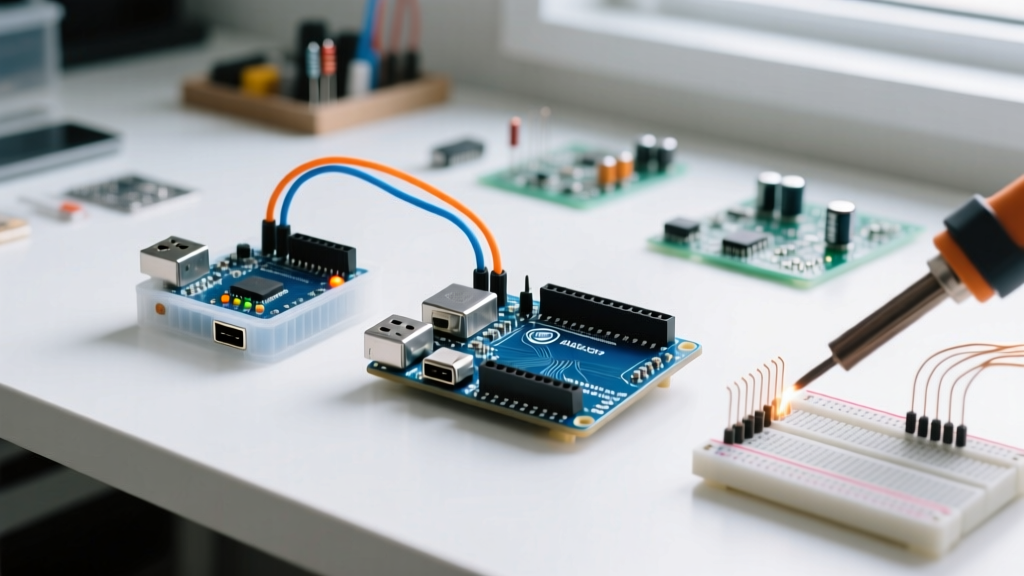
As detailed in the official ArduinoISP documentation, you can flash a spare Arduino Uno or Nano with a sketch that turns it into a makeshift ISP programmer. This costs exactly $0 if you already have a spare board.
However, this method is fundamentally bottlenecked by the host board's UART-to-USB baud rate (typically 19200 bps). Flashing a full 32KB sketch via 'Arduino as ISP' can take several minutes, compared to seconds on dedicated hardware. Furthermore, the host board's reset circuitry often interferes with the SPI handshake unless a 10µF capacitor is placed between the RESET and GND pins to disable the auto-reset feature.
The Premium Tier: Professional Reliability
Premium programmers are not just flash tools; they are hardware debuggers and development bridges designed for custom PCB fabrication, production environments, and complex troubleshooting.
Microchip Atmel-ICE Basic
Priced around $75 to $85, the Microchip Atmel-ICE is the industry standard for AVR development. While the 'Basic' kit includes only the debugger module and a basic cable, its capabilities dwarf budget alternatives.
- True Hardware Debugging: Unlike the USBasp, the Atmel-ICE supports debugWIRE and JTAG (on supported chips). This allows you to set hardware breakpoints, step through C++ code line-by-line in Microchip Studio, and inspect RAM registers in real-time without halting the CPU.
- Universal Voltage Translation: The Atmel-ICE features built-in level shifters. It senses the target's VCC (from 1.62V to 5.5V) and automatically translates its SPI logic signals to match, making it perfectly safe for both 5V Arduino Unos and 3.3V ARM Cortex-M0 custom boards.
- Future-Proofing: Beyond the Uno's ATmega328P, the Atmel-ICE supports PDI and UPDI interfaces, meaning it can program modern tinyAVR and megaAVR chips (like the ATmega4809) that budget ISP programmers cannot touch.
Pololu USB AVR Programmer v2
Sitting in the mid-to-premium tier at roughly $25, the Pololu USB AVR Programmer v2 is a masterclass in practical engineering. It solves the most common pain points of the USBasp while remaining affordable.
It features a user-configurable VCC regulator (1.8V to 5.5V), eliminating the need for external level shifters. Crucially, it includes a built-in USB-to-TTL serial adapter that shares the same USB port. When designing a custom PCB, you can use the Pololu to program the chip via ISP, and simultaneously monitor serial debug output without unplugging and swapping cables.
Specification and Pricing Matrix
| Programmer Model | Approx. Price (2026) | Target Voltage Support | Max ISP Speed | Serial Bridge Included? | Hardware Debugging |
|---|---|---|---|---|---|
| USBasp V2.0 (Clone) | $4 - $9 | 5V Only (Fixed) | 375 kHz | No | No |
| Arduino as ISP | $0 (Requires spare board) | 5V / 3.3V (Depends on host) | ~10 kHz (UART bottleneck) | Yes (via host) | No |
| Pololu USB AVR v2 | $25 | 1.8V - 5.5V (Adjustable) | 3 MHz | Yes (Simultaneous) | No |
| Microchip Atmel-ICE | $75 - $85 | 1.62V - 5.5V (Auto-sensing) | 5 MHz+ | No (Dedicated debug) | Yes (debugWIRE/JTAG) |
Edge Case Analysis: Recovering a Bricked ATmega328P
The true test of an Arduino Uno programmer is not when things go right, but when a user accidentally modifies the AVR fuse bits and 'bricks' the microcontroller. A common disaster occurs when a user attempts to disable the external 16MHz crystal oscillator via software, setting the Low Fuse byte to 0xE2 (Internal 8MHz RC oscillator) but forgets to update the boards.txt upload speed. The chip is perfectly fine, but the Arduino IDE is trying to talk to it at the wrong baud rate, resulting in a stk500_recv() programmer is not responding error.
Expert Recovery Insight: If you accidentally set the fuses to expect an external crystal oscillator (Low Fuse 0xFF) but the physical crystal on your custom PCB is broken or missing, the ATmega328P will not generate a clock signal. Without a clock, the SPI state machine is dead, and no programmer in the world can connect via ISP.
The Budget Fix: You must physically inject a square wave clock signal (between 1MHz and 8MHz) directly into Pin 9 (XTAL1) of the DIP chip using a secondary oscillator or a 555 timer circuit, while simultaneously using the USBasp to rewrite the fuses back to the internal RC oscillator.
The Premium Fix: Tools like the Atmel-ICE, when paired with advanced parallel programming adapters or specific UPDI/PDI recovery routines, can sometimes negotiate slow-clock recovery modes that budget SPI bridges simply lack the hardware timing precision to execute. Furthermore, premium tools log exact SPI handshake failure codes in Microchip Studio, telling you exactly why the chip isn't responding (e.g., 'Target VCC missing' vs 'No clock detected'), saving hours of blind troubleshooting.
The 2x3 ICSP Header: A Warning on Pinouts
Regardless of whether you buy a $5 clone or an $80 Atmel-ICE, the physical connection relies on the standard 2x3 ICSP header. The pinout is strictly defined:
- MISO (Master In Slave Out)
- VCC (Target Power)
- SCK (Serial Clock)
- MOSI (Master Out Slave In)
- RESET (Active Low)
- GND (Ground)
Critical Failure Mode: Budget ribbon cables often lack a clear polarity indicator. If you plug the cable in reversed, you are directly shorting the programmer's VCC to the target's GND, and sending 5V straight into the MISO pin. The Pololu v2 and Atmel-ICE feature overcurrent protection and will shut down gracefully, flashing a red error LED. A cheap USBasp will simply fry its internal ATmega8 or damage the target Uno's microcontroller instantly.
Final Verdict: Matching the Tool to the Project
If your goal is strictly to revive an old Arduino Uno with a corrupted bootloader, or you are a student on a strict budget, the USBasp V2.0 remains a highly capable, albeit slightly frustrating, entry point. Just ensure you verify the presence of the JP3 slow-clock jumper before purchasing.
However, if you are designing custom PCBs, working with mixed-voltage logic (3.3V sensors and 5V microcontrollers), or require simultaneous serial debugging without juggling multiple USB cables, the Pololu USB AVR Programmer v2 is the ultimate sweet spot for serious DIYers. For professional firmware engineers requiring hardware breakpoints, RAM inspection, and seamless integration with modern IDEs, the Microchip Atmel-ICE is an indispensable, non-negotiable investment.