
The Core Dilemma: Divergent Ecosystem Paths
When makers and engineers evaluate the Arduino Uno vs Nano, the conversation often stalls on basic physical dimensions. However, in 2026, this comparison is no longer just about the legacy ATmega328P microcontroller in two different footprints. It is a choice between two fundamentally different hardware ecosystems. The Uno family has evolved into a desktop-centric, shield-compatible prototyping powerhouse, while the Nano family has transformed into a diverse, space-constrained IoT and embedded deployment platform.
Understanding these ecosystem differences is critical. Selecting the wrong form factor can lead to shield incompatibility, thermal throttling on power rails, or fried GPIO pins due to logic level mismatches. This guide provides a deep-dive ecosystem overview to help you select the right board architecture for your specific application.
Physical Footprint and Prototyping Realities
The most immediate difference remains physical, but the implications extend far beyond simple size.
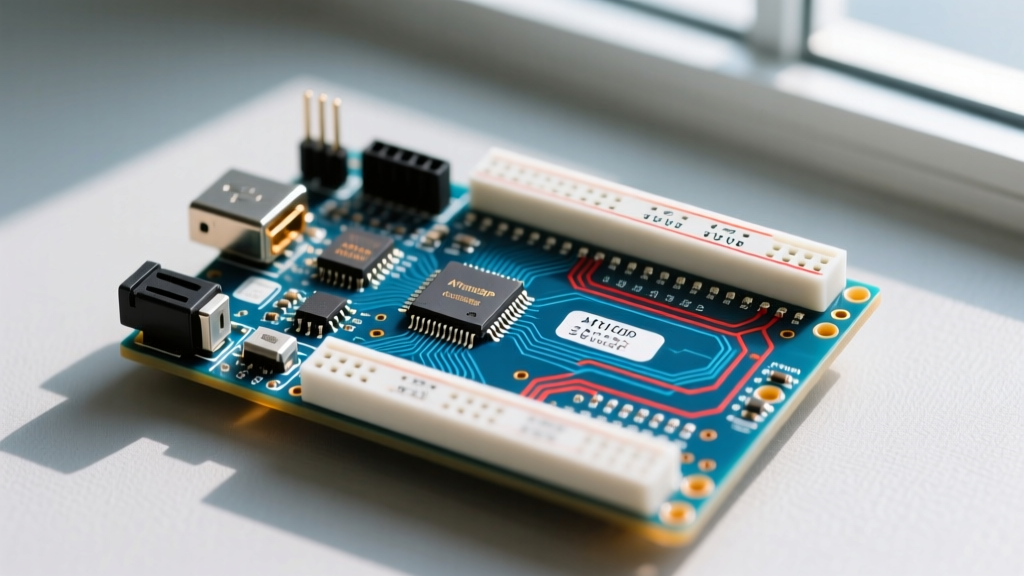
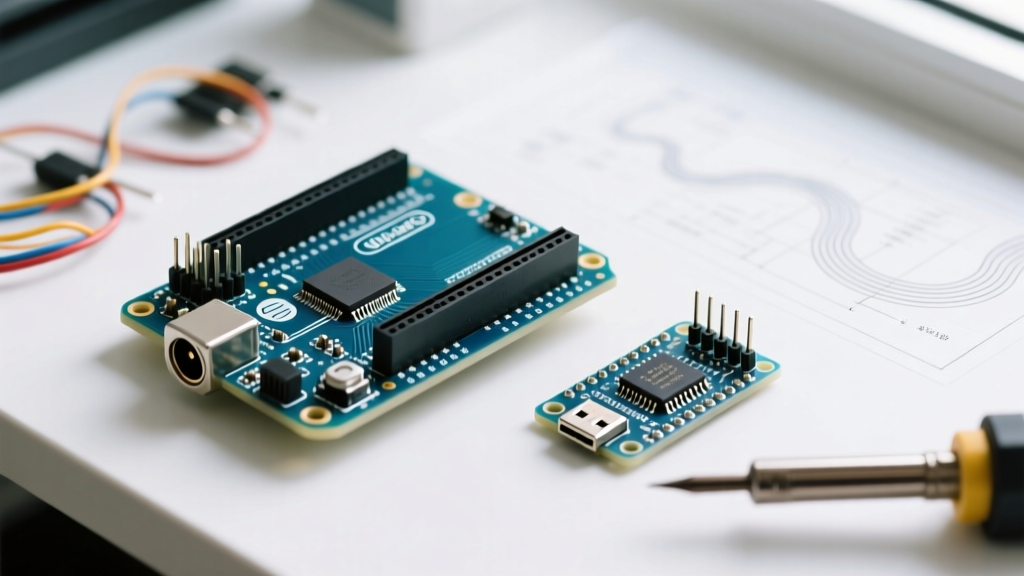
- Arduino Uno (68.6 x 53.4 mm): The standard footprint is designed for stability and expansion. It features four mounting holes and perfectly aligns with standard Arduino shields. For breadboarding, the Uno is too wide to sit directly on a standard solderless breadboard; it requires a dedicated prototyping shield or male-to-female jumper wires.
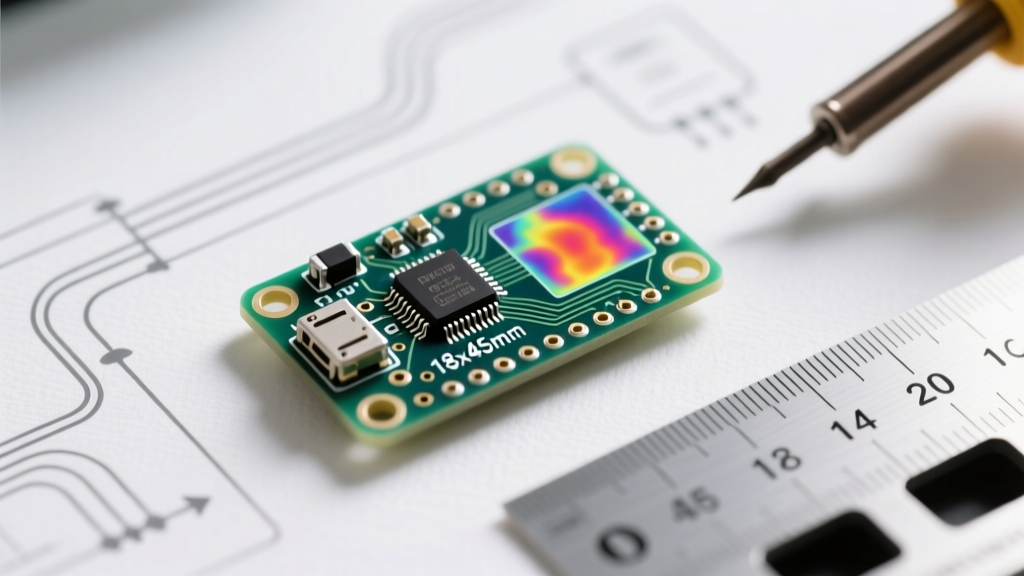
- Arduino Nano (45 x 18 mm): The Nano is engineered to plug directly into a standard solderless breadboard. However, it straddles the center trench, leaving only a single row of holes available on either side for component insertion. This makes complex, multi-component breadboard prototyping frustrating without the use of Nano expansion shields or custom PCBs.
The Modern Uno Ecosystem: Desktop and Shield Dominance
The Uno ecosystem is built around the concept of stackability and education. With the release of the Uno R4 Minima ($19.50) and Uno R4 WiFi ($27.50), the platform transitioned from 8-bit AVR to a 32-bit ARM Cortex-M4 architecture powered by the Renesas RA4M1. According to the official Arduino Uno R4 WiFi documentation, this shift brought a massive leap in processing power (48 MHz clock speed, 256 KB Flash, 32 KB SRAM) while maintaining strict 5V logic and legacy shield compatibility.
Ecosystem Advantages
- Shield Stacking: The standardized 14-pin digital and 2x8-pin analog/power header layout means thousands of third-party motor drivers, GPS modules, and relay shields fit perfectly without wiring harnesses.
- Robust Power Delivery: The Uno R4 features a beefier power regulation stage capable of handling wider input voltages and delivering more current to external peripherals via the 5V pin compared to the Nano.
- Native HID Support: The RA4M1 chip natively supports USB HID, allowing the Uno R4 to act as a keyboard or mouse without the complex firmware workarounds required on older AVR boards.
The Modern Nano Ecosystem: Embedded, IoT, and Wearables
If the Uno is the workbench, the Nano is the field deployer. The Nano ecosystem has fractured into specialized boards targeting distinct connectivity and processing needs. The classic Nano Every ($11.00) handles basic 8-bit tasks, but the real power lies in the 32-bit variants.
Boards like the Nano 33 IoT ($18.00), Nano RP2040 Connect ($21.50), and the incredibly popular Nano ESP32 ($21.00) dominate the IoT space. The Arduino Nano ESP32, for instance, utilizes the dual-core ESP32-S3, offering native Wi-Fi and Bluetooth 5.0, making it the undisputed king of wireless sensor nodes.
Ecosystem Advantages
- Permanent Integration: The Nano's DIP-30 footprint makes it ideal for soldering directly onto custom PCBs or perfboards for permanent installations.
- Specialized Silicon: Instead of a one-size-fits-all approach, the Nano ecosystem offers boards with dedicated cryptographic chips (ATECC608A on the 33 IoT) or specialized AI accelerators.
- Low-Profile Deployments: Essential for wearables, drone telemetry, and hidden environmental sensors where the bulk of an Uno is physically prohibitive.
Hardware Specification Matrix: 2026 Lineup
To illustrate the divergence in the ecosystems, here is a comparison of the current flagship and legacy boards across both form factors.
| Feature | Uno R4 WiFi | Nano ESP32 | Classic Uno R3 | Classic Nano V3 |
|---|---|---|---|---|
| Microcontroller | Renesas RA4M1 (ARM Cortex-M4) | ESP32-S3 (Dual-core Xtensa LX7) | ATmega328P (8-bit AVR) | ATmega328P (8-bit AVR) |
| Clock Speed | 48 MHz | 240 MHz | 16 MHz | 16 MHz |
| Flash / SRAM | 256 KB / 32 KB | 8 MB / 512 KB | 32 KB / 2 KB | 32 KB / 2 KB |
| Native Wireless | Wi-Fi 4, Bluetooth 5.1 | Wi-Fi 4, Bluetooth 5.0 | None | None |
| Logic Voltage | 5V (5V tolerant I/O) | 3.3V (Strict) | 5V | 5V |
| Approx. Price | $27.50 | $21.00 | $27.00 (Legacy) | $22.00 (Legacy) |
Note: Pricing reflects official Arduino store MSRP. Third-party clones are significantly cheaper but often lack quality control on voltage regulators and USB bridges.
Power Delivery and Thermal Failure Modes
A critical, often overlooked aspect of the Arduino Uno vs Nano debate is how they handle power. Both form factors rely on linear voltage regulators to step down external DC input to 5V, but their thermal mass dictates their failure modes.
The Nano Thermal Bottleneck
The classic Nano uses a micropackage linear regulator (often a MIC5205 or similar clone equivalent). Because the PCB footprint is tiny, there is virtually no copper pour area to act as a heatsink. If you supply 9V via the VIN pin and attempt to draw 150mA from the 5V pin to power a small servo or an OLED display, the regulator will dissipate roughly 0.6W of heat. This will rapidly trigger the regulator's internal thermal shutdown, causing the board to brownout and reset continuously.
The Uno's Thermal Advantage
The Uno utilizes a larger SOT-223 package regulator (like the NCP1117) and has a significantly larger ground plane to dissipate heat. While still inefficient compared to a switching buck converter, the Uno can safely sustain higher current draws from the 5V rail before thermal throttling occurs. For projects requiring multiple 5V sensors or relays, the Uno's power ecosystem is vastly superior without requiring external power modules.
Logic Level Edge Cases: The 3.3V Trap
As the ecosystem has modernized, the Renesas RA4M1 architecture in the Uno R4 maintained 5V tolerance to ensure legacy 5V shields wouldn't destroy the new 32-bit silicon. The Uno ecosystem remains largely 5V-centric.
Conversely, the modern Nano ecosystem (specifically the Nano ESP32, Nano 33 BLE, and Nano RP2040) operates strictly at 3.3V logic. This creates a massive edge case for migrating users:
Warning: Connecting a standard 5V I2C sensor (like the common HC-SR04 ultrasonic sensor or older 5V LCD backpacks) directly to the GPIO pins of a Nano ESP32 will back-feed 5V into the 3.3V silicon, permanently destroying the microcontroller's input buffers. You must use a bidirectional logic level shifter (such as a BSS138 MOSFET-based module) when bridging legacy 5V components to modern Nano IoT boards.
Final Decision Framework
Choose your ecosystem based on the deployment environment, not just the price tag.
Choose the Arduino Uno Ecosystem If:
- You are rapidly prototyping on a desk using off-the-shelf shields.
- Your project requires 5V logic compatibility with legacy industrial sensors or automotive relays.
- You are building an educational curriculum where physical robustness and standardized stacking are required.
- You need to draw moderate current (up to 300mA) directly from the onboard 5V regulator.
Choose the Arduino Nano Ecosystem If:
- You are designing a custom PCB and need to socket or solder the microcontroller directly.
- Your project is an IoT edge node requiring native Wi-Fi, Bluetooth, or MQTT connectivity (via Nano ESP32 or RP2040 Connect).
- Space and weight are at a premium, such as in UAVs, wearables, or hidden home-automation nodes.
- You are comfortable managing 3.3V logic level translation and external power regulation for high-current peripherals.
Ultimately, the Arduino Uno vs Nano decision is a choice between modularity and integration. The Uno remains the undisputed champion of the workbench, while the Nano has evolved into the premier silicon engine for embedded, connected devices.