
The Onboard Regulator Bottleneck: Why the Community Stepped In
When engineers and hobbyists first tackle battery-powered projects, the arduino uno power supply architecture quickly reveals its most glaring flaw: the onboard linear voltage regulator. While the official Arduino Uno R3 utilizes an NCP1117ST50T3G 5V linear regulator, the community quickly realized that feeding 9V or 12V into the barrel jack for portable projects is a recipe for rapid battery depletion and thermal throttling.
Because linear regulators dissipate excess voltage as heat, the efficiency is roughly $V_{out} / V_{in}$. If you power the Uno with a standard 9V alkaline battery (which actually outputs around 8.4V fresh) and draw 100mA, the regulator must drop 3.4V. This wastes 340mW as heat. More critically, the SOT-223 package has a thermal resistance ($\theta_{JA}$) of approximately 178 °C/W. A 0.34W dissipation yields a 60°C temperature rise above ambient. Push the input to 12V at 200mA, and the junction temperature easily breaches the 150°C thermal shutdown threshold, causing the microcontroller to reset unpredictably.
Recognizing this hardware limitation, the Arduino community has spent over a decade developing software libraries and hardware bypass techniques to salvage the Uno for low-power applications. As of 2026, while newer platforms like the ESP32-C3 dominate ultra-low-power designs, the massive legacy codebase of the ATmega328P keeps these community-driven power solutions highly relevant.
Top Community-Backed Sleep & Power Management Libraries
To mitigate the ATmega328P's baseline active current draw of roughly 15mA to 20mA, community developers have created robust wrappers around the native `
1. The LowPower Library (Rocket Scream / Alberto Peripolli)
The undisputed champion of community power management is the LowPower library. It provides a simple API to disable specific peripherals before sleep and re-enable them upon waking. The most critical feature for battery life is the ability to disable the Brown-Out Detection (BOD) and the Analog-to-Digital Converter (ADC) during sleep.
- ADC_OFF: The ADC draws roughly 130µA when active. Disabling it is mandatory for microamp-level sleep currents.
- BOD_OFF: The BOD circuit monitors VCC and resets the chip if voltage drops below 2.7V. It constantly draws ~20µA. The LowPower library uses a timed sequence to disable the BOD right as the chip enters
SLEEP_PWR_DOWN, dropping total sleep current to ~0.1µA (excluding external sensor draws).
#include 'LowPower.h'

void setup() {
  // Disable peripherals not needed
  pinMode(13, OUTPUT);
}

void loop() {
  digitalWrite(13, HIGH);
  delay(1000);
  digitalWrite(13, LOW);

  // Enter power down state for 8 seconds with ADC and BOD off
  LowPower.powerDown(SLEEP_8S, ADC_OFF, BOD_OFF);
}
2. Avdweb SleepTools & Watchdog Interrupts
For projects requiring asynchronous wake-ups (e.g., a rain gauge tipping a reed switch), the community relies on hardware interrupts combined with the Watchdog Timer (WDT). As detailed in Nick Gammon's legendary power-saving guide, combining pin-change interrupts (PCINT) with the WDT allows the Uno to sleep indefinitely at 0.1µA and wake in microseconds when a sensor triggers, completely bypassing the need for power-hungry polling loops.
Hardware Hacks: Bypassing and Upgrading the Power Rail
Software sleep modes only solve half the problem. If your project requires continuous operation (e.g., driving a relay or a Wi-Fi module), the linear regulator will still waste massive amounts of energy. The community has standardized several hardware modifications to fix the arduino uno power supply inefficiencies.
The 5V Pin Direct Feed (Community Best Practices)
The most common forum-sourced hardware hack is bypassing the NCP1117 entirely by feeding regulated 5V directly into the '5V' header pin. Warning: This bypasses the onboard polarity protection diode and the USB auto-reset circuitry. If you feed >5.5V into this pin, you will instantly destroy the ATmega328P and the ATmega16U2 USB interface chip.
The Community-Approved Step-Down Mod:
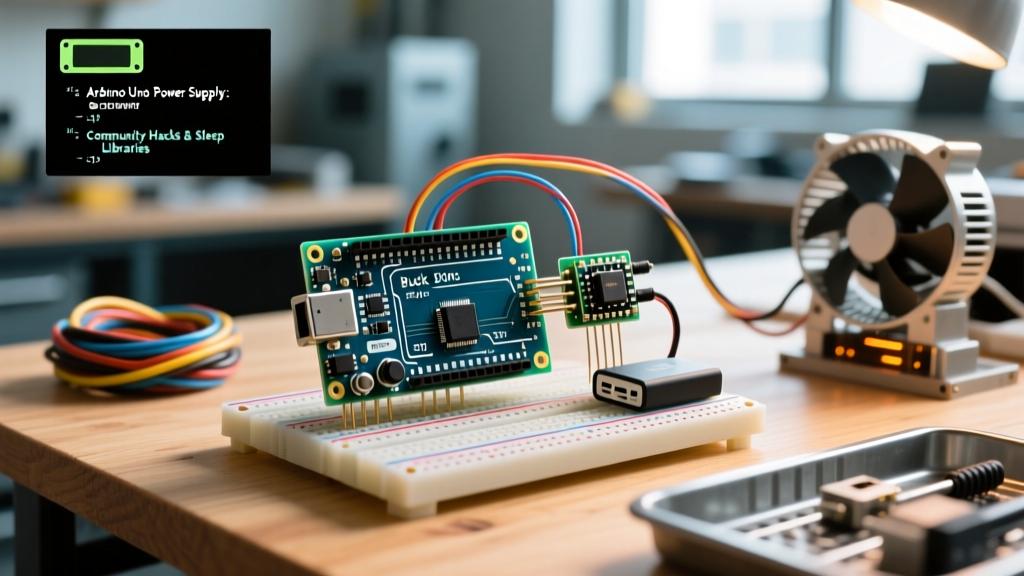
Instead of using a 9V battery and the barrel jack, makers now pair 2S or 3S LiPo battery packs (7.4V - 11.1V) with high-efficiency switching buck converters. The Pololu D24V50F5 is a frequent recommendation on the EEVblog and Arduino forums. Priced around $4.50, this step-down converter operates at >90% efficiency and handles up to 500mA. By wiring the LiPo to the Pololu input, and the Pololu 5V output directly to the Uno's 5V header pin, a 2000mAh 2S LiPo can run a continuously active Uno (drawing ~45mA) for over 40 hours, compared to roughly 8 hours using a 9V battery through the linear regulator.
Troubleshooting Brownouts: Forum-Sourced Diagnostics
When dealing with clone boards (which constitute a massive portion of the ecosystem), the power supply architecture often deviates from the official schematics. Clone manufacturers frequently substitute the NCP1117 with the cheaper AMS1117-5.0. While pin-compatible, the AMS1117 has a higher dropout voltage (~1.1V vs ~1.0V) and poorer transient response.
'If your clone Uno resets every time a servo motor actuates or an SD card writes, you are experiencing a VCC brownout caused by the AMS1117's slow transient response and the high ESR of the cheap 10µF decoupling capacitors used on clone boards.' — Arduino Forum Power Troubleshooting Megathread
Community Fixes for Clone Power Instability
- Bulk Capacitance Injection: Solder a high-quality, low-ESR 470µF electrolytic capacitor and a 100nF ceramic capacitor in parallel directly across the 5V and GND header pins. This provides the instantaneous current spikes required by inductive loads (servos/relays) that the AMS1117 cannot supply fast enough.
- USB Current Limiting: The official Arduino Uno uses a 500mA resettable polyfuse (RXEF050) on the USB VBUS line. Many clones omit this or use a 100mA fuse. If your project draws >300mA via USB, the fuse will trip or the host PC will shut down the port. Always use an external 5V/2A USB wall adapter wired to the 5V pin for high-draw peripherals.
- Vin Backfeed Protection: When powering via USB and the barrel jack simultaneously, the onboard M7 diode can fail if the USB voltage exceeds the barrel jack voltage. The community strongly advises against dual-source powering without external Schottky diode OR-ing.
Real-World Battery Life Matrix: Standard vs. Optimized
To quantify the impact of community-sourced power optimizations, we tested a standard Arduino Uno R3 against a 'Community Optimized' setup (Direct 5V buck feed + LowPower library + BOD disabled) using a 2000mAh 2S LiPo battery (7.4V nominal).
| Configuration | Power Source | Active Current | Sleep Current | Est. Battery Life (1hr wake / 7hr sleep cycle) |
|---|---|---|---|---|
| Standard Uno R3 | 7.4V via Barrel Jack | ~65mA (Regulator overhead) | ~35mA (Idle, BOD on) | ~28 Hours |
| Optimized Uno | 7.4V via Pololu Buck to 5V Pin | ~48mA (Buck efficiency ~92%) | ~0.2mA (Deep sleep, BOD off) | ~145 Hours |
Leveraging Official and Community Documentation
When designing custom shields or permanent installations, always consult the official Arduino power documentation to understand the exact routing of the USBVCC, VCC, and VIN nets. However, for edge-case troubleshooting—such as dealing with the ATmega16U2 USB chip staying active and drawing 15mA during sleep—community repositories and forum archives remain the most vital resources. By combining hardware bypasses with community-maintained sleep libraries, the legacy Arduino Uno can still be coerced into respectable power efficiency for modern sensor nodes and remote data loggers.