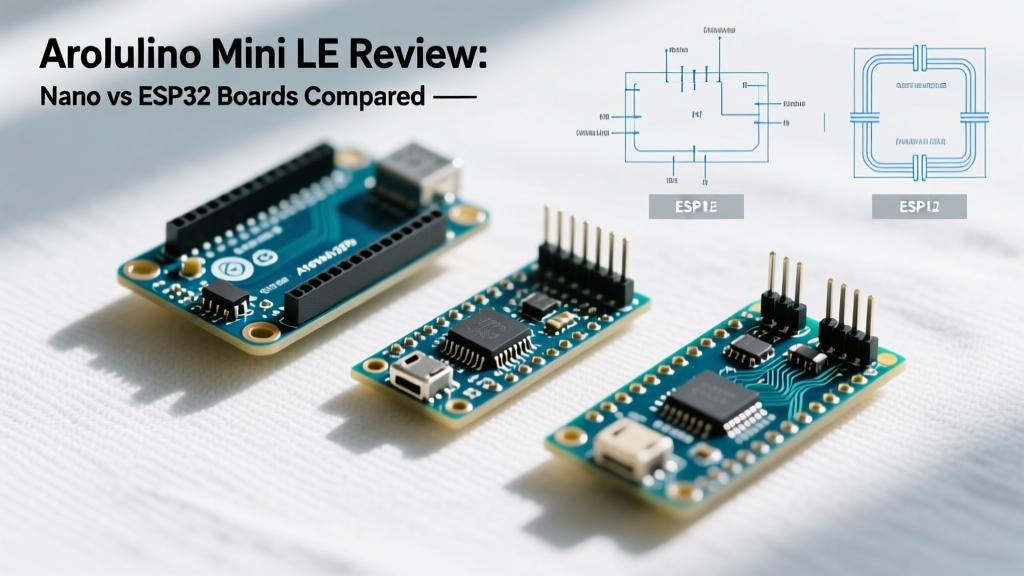

Decoding the 'Arduino Uno Mini' Search Intent
When makers and engineers search for an 'Arduino Uno Mini', they are typically navigating a intersection of nostalgia, form-factor constraints, and naming confusion. Strictly speaking, there is no mass-production board officially named the 'Arduino Uno Mini.' Instead, this search intent usually points to one of three things: the highly coveted Arduino UNO Mini Limited Edition (LE), the ubiquitous Arduino Nano (the functional equivalent of a mini Uno), or the modern desire for a compact powerhouse like the Arduino Nano ESP32.
In this comprehensive 2026 board review and comparison, we will dissect the actual Arduino UNO Mini LE (SKU: ABX00049), evaluate its viability for serious prototyping, and stack it up against the practical Nano alternatives to help you choose the right compact microcontroller for your next embedded project.
The Collector's Anomaly: Arduino UNO Mini LE (ABX00049)
Released to celebrate the 10th anniversary of the Arduino UNO, the Arduino UNO Mini LE is a marvel of dense PCB routing. Measuring a microscopic 34.4 x 25.7 mm, it shrinks the classic UNO footprint by roughly 70% while retaining the core ATmega328P architecture.
Hardware Specifications and Quirks
- Microcontroller: ATmega328P (8-bit AVR, 16 MHz)
- Memory: 32 KB Flash, 2 KB SRAM, 1 KB EEPROM
- I/O Pins: 14 Digital (6 PWM), 6 Analog
- Power: USB-C (5V), no external barrel jack
- Mounting: Gold-plated castellated holes for direct PCB soldering
While the black solder mask and gold-plated castellated edges make it a stunning display piece, the UNO Mini LE presents severe mechanical challenges for standard prototyping. Because it is shorter than a standard solderless breadboard's power rail span, you cannot plug it directly into a breadboard and access all pins simultaneously without a custom breakout shield or surface-mount adapter.
Expert Insight: As of 2026, the UNO Mini LE is strictly a secondary-market collector's item. Originally priced at $45, sealed units now routinely fetch $75 to $90 on auction sites. For production or iterative prototyping, we strongly advise looking at the Nano family instead.
The Practical Contenders: Nano Classic vs. Nano ESP32
If your goal is miniaturization without the collector's premium, the Arduino Nano ecosystem offers far superior utility. We are comparing the classic Arduino Nano (ATmega328P) against the modern IoT powerhouse, the Arduino Nano ESP32 (ABX00092).
Head-to-Head Comparison Matrix
| Feature | UNO Mini LE (ABX00049) | Nano Classic (ATmega328P) | Nano ESP32 (ABX00092) |
|---|---|---|---|
| Form Factor | 34.4 x 25.7 mm | 45 x 18 mm | 45 x 18 mm |
| Processor | ATmega328P (8-bit) | ATmega328P (8-bit) | ESP32-S3 (Dual-core 32-bit) |
| Clock Speed | 16 MHz | 16 MHz | 240 MHz |
| Flash / SRAM | 32 KB / 2 KB | 32 KB / 2 KB | 8 MB / 512 KB |
| Connectivity | None | None | Wi-Fi 802.11 b/g/n, BLE 5.0 |
| Logic Voltage | 5V | 5V | 3.3V |
| USB Interface | USB-C (Native/Bridge) | Mini-USB / Micro-USB | USB-C (Native) |
| 2026 Street Price | ~$80 (Secondary) | ~$22 - $26 | ~$21 - $25 |
The Arduino Nano ESP32 has effectively rendered the classic 8-bit Nano obsolete for new IoT designs, offering dual-core processing, native USB-C, and wireless capabilities for less than the cost of a classic Nano.
Power Architecture and Logic Level Edge Cases
When downsizing from a full-sized UNO to a 'Mini' or Nano footprint, power delivery and logic levels are the most common failure points for intermediate makers.
Voltage Regulation Realities
The full-sized Arduino UNO R3 and R4 utilize robust linear regulators and dedicated power paths capable of sourcing up to 800mA (depending on the board revision and thermal limits). The UNO Mini LE and Nano boards, constrained by their tiny PCB surface area, have severe thermal limitations regarding onboard voltage regulation.
- 5V Pin Sourcing: When powered via USB-C on the UNO Mini LE or Nano ESP32, the 5V pin is tied directly to the USB VBUS. You can safely draw up to 500mA, provided your host USB port supports it and your traces don't overheat.
- 3.3V Output Limits: The onboard 3.3V regulators on these compact boards are typically rated for a maximum of 50mA to 150mA. Attempting to power an external OLED display and an RF transceiver simultaneously from the Nano's 3.3V pin will cause brownouts and erratic MCU resets.
The 5V vs. 3.3V Logic Shifting Trap
A critical edge case arises when mixing the 5V logic of the UNO Mini LE (or classic Nano) with modern 3.3V sensors. Feeding a 5V digital output from the ATmega328P directly into a 3.3V I2C sensor (like the BME280) will slowly degrade the sensor's internal protection diodes, leading to premature failure.
Solution: Always use a bidirectional logic level shifter, such as the TXB0108 or a simple BSS138 MOSFET-based breakout, when interfacing the 5V 'Mini' boards with modern 3.3V peripherals. If you want to avoid this hardware overhead entirely, the 3.3V native logic of the Nano ESP32 is a major architectural advantage.
Mechanical Integration: Breadboards vs. Custom PCBs
How you physically mount your microcontroller dictates which 'Mini' board you should select.
Solderless Breadboard Prototyping
The Arduino Nano (both Classic and ESP32) is explicitly designed for standard 830-point or 400-point solderless breadboards. When plugged in across the center trench, exactly one row of holes is exposed on either side for jumper wires. Warning: Many third-party clone Nanos use a wider pin spacing (0.6 inches instead of the standard 0.3-inch trench span), which will not fit into quality breadboards like those from SparkFun or Bus Pirate. Always verify the 0.3-inch trench compatibility when sourcing clones.
Permanent SMD Integration
If you are transitioning from a breadboard prototype to a permanent, hand-soldered custom PCB, the UNO Mini LE is unmatched. Its castellated holes allow you to solder it flush to your board like a surface-mount IC, saving vertical clearance in tight enclosures. However, designing a custom PCB for the Nano ESP32 using standard through-hole headers is generally easier and more forgiving for hobbyists using toner-transfer or entry-level CNC routing methods.
Verdict: Which Compact Board Should You Choose in 2026?
Your choice of an 'Arduino Uno Mini' equivalent depends entirely on your project lifecycle phase:
- For the Collector / Display Builder: The UNO Mini LE is a beautiful piece of engineering history. Buy it, frame it, or use it in a permanent, space-constrained 5V art installation where cost is irrelevant.
- For Rapid IoT Prototyping: The Nano ESP32 is the undisputed champion. At ~$23, it offers native USB-C, Wi-Fi/BLE, and MicroPython/Arduino IDE compatibility, making it the most versatile compact board on the market.
- For Legacy 5V Sensor Integration: Stick to the Classic Nano (ATmega328P). Its 5V logic natively supports older industrial sensors and 5V LCD character displays without requiring logic shifters.
Ultimately, while the 'Arduino Uno Mini' name evokes the desire for a shrunken UNO, the modern Nano ecosystem—specifically the ESP32 variant—delivers the compact power that today's electrical engineers and DIYers actually require.
Frequently Asked Questions (FAQ)
Can I use the standard Arduino UNO bootloader on the UNO Mini LE?
Yes. The UNO Mini LE ships with the standard Optiboot bootloader. It appears in the Arduino IDE as a standard UNO, meaning any sketch compiled for the UNO R3 will work flawlessly on the Mini LE, provided it does not rely on the physical placement of standard shield headers.
Does the Nano ESP32 support 5V tolerant GPIOs?
No. The ESP32-S3 chip on the Nano ESP32 is strictly 3.3V. Applying 5V to any GPIO pin (including analog inputs) will permanently damage the silicon. Use a voltage divider or logic level shifter for 5V signal integration.
Why doesn't the UNO Mini LE have an external power jack?
To maintain the 34.4 x 25.7 mm footprint, the engineering team at Arduino eliminated the barrel jack and the heavy linear regulator. Power must be supplied via the USB-C port or directly through the 5V and GND castellated pads.