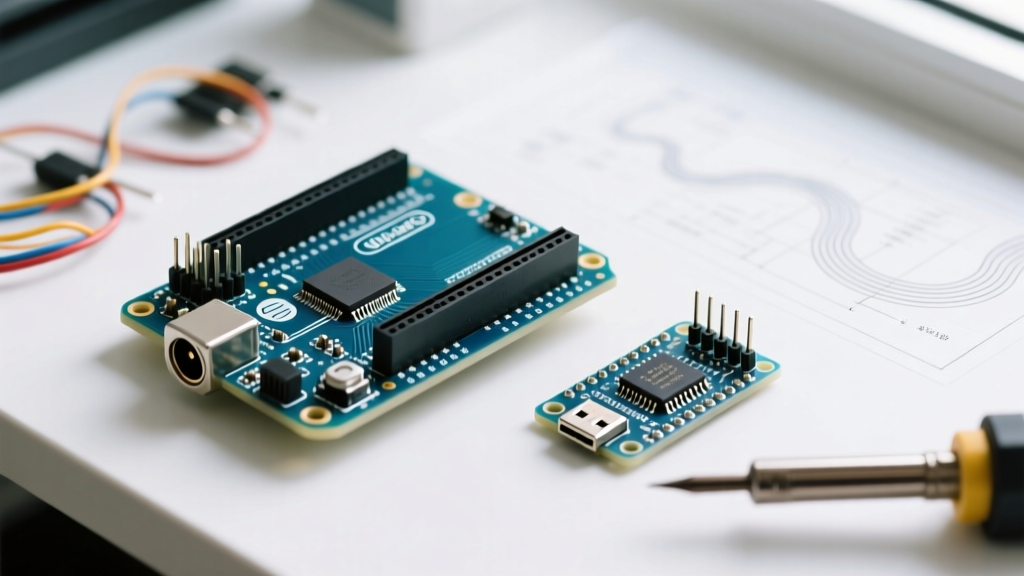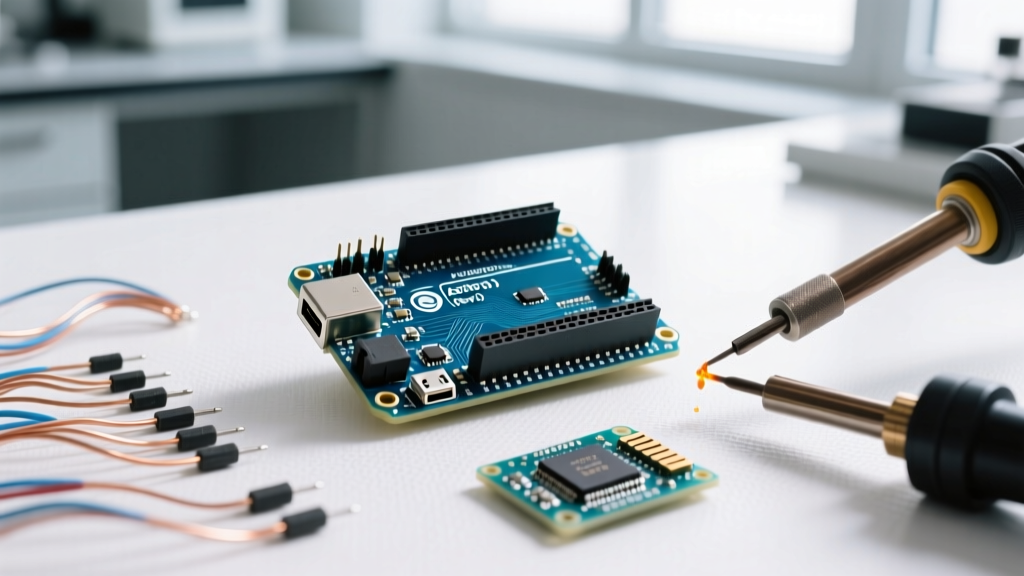

The "Arduino Uno 3" Misnomer: Understanding the Rev3 Legacy
When makers and engineers search for the Arduino Uno 3, they are almost universally referring to the legendary Arduino Uno Rev3. Despite the release of 32-bit ARM Cortex-M4 successors like the Uno R4 Minima and the Wi-Fi variant, the 8-bit Rev3 remains a staple on workbenches worldwide. But in 2026, with the Raspberry Pi Pico 2 (RP2350) and ESP32-S3 dominating the sub-$10 microcontroller space, where does the classic ATmega328P-based board fit into the modern electronics ecosystem?
This ecosystem overview dissects the hardware reality, the enduring 5V logic advantage, shield compatibility matrices, and the specific failure modes you must navigate when deploying the Uno Rev3 in contemporary projects.
Hardware Deep Dive: ATmega328P in a Modern Context
The core of the Uno Rev3 is the Microchip ATmega328P-PU, housed in a 28-pin DIP socket. This socketed design is a massive advantage for field repairs and educational environments, allowing a fried chip to be replaced in seconds for roughly $3.50. The board operates at 16 MHz via a ceramic resonator, yielding 16 MIPS (Million Instructions Per Second).
According to the official Microchip ATmega328P product data, the MCU features 32KB of ISP Flash memory, 2KB of SRAM, and 1KB of EEPROM. While these numbers are dwarfed by modern alternatives, they are perfectly adequate for state-machine logic, PID temperature control loops, and basic sensor polling where RTOS (Real-Time Operating Systems) overhead is unnecessary.
2026 Microcontroller Comparison Matrix
| Feature | Uno Rev3 ("Uno 3") | Arduino Uno R4 Minima | Raspberry Pi Pico 2 |
|---|---|---|---|
| Core MCU | ATmega328P (8-bit AVR) | Renesas RA4M1 (Cortex-M4) | RP2350 (Dual Cortex-M33 / Hazard3 RISC-V) |
| Clock Speed | 16 MHz | 48 MHz | 150 MHz |
| Flash / SRAM | 32KB / 2KB | 256KB / 32KB | 4MB Flash / 520KB SRAM |
| Native Logic Level | 5V | 5V (3.3V tolerant I/O) | 3.3V |
| Average Price (2026) | $27.60 (Official) / $5.00 (Clone) | $20.00 | $5.00 |
The 5V Logic Advantage: Why Rev3 Survives
The most compelling reason to choose the Uno Rev3 in 2026 is its native 5V logic level. The broader embedded industry has aggressively shifted to 3.3V (and increasingly 1.8V) logic to accommodate smaller silicon nodes and lower power consumption. However, a vast ecosystem of legacy industrial equipment, vintage displays, and heavy-duty electromechanical components still rely on 5V TTL thresholds.
Engineering Insight: Interfacing a 3.3V ESP32 with a classic HD44780 character LCD or a 5V industrial 4-20mA current loop transmitter often requires bidirectional logic level shifters (like the BSS138 MOSFET circuit). The Uno Rev3 eliminates this BOM (Bill of Materials) complexity, allowing direct pin-to-pin wiring for 5V peripherals. For a comprehensive breakdown of voltage thresholds, refer to the SparkFun Logic Levels Tutorial.
Ecosystem & Shield Compatibility
The "R3" mechanical footprint—featuring the 1.0-inch spacing between digital pins 7 and 8, and the addition of the SDA/SCL I2C header pins—became the de facto standard for the maker industry. While newer boards mimic this footprint, the Uno Rev3 remains the physical reference design.
- Motor Control: Shields like the Adafruit Motor Shield V2 utilize I2C and 5V logic, working flawlessly without the level-shifting headaches encountered on 3.3V native boards.
- Automotive Diagnostics: CAN-BUS shields (e.g., SparkFun CAN-BUS Shield V2) rely on the 5V rail to power the MCP2515 CAN controller and MCP2551 transceiver, which are optimized for 5V operation.
- Relay Modules: Standard opto-isolated 5V relay modules (commonly sourced globally) often fail to trigger reliably when driven by 3.3V logic pins due to insufficient forward voltage on the internal IR LEDs. The Rev3's 5V digital pins drive these directly.
Common Failure Modes and Hardware Edge Cases
Despite its rugged reputation, the Uno Rev3 has specific hardware limitations that catch intermediate users off guard. Understanding these edge cases is critical for reliable deployment.
1. The Onboard LDO Thermal Trap
The board utilizes an NCP1117ST50T3G linear voltage regulator to step down the barrel jack input (7-12V recommended) to 5V. Because it is a linear regulator, it dissipates excess voltage as heat. If you supply 12V to the barrel jack and attempt to draw 500mA from the 5V pin to power a servo or LED strip, the LDO must dissipate 3.5 Watts [(12V - 5V) * 0.5A]. The SOT-223 package will rapidly exceed its thermal junction limit, triggering internal thermal shutdown. Rule of thumb: When powering via the barrel jack at 12V, limit your 5V rail draw to under 150mA. For higher current 5V loads, bypass the onboard regulator and inject regulated 5V directly into the 5V pin.
2. ATmega16U2 Bricking via ISP
Unlike older revisions that used an FTDI FT232RL chip, the Rev3 uses an ATmega16U2-MU microcontroller programmed as a USB-to-Serial converter. The 6-pin ICSP header near the USB port is for the 16U2, not the main ATmega328P. Accidentally flashing a custom sketch to the 16U2's ICSP header will erase its USB firmware, effectively "bricking" the board's USB connectivity. Recovery requires an external ISP programmer and the Arduino IDE's "ArduinoISP" firmware restore process. The main ATmega328P ICSP header is located near the DIP chip itself.
3. USB Port PTC Fuse Degradation
The Rev3 features a resettable PTC polyfuse (typically a 500mA Littelfuse or Bourns part) to protect your computer's USB port from dead shorts. While it will trip and reset during a momentary short, repeatedly tripping the fuse by shorting the 5V pin to GND can permanently degrade the polymer matrix inside the fuse, leading to a high-resistance state where the board fails to power on via USB even under normal loads.
Sourcing in 2026: Official vs. Clone Economics
The market for the Uno Rev3 is heavily bifurcated. Understanding what you are buying is essential for project reliability.
Official Arduino (Made in Italy)
Priced around $27.60, official boards feature the genuine ATmega16U2 USB bridge, a socketed DIP ATmega328P, and high-quality passive components. The solder mask is the iconic teal, and the USB connector is a reinforced Type-B. These are mandatory for educational institutions and commercial prototyping where BOM consistency is required.
The Clone Market (CH340 Variants)
Available for $4.00 to $7.00 on major e-commerce platforms, clones make up the vast majority of "Uno 3" boards in the wild. To cut costs, manufacturers make specific substitutions:
- USB Bridge: Replaced with the WCH CH340G or CH340C. This requires installing third-party drivers on Windows and macOS, but functions identically once configured.
- MCU Package: The socketed DIP chip is replaced with a surface-mount ATmega328P-AU (TQFP-32) soldered directly to the PCB, eliminating field-replaceability.
- Crystal vs. Resonator: Many clones use a cheaper 16MHz quartz crystal with two 22pF load capacitors instead of the integrated ceramic resonator found on the official board.
For hobbyists and one-off home automation nodes, the CH340 clones offer an unbeatable price-to-performance ratio. However, for industrial environments subject to high EMI (Electromagnetic Interference), the official board's rigorous grounding and component tolerances are worth the premium.
Final Verdict: Who Should Still Buy the Uno Rev3?
In 2026, the Arduino Uno Rev3 is no longer the default choice for every project. If you need Wi-Fi, Bluetooth, high-speed ADC sampling, or floating-point math, you should immediately look to the ESP32-S3 or the Arduino Uno R4 WiFi.
However, the "Arduino Uno 3" remains the undisputed king of legacy hardware integration, 5V educational environments, and rapid electromechanical prototyping. Its massive repository of 15-year-old tutorials, direct compatibility with 5V relay and motor shields, and the physical robustness of the DIP-28 socket ensure that the Rev3 will remain a vital tool in the electrical engineer's arsenal for years to come.
For complete pinout diagrams and schematic downloads, always refer to the official Arduino Uno Rev3 Documentation before designing custom carrier boards or shields.