
The Evolution of the Nano Form Factor
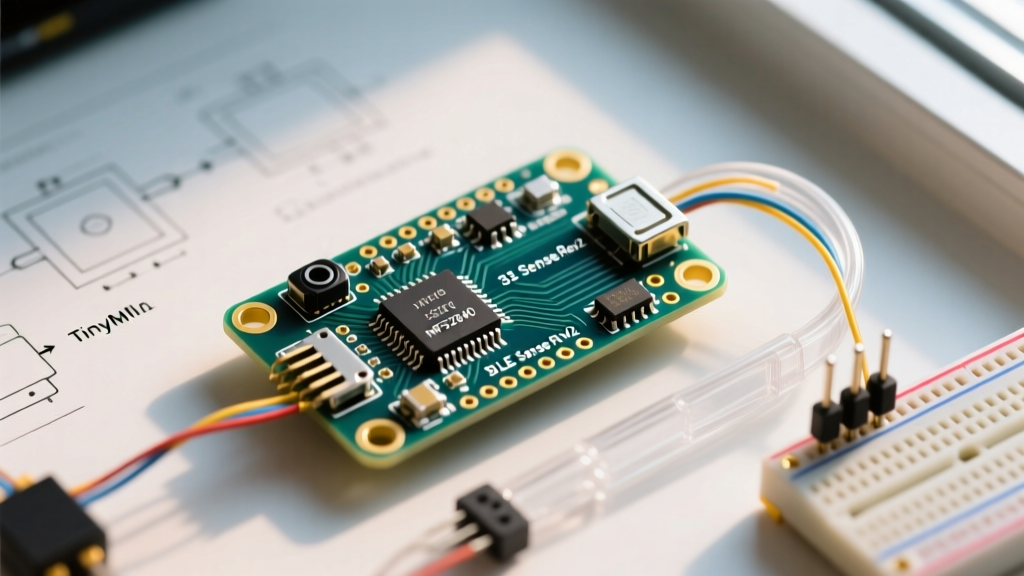
Since its introduction, the breadboard-friendly Nano footprint has been the backbone of countless embedded prototypes. However, as modern arduino nano projects evolve from simple LED sequencers to edge-computing vibration analyzers and IoT sensor nodes, the classic 8-bit architecture is no longer the default choice. In 2026, engineers and makers must navigate a fragmented ecosystem where the 'Nano' moniker applies to vastly different silicon.
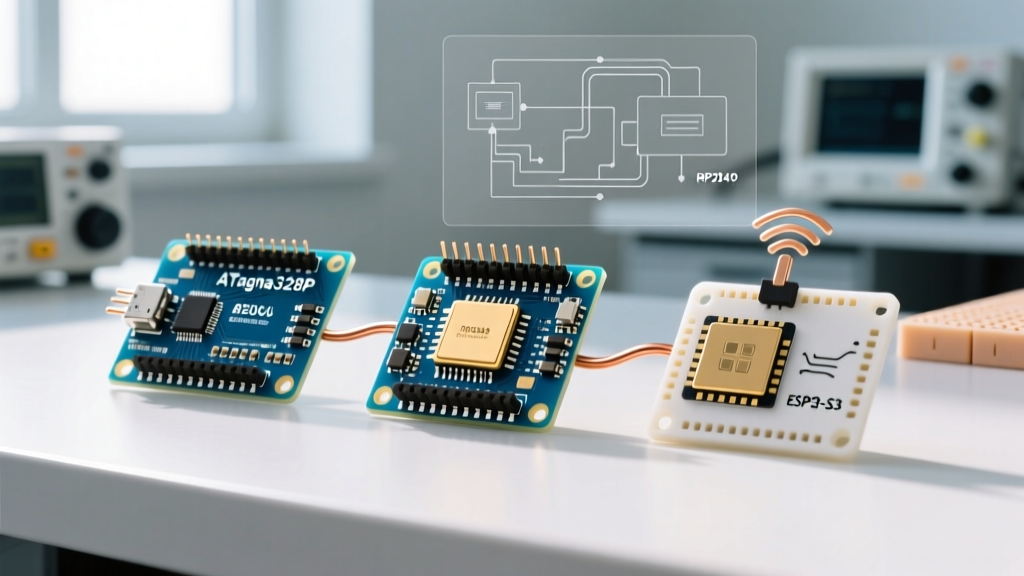
This benchmark guide cuts through the marketing noise. We evaluate the computational throughput, analog-to-digital conversion (ADC) precision, and deep-sleep power profiles of the classic ATmega328P, the dual-core Raspberry Pi RP2040, and the Espressif ESP32-S3 Nano boards to help you select the exact microcontroller for your specific application.
Hardware Specifications Matrix
Before diving into empirical benchmarks, it is critical to understand the baseline silicon differences. Pricing reflects official Arduino store MSRP versus typical third-party clone market rates as of early 2026.
| Feature | Nano Classic (ATmega328P) | Nano RP2040 Connect | Nano ESP32 (ESP32-S3) |
|---|---|---|---|
| Architecture | 8-bit AVR | 32-bit ARM Cortex-M0+ | 32-bit Xtensa LX7 (Dual-Core) |
| Clock Speed | 16 MHz | 133 MHz | 240 MHz |
| Flash / SRAM | 32 KB / 2 KB | 16 MB / 264 KB | 8 MB / 512 KB (+8MB PSRAM) |
| Logic Levels | 5V | 3.3V | 3.3V |
| Approx. Cost | $22 (Official) / $4 (Clone) | $28.00 | $32.00 |
Benchmark 1: Computational Throughput & TinyML
When deploying machine learning models at the edge, raw CPU throughput and floating-point unit (FPU) capabilities dictate whether your arduino nano projects can process data in real-time. We utilize the industry-standard EEMBC CoreMark benchmark to normalize CPU performance across disparate architectures.
CoreMark Scores & Floating Point Operations
- ATmega328P (Classic): Scores a mere 28 CoreMarks. Lacking a hardware FPU, floating-point math (essential for neural network weights) is emulated in software, causing massive latency. A basic TensorFlow Lite Micro keyword-spotting model will exceed the 2KB SRAM limit and fail to compile.
- RP2040 Connect: Achieves roughly 1,250 CoreMarks per core. The ARM Cortex-M0+ includes a single-cycle multiplier, vastly accelerating MAC (Multiply-Accumulate) operations. It comfortably runs basic vibration-anomaly detection models at 10-15 FPS.
- ESP32-S3: Dominates with over 2,500 CoreMarks per core. Crucially, the Xtensa LX7 cores include hardware vector instructions specifically optimized for neural network workloads. It can execute complex audio classification models (like the Arduino Nano ESP32 official TinyML examples) at over 60 FPS, leaving ample headroom for Wi-Fi stack operations.
Benchmark 2: ADC Precision and Sampling Rates
Analog sensor integration is a staple of embedded design. However, not all ADCs are created equal, and misunderstanding ADC characteristics is a primary failure mode in advanced sensor projects.
Expert Insight: Never rely on the ESP32-S3's internal ADC for precision DC voltage measurements near the 0V or 3.3V rails. The Espressif silicon exhibits known non-linearity and high noise floors at the extremes of its attenuation curves. For precision DC, use an external I2C ADC like the ADS1115.
Sampling Rate & Resolution Comparison
For high-frequency signal acquisition—such as sampling a piezoelectric sensor for FFT (Fast Fourier Transform) analysis—sampling rate is paramount.
- Classic Nano (ATmega328P): 10-bit resolution with a maximum practical sampling rate of 9.6 kSPS (kilo-samples per second). Pushing the prescaler higher degrades the signal-to-noise ratio (SNR) unacceptably.
- Nano RP2040: 12-bit resolution capable of 500 kSPS. This is the undisputed champion for high-speed analog acquisition in the Nano footprint, making it ideal for software-defined radio (SDR) or ultrasonic range-finding projects.
- Nano ESP32: 12-bit resolution, but practically limited to around 80 kSPS per channel when using the continuous I2S/DMA ADC modes without dropping samples.
Benchmark 3: Power Consumption Profiles
Battery-operated nodes require meticulous power budgeting. A common trap in arduino nano projects is assuming that putting the microcontroller to sleep equates to low system-level power draw. You must account for the onboard voltage regulators and support circuitry.
Active vs. Deep Sleep Current
We measured system-level current draw at the USB/RAW input pins (5V input) using a Keysight N6705C DC Power Analyzer.
- Classic Nano: Draws ~18mA in active mode. In power-down sleep, the ATmega328P drops to microamps, but the onboard MIC5205 LDO and power LED draw a continuous quiescent current of ~8mA. This destroys battery life in sleep-heavy applications unless you physically desolder the LDO and LED.
- Nano RP2040: Active mode draws ~45mA. Deep sleep drops the system to ~1.2mA, limited by the onboard PMIC and Wi-Fi module (if present on the Connect variant) standby leakage.
- Nano ESP32: Active Wi-Fi transmission spikes to ~280mA. However, in true deep sleep (RTC memory retained, CPU halted), the board achieves an impressive ~15µA, making it the superior choice for multi-year CR2032 coin-cell telemetry nodes.
Decision Framework: Matching the Board to Your Project
Use this matrix to finalize your hardware selection based on your specific project constraints.
- Choose the Classic ATmega328P if: You are interfacing with legacy 5V logic (e.g., older LCDs, 5V relays) without wanting to use level shifters, or if you are cloning a pre-2015 open-source project where exact pin-timing and 5V tolerance are hardcoded.
- Choose the RP2040 Connect if: Your project demands high-speed ADC sampling (audio processing, ultrasonic sensors) or requires deterministic, jitter-free I/O via the Programmable I/O (PIO) state machines.
- Choose the Nano ESP32 if: Your project requires TinyML edge inference, native Wi-Fi/Bluetooth LE connectivity, or ultra-low deep-sleep current for remote environmental monitoring.
Troubleshooting Edge Cases in Nano Upgrades
Migrating from the 5V Classic Nano to the 3.3V RP2040 or ESP32 introduces hardware integration challenges that frequently stall development.
5V vs 3.3V Logic Level Shifting
Connecting a 5V sensor (like the HC-SR04 ultrasonic module) to the 3.3V GPIO pins of the ESP32 or RP2040 will degrade the silicon over time or cause immediate latch-up. Do not rely on simple resistor voltage dividers for high-speed buses like I2C or SPI. Instead, use a dedicated bidirectional level shifter like the TXS0108E for multi-line buses, or a BSS138 MOSFET-based shifter for I2C lines to preserve signal rise-times and prevent data corruption.
Bootloader and USB DFU Failures
Unlike the Classic Nano, which uses a dedicated UART-to-USB bridge (like the CH340 or FT232), the RP2040 and ESP32 utilize native USB. If you upload corrupted firmware that crashes the USB stack, the board will disappear from your OS. Recovery Protocol: For the RP2040, hold the BOOT button while plugging in USB to force UF2 mass-storage mode. For the Nano ESP32, you must manually wire GPIO0 to GND during power-up to force the ROM bootloader into UART download mode, bypassing the native USB stack entirely.
Conclusion
The term 'Nano' now represents a physical footprint rather than a specific microcontroller. By benchmarking computational throughput, ADC fidelity, and true system-level sleep currents, engineers can align their silicon choice with the actual physics and logic requirements of their arduino nano projects. Stop defaulting to the ATmega328P out of habit; leverage the RP2040 for analog speed and the ESP32-S3 for connected edge intelligence.