
The Enduring ESP8266 Ecosystem in 2026
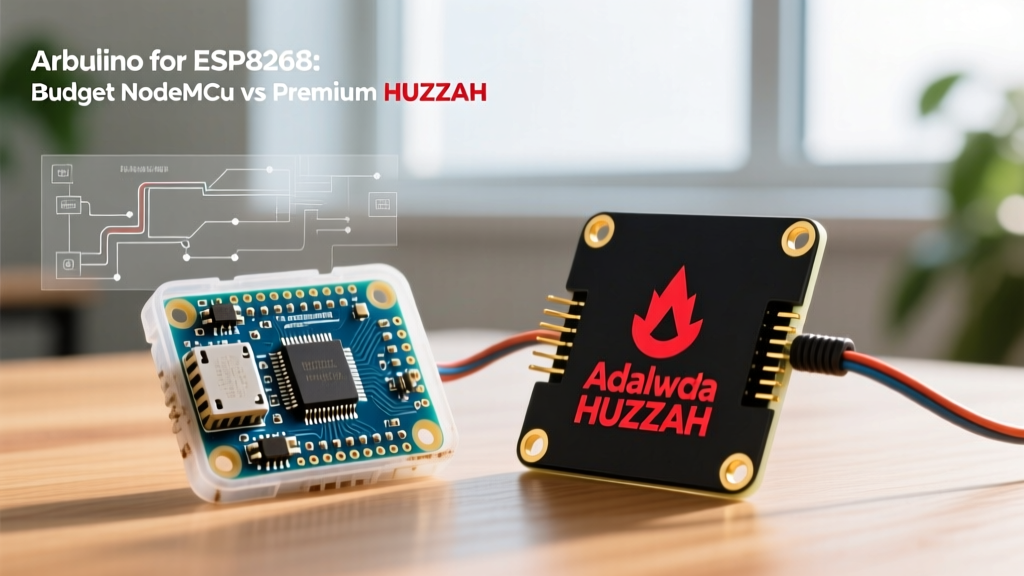
Even as newer microcontrollers flood the market, the ESP8266 remains a staple in the IoT engineer's toolkit. When developers search for the ideal arduino for esp8266 setup, they are rarely looking for an actual Arduino board to pair with an ESP shield. Instead, they are looking for ESP8266 development boards that integrate seamlessly with the Arduino IDE via the open-source ESP8266 Community Core. However, the hardware market for these boards is deeply fractured. On one side, you have ultra-budget clones flooding e-commerce platforms; on the other, meticulously engineered premium boards from established manufacturers. Understanding the electrical and architectural differences between these tiers is critical for moving from a blinking LED prototype to a reliable, field-deployed IoT sensor node.
The Budget Tier: NodeMCU V3 and Wemos D1 Mini Clones
If you have ever browsed AliExpress, Amazon, or eBay for ESP8266 boards, you have encountered the NodeMCU V3 (often branded as LoLin) and the Wemos D1 Mini. In 2026, these boards typically cost between $3.50 and $5.00 in bulk. They are fantastic for learning the basics of Wi-Fi networking and MQTT protocols, but their bill of materials (BOM) reveals severe compromises.
Hardware Reality Check
Budget boards almost universally rely on the CH340G USB-to-serial converter. While functional, the CH340G requires manual driver installation on many Windows environments, adding friction to your workflow. More critically, these boards use the AMS1117-3.3 linear dropout (LDO) regulator to step down the 5V USB VBUS to the 3.3V required by the Espressif ESP8266 SoC. The AMS1117 is a legacy component with a high dropout voltage (typically 1.1V) and poor transient response.
Common Failure Modes in the Field
- TX Burst Brownouts: When the ESP8266 transmits data over Wi-Fi, it draws current spikes up to 170mA for several milliseconds. The cheap AMS1117 regulators on clone boards often cannot respond fast enough to this transient load. The voltage sags below the ESP8266's 3.0V brownout threshold, triggering an endless reboot loop characterized by the serial monitor error:
rst cause:2, boot mode:(3,6). - Micro-USB Shearing: The surface-mount micro-USB ports on budget boards are often soldered with minimal mechanical reinforcement. Plugging and unplugging the cable at slight angles frequently tears the pads right off the PCB.
- Thermal Throttling: Dropping 5V to 3.3V at 100mA of continuous idle current generates roughly 0.17W of heat. On the tiny SOT-223 packages used by clone manufacturers, lacking adequate copper pour heatsinking, the regulator runs hot to the touch, accelerating long-term silicon degradation.
The Premium Tier: Adafruit Feather HUZZAH and SparkFun Thing
Premium boards, such as the Adafruit Feather HUZZAH ESP8266 and the SparkFun ESP8266 Thing, command a higher price—typically ranging from $16.50 to $22.00. This premium is not merely for the brand name; it is invested directly into power integrity, RF reliability, and ecosystem integration.
Engineering Upgrades That Matter
Premium boards ditch the CH340G in favor of Silicon Labs CP2104 or FTDI USB-to-UART bridges. These chips offer native OS-level driver support across Windows, macOS, and Linux, and they support higher, more stable baud rates for rapid firmware flashing. More importantly, premium boards utilize modern, high-PSRR (Power Supply Rejection Ratio) LDOs like the ME6211C33. These regulators feature incredibly low dropout voltages and integrated bulk capacitors placed millimeters from the ESP8266's VBAT pin, entirely eliminating TX burst brownouts.
Furthermore, premium boards are designed for autonomous deployment. The Feather HUZZAH includes an integrated MCP73831 LiPo charge controller and a JST-PH 2.0 battery connector, allowing the board to seamlessly switch between USB power and battery power without dropping the 3.3V rail. They also feature standardized ecosystem connectors, such as STEMMA QT / Qwiic, enabling solderless I2C integration with modern sensors.
Head-to-Head Comparison Matrix
| Feature | Budget NodeMCU V3 Clone | Premium Adafruit Feather HUZZAH |
|---|---|---|
| Average Price (2026) | $3.50 - $5.00 | $18.50 - $22.00 |
| USB-to-UART Chip | CH340G (Requires Drivers) | CP2104 (Native Support) |
| Voltage Regulator | AMS1117-3.3 (High Dropout) | ME6211C33 (Low Dropout, High PSRR) |
| Brownout Protection | Poor (Requires external caps) | Excellent (Integrated bulk capacitance) |
| Battery Management | None | Integrated LiPo Charging (MCP73831) |
| Form Factor | Breadboard-blocking width | Feather standard (Breadboard friendly) |
| RF Shielding | None (Exposed PCB trace) | FCC/CE certified module with shielding |
Deep Dive: Power Delivery and RF Brownouts
The most common reason hobbyists abandon the ESP8266 is the infamous 'random reboot' issue. This is rarely a software bug; it is almost always a hardware power delivery failure. The ESP8266's RF power amplifier is highly demanding. When transmitting at maximum power (+20.5 dBm), the current draw spikes violently.
Expert Troubleshooting Tip: If you are locked into using a budget NodeMCU for a production run, you must mitigate brownouts manually. Solder a 1000µF low-ESR tantalum capacitor directly across the 3V3 and GND header pins. This provides a localized energy reservoir to satisfy the 170mA TX spikes without relying on the slow transient response of the AMS1117 regulator.
Premium boards solve this at the schematic level. By placing a 100µF ceramic capacitor and a 10µF bulk capacitor in parallel directly adjacent to the ESP8266's VBAT and GND pads, the high-frequency RF spikes are absorbed locally. The LDO only has to replenish the capacitors at a steady, manageable rate. This results in a rock-solid 3.3V rail, even during continuous MQTT publishing or OTA (Over-The-Air) firmware updates.
Decision Framework: Which Should You Buy?
Choosing between budget and premium ESP8266 boards depends entirely on your project's lifecycle stage and deployment environment.
Choose the Budget NodeMCU or Wemos D1 Mini When:
- Prototyping on a Breadboard: The wider footprint of the NodeMCU makes it easy to straddle a standard breadboard, leaving one row of pins accessible on either side for jumper wires.
- Educational Workshops: When buying 30 boards for a classroom where hardware attrition is high, the $4 price point is justifiable.
- USB-Powered Desktop Toys: If the device will never leave your desk, will remain plugged into a high-quality 5V/2A USB wall adapter, and does not require battery operation.
Choose the Premium Feather HUZZAH or SparkFun Thing When:
- Field Deployment and Battery Power: If your IoT node needs to run off a LiPo battery in an enclosure, the integrated charge controller and deep-sleep wake-up circuitry on premium boards are non-negotiable.
- Commercial or Client Projects: When you are delivering a finished product to a client, the FCC/CE certification of the premium RF modules saves you thousands of dollars in compliance testing.
- Complex Sensor Arrays: If you need to daisy-chain multiple I2C sensors, the STEMMA QT / Qwiic connectors on premium boards eliminate the need for messy, unreliable soldered wire harnesses.
Final Thoughts
The 'arduino for esp8266' ecosystem remains incredibly vibrant in 2026, but treating all ESP8266 boards as interchangeable is a critical mistake. Budget clones are excellent educational tools, but their compromised power delivery and mechanical fragility make them a liability in real-world IoT applications. By investing in premium hardware like the Adafruit Feather HUZZAH, you are not just paying for a logo; you are buying engineered power integrity, native driver support, and the reliability required to keep your IoT nodes online for years, not just hours.