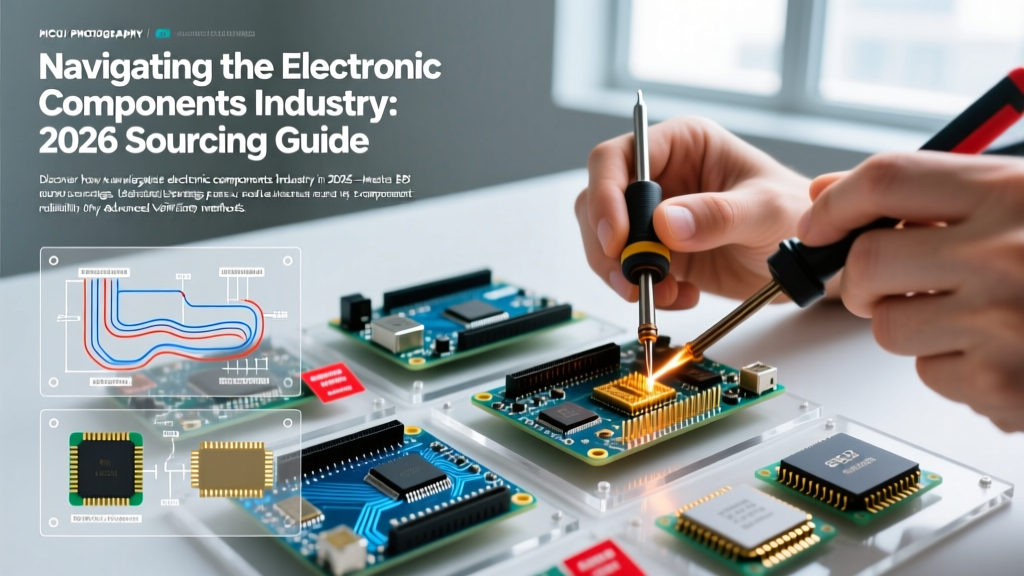

The 2026 Landscape of the Electronic Components Industry
The global electronic components industry has undergone a radical transformation since the severe allocation crises of the early 2020s. As of 2026, the market has largely stabilized, but it has bifurcated into two distinct realities. On one side, consumer-grade passives, legacy 8-bit microcontrollers, and standard logic ICs are experiencing oversupply, driving prices down by 12% to 18% year-over-year. On the other side, advanced edge-AI inference chips, automotive-grade Silicon Carbide (SiC) MOSFETs, and high-reliability aerospace connectors remain heavily constrained, with lead times frequently exceeding 40 weeks.
For hardware startups, procurement engineers, and advanced DIY makers, understanding these macroeconomic currents is no longer optional—it is a prerequisite for survival. A poorly sourced Bill of Materials (BOM) can stall a product launch for months or introduce catastrophic field failures via counterfeit parts. This guide provides a comprehensive, actionable framework for procuring components safely and efficiently in the current market.
Industry Insight: 'The era of single-source BOMs is dead. In 2026, Design for Availability (DfA) is just as critical as Design for Manufacturing (DfM). Engineers who do not validate secondary footprint compatibilities before tape-out are effectively gambling their production schedules.' — Hardware Procurement Quarterly, Q1 2026
Tier 1 vs. Tier 2 Distributors: Where Should You Buy?
Knowing where to source your components is the first line of defense against supply chain disruptions and fraudulent parts. The electronic components industry is broadly divided into authorized (Tier 1) and independent (Tier 2) distributors.
| Feature | Tier 1 (Authorized: Digi-Key, Mouser, Arrow) | Tier 2 (Independent: Smith, Win Source, Fusion) |
|---|---|---|
| Authentication | 100% Guaranteed (Direct from OEM) | Variable (Requires AS6081 inspection) |
| Pricing Model | Franchise pricing, volume breaks | Spot market, highly volatile |
| Lead Times | Dictated by manufacturer backlog | Immediate (if stock is held) |
| Best Used For | Prototyping, production runs, NRND avoidance | Line-down emergencies, legacy EOL parts |
| Traceability | Full Certificate of Conformance (CoC) | Often incomplete or forged |
Actionable Advice: Always begin your procurement by verifying authorized channels through the Electronic Components Industry Association (ECIA) database. If a part is obsolete or allocated, and you must use an independent broker, demand a Certificate of Conformance (CoC) tracing back to the original manufacturer, not just the previous broker.
Spotting Counterfeits in the Secondary Market
Despite tighter regulations, the secondary market remains rife with counterfeit components. In 2025 alone, the Electronic Resellers Association International (ERAI) reported thousands of incidents involving resurfaced, remarked, and pulled components. The most common failure modes include:
- Resurfacing and Remarking: Fraudsters sand down the original epoxy package of a cheaper, lower-spec IC (e.g., a commercial-grade STM32) and laser-print the part number of a higher-spec, automotive-grade variant (e.g., an NXP S32K).
- Pulled Parts: Components desoldered from e-waste PCBs, re-tinned, and sold as new. These often suffer from degraded moisture sensitivity levels (MSL) and micro-fractures in the wire bonds.
- Ghost Parts: Entirely fabricated ICs that contain no silicon die, or a dummy die, resulting in a complete open-circuit failure upon assembly.
The 3-Point AS6081 Inspection Checklist
When sourcing from non-authorized vendors, align your incoming quality control (IQC) with the SAE AS6081 standard for counterfeit avoidance. Implement this minimum viable inspection protocol:
- The Acetone Swab Test: Vigorously rub the top surface of the IC with an industrial cotton swab soaked in high-purity acetone. If the laser markings smudge, lift, or reveal a different part number underneath, the component has been resurfaced and blacktopped.
- Scanning Acoustic Microscopy (SAM): Use SAM to detect delamination between the silicon die and the epoxy encapsulant. Pulled parts that have been baked or exposed to harsh desoldering temperatures often exhibit internal micro-cracking that is invisible to the naked eye.
- Decapsulation (Destructive Testing): For high-stakes batches (e.g., medical or aerospace), sacrifice 1% of the lot. Use fuming nitric acid to dissolve the epoxy and expose the die. Verify the die markings and wire bond topology against the manufacturer's proprietary datasheet.
Strategic BOM Optimization for Hardware Startups
Navigating the electronic components industry requires proactive engineering, not just reactive purchasing. Hardware startups must adopt 'Design for Availability' (DfA) methodologies during the schematic capture phase.
Step-by-Step BOM Resilience Framework
- Implement Drop-In Footprint Alternatives: Design your PCB pads to accommodate multiple manufacturer footprints. For example, when designing a buck converter circuit, route the PCB so it can accept either the Texas Instruments TPS5430 (SOIC-8) or the Monolithic Power Systems MP2315 (SOT23-8) using a dual-pad layout. This dual-sourcing strategy insulates you from single-vendor stockouts.
- Monitor Lifecycle Statuses Weekly: Integrate API feeds from Octopart or SiliconExpert directly into your Altium or KiCad environment. Flag any component that transitions to 'NRND' (Not Recommended for New Designs) or 'Active but Unspecified' before you finalize your Gerber files.
- Standardize Passive Values: Reduce your unique part count. Instead of using 11kΩ and 12kΩ resistors in different voltage dividers, standardize on 10kΩ and 15kΩ across the entire board. High-volume consolidated purchasing of standard E12/E24 series passives yields better pricing and guarantees higher buffer stock.
Navigating Tariffs and Geopolitical Supply Chain Shifts
The geographic distribution of the electronic components industry continues to shift in response to trade policies. With the maturation of Section 301 tariffs and new 2026 semiconductor localization acts, the country of origin (CoO) for your components directly impacts your landed cost.
Many major passive manufacturers, such as Yageo and Walsin, have expanded their manufacturing footprints into Vietnam, India, and Mexico to bypass US-China import duties. When requesting quotes from global distributors, explicitly ask for the CoO on the packing slip. Sourcing a Murata MLCC from a Japanese or Mexican distribution hub may incur a 0% tariff, whereas the exact same reel shipped from a Shenzhen warehouse could be hit with a 25% import surcharge upon entering the US or EU.
FAQ: Electronic Components Industry Sourcing
How do I handle Moisture Sensitivity Level (MSL) violations?
If you receive MSL 3 or higher components (like BGAs or QFNs) from an independent broker with a breached or missing moisture barrier bag (MBB), do not mount them immediately. You must bake them in a convection oven at 125°C for 24 hours to drive out absorbed moisture. Failing to do so will cause the 'popcorn effect' during reflow soldering, where trapped water turns to steam and fractures the IC package from the inside.
What is the best strategy for sourcing end-of-life (EOL) microcontrollers?
For EOL microcontrollers, first contact the original manufacturer to see if they have transferred the tooling and IP to a specialized legacy foundry (like Rochester Electronics). If not, you must source from the secondary market. In this scenario, mandate X-ray inspection on 100% of the lot to verify that the internal wire bonds match the original die topology, as remarking EOL parts is highly profitable for counterfeiters.
Are online marketplaces like AliExpress or eBay safe for prototyping?
For non-critical, hobbyist prototyping (e.g., blinking LEDs with generic 555 timers), they are acceptable. However, never source complex mixed-signal ICs, FPGAs, or power management chips from these platforms for functional prototypes. The prevalence of cloned silicon with altered internal registers will result in weeks of wasted firmware debugging time.