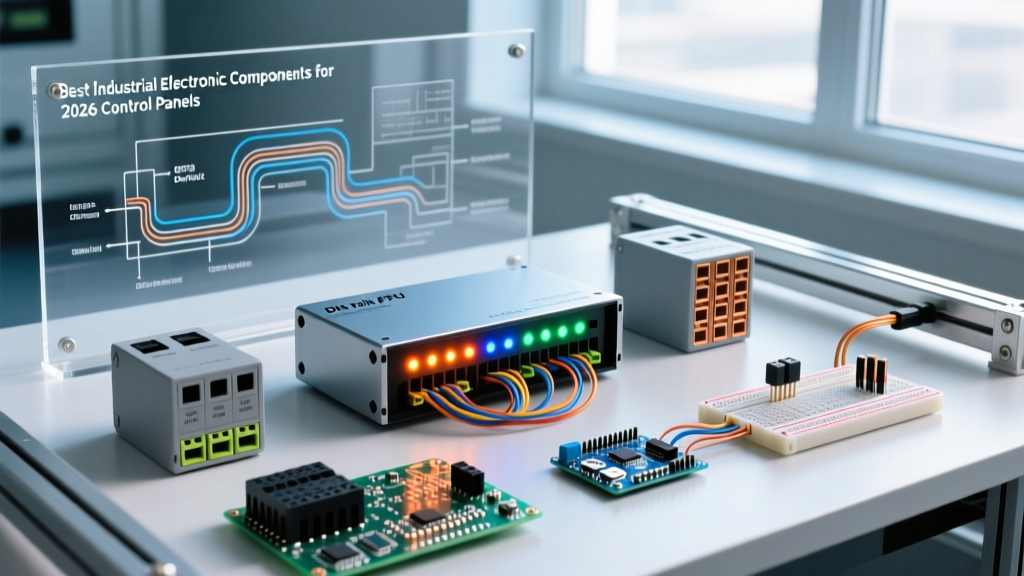

The 2026 Standard for Industrial Control Panel Builds
Building a reliable control panel in 2026 requires more than just picking parts off a consumer electronics shelf. When sourcing industrial electronic components, the margin for error is zero. A failed relay in a commercial HVAC system is an inconvenience; a failed relay in an industrial motor control center can cause catastrophic arc flashes or halt a $100,000-per-hour production line.
As panel builders and maintenance engineers navigate stricter compliance requirements—specifically UL 508A and NFPA 70 (NEC Article 409)—the demand for components with higher Mean Time Between Failures (MTBF), superior vibration resistance, and advanced diagnostic feedback has surged. This guide reviews and recommends the highest-performing industrial electronic components across three critical categories: DIN-rail power supplies, solid-state relays (SSRs), and terminal blocks.
DIN-Rail Power Supplies: The Heartbeat of the Panel
The 24VDC control bus is the lifeline of any PLC-based system. Consumer-grade power supplies often fail under the inductive surge loads typical of industrial contactors and valve manifolds. Here is how the top contenders compare for heavy-duty applications.
1. Phoenix Contact QUINT4 (Premium Tier)
The Phoenix Contact QUINT4 series remains the gold standard for mission-critical panels. The standout feature is SFB (Selective Fuse Breaking) technology, which delivers 6 times the nominal current for 15 milliseconds. This allows you to reliably trip standard MCBs on secondary circuits without dropping the main 24VDC bus.
- Model: QUINT4-PS/1AC/24DC/10 (240W)
- Price: ~$285
- MTBF: > 500,000 hours
- Best For: Automotive manufacturing, pharmaceutical clean rooms, and systems where a bus brownout costs thousands of dollars.
2. Mean Well HDR-150-24 (Value/High-Volume Tier)
For high-volume OEM skids where panel real estate and BOM costs are tightly constrained, the Mean Well HDR-150-24 is unbeatable. At just 40mm wide, it saves crucial DIN-rail space. While it lacks the dynamic surge reserves of the QUINT4, its 90% efficiency and rugged conformal-coated PCB make it highly reliable for standard automation tasks.
- Model: HDR-150-24 (150W)
- Price: ~$65
- MTBF: ~ 346,000 hours
- Best For: Water/wastewater telemetry panels, commercial HVAC, and OEM packaging machinery.
Power Supply Comparison Matrix
| Feature | Phoenix QUINT4 (10A) | Mean Well HDR-150 (6.5A) | Siemens SITOP PSU8200 (10A) |
|---|---|---|---|
| Price (Approx) | $285 | $65 | $145 |
| Width (mm) | 60mm | 40mm | 70mm |
| Surge Capability | SFB (6x Inom) | 1.5x Inom (3s) | 3x Inom (25ms) |
| Diagnostic Output | IO-Link / Analog | Relay Contact | Relay / LED |
| Operating Temp | -40 to +70°C | -30 to +70°C | -40 to +70°C |
Solid-State Relays (SSRs) and Thermal Failure Modes
Mechanical contactors are loud, generate EMI, and have finite mechanical lifespans. SSRs solve these issues but introduce a silent killer: thermal runaway. The most common failure mode in industrial SSRs is not electrical overcurrent, but inadequate heat sinking leading to junction temperatures exceeding 125°C, causing the internal TRIAC to short-circuit and fail in the 'ON' state.
Calculating Thermal Dissipation
A general rule of thumb for AC SSRs is a forward voltage drop of 1.2V to 1.4V. If you are switching a 30A resistive heater load, the power dissipated as heat is:
P = V_drop × I_load
P = 1.2V × 30A = 36 Watts
Without a heat sink rated for at least 0.5°C/W, the SSR baseplate will rapidly exceed its thermal limits in a 40°C panel environment. Always pair high-current SSRs with thermal pads and extruded aluminum DIN-rail heat sinks.
Top SSR Recommendations
- Omron G3NA-250B (~$45): A 50A, 24-264VAC workhorse. Features a built-in varistor for surge absorption and an isolated, replaceable input cartridge. Excellent for standard heater control.
- Carlo Gavazzi RM1A60D50 (~$65): Offers integrated overvoltage protection and a highly optimized thermal design. The internal thermal pad interface is superior, reducing mounting thermal resistance by up to 15% compared to competitors.
Vibration-Proof Terminal Blocks: Spring vs. Push-In
Screw-terminal blocks are obsolete in high-vibration industrial environments. Over time, thermal cycling and mechanical vibration cause screw connections to loosen, leading to high-resistance joints and eventual arcing. The industry has standardized on spring-loaded and push-in technologies.
Wago TOPJOB S (2002 Series)
Wago’s cage-clamp technology is legendary. The 2002 series uses a stainless-steel spring that maintains constant pressure on the conductor regardless of temperature fluctuations. Cost: ~$1.80 per 2-conductor block. The primary advantage is the side-entry wiring and the ability to daisy-chain jumpers across multiple levels without losing wiring space.
Phoenix Contact CLIPLINE Complete (PT Series)
Phoenix Contact’s push-in technology (PT) requires 50% less insertion force than traditional spring clamps. You can insert ferruled wires directly without a tool. Cost: ~$2.40 per block. The CLIPLINE system excels in standardized color-coding and integrated testing points that accept standard 2.3mm test plugs, drastically reducing troubleshooting time during FAT (Factory Acceptance Testing).
Verifying Component Health: The Testing Protocol
Recommending top-tier industrial electronic components is only half the battle; verifying their performance in the field is the other. When commissioning a new panel, do not rely solely on the PLC’s internal diagnostics.
- DC Bus Ripple Analysis: Use a True-RMS multimeter with a low-pass filter (like the Fluke 87V) or a power quality analyzer to measure AC ripple on the 24VDC bus. Ripple exceeding 150mV AC indicates failing filter capacitors in the PSU or excessive harmonic distortion from nearby VFDs.
- Thermal Imaging: After 4 hours of full-load operation, scan the panel with a thermal camera (e.g., FLIR E8-XT). Look for hotspots on SSR heat sinks (should not exceed 80°C) and terminal block connections (a delta of >5°C between phases indicates a loose crimp).
Final Sourcing Advice for 2026
The global supply chain for industrial electronic components has largely stabilized, but the gray market remains flooded with counterfeit relays and power supplies that lack proper UL recognition. Counterfeit SSRs often use undersized silicon dies that fail catastrophically under nominal loads.
Never source safety-critical industrial components from unauthorized marketplaces. Always procure through authorized, franchised distributors (e.g., Mouser, Digi-Key, Newark, or direct from the manufacturer) to ensure traceability, valid warranties, and genuine UL/CE certification marks. Investing an extra 20% in authentic, premium-tier components like the Phoenix QUINT4 or Carlo Gavazzi RM1A will yield a 10x return in reduced downtime and eliminated field-service callbacks.