
The Hidden Cost of the Gray Market in 2026
As we navigate the semiconductor landscape in 2026, supply chain volatilities for legacy and specialized nodes continue to drive procurement teams toward the secondary market. While independent brokers and online marketplaces offer tempting lead-time reductions, the proliferation of electronic components counterfeit parts poses a severe risk to system reliability, safety, and intellectual property. According to data tracked by Electronic Risks and Intelligence (ERAI), counterfeit incidents remain stubbornly high, particularly in power management ICs, microcontrollers, and discrete MOSFETs. For DIY builders, repair technicians, and hardware startups, integrating a cloned or degraded component doesn't just mean a failed prototype—it can mean catastrophic thermal events or bricked production runs.
High-Target Components: What Fakers Clone Most
Counterfeiters operate on margins of scale. They target high-volume, widely used components where a $0.50 price discrepancy can yield massive profits across reels of 3,000 units. Below is a breakdown of the most frequently counterfeited parts in 2026, comparing genuine authorized pricing against gray market traps.
| Component Model | Authorized Price (2026) | Gray Market Price | Common Counterfeit Method | Catastrophic Failure Mode |
|---|---|---|---|---|
| STM32F103C8T6 | $3.85 | $0.65 | Remarketed lower-tier MCU (e.g., STM32F030) | Bricked firmware, missing USB/CAN peripherals |
| IRFZ44N (Infineon) | $1.45 | $0.25 | High Rds(on) clone die in genuine package | Thermal runaway and melting at >15A continuous |
| LM2596S-5.0 | $1.80 | $0.30 | Under-specced internal FET, thinner bond wires | Output voltage drift, inductor saturation under load |
| ESP32-WROOM-32E | $3.20 | $1.40 | Salvaged e-waste modules, re-tinned pads | Intermittent Wi-Fi drops, flash memory corruption |
The 4-Step Receiving Inspection Protocol
To align with the rigorous SAE AS5553 standard for counterfeit electronic parts avoidance, your receiving department or personal workbench must implement a tiered inspection protocol. Do not rely solely on visual checks; modern fakes are visually nearly identical to genuine silicon.
1. Packaging and Label Verification
Before opening the Moisture Barrier Bag (MBB), inspect the label. Genuine manufacturers use high-resolution thermal transfer or laser-etched barcodes. Counterfeit labels often exhibit pixelation, misaligned datamatrix codes, or incorrect font weights. Check the Humidity Indicator Card (HIC) inside the bag. If the 10% or 60% dot has turned pink (or the specific color indicated by the manufacturer for 2026 standards), the parts have been exposed to moisture, indicating the bag was likely resealed after the parts were harvested from e-waste.
2. Visual and Microscopic Examination (40x - 100x)
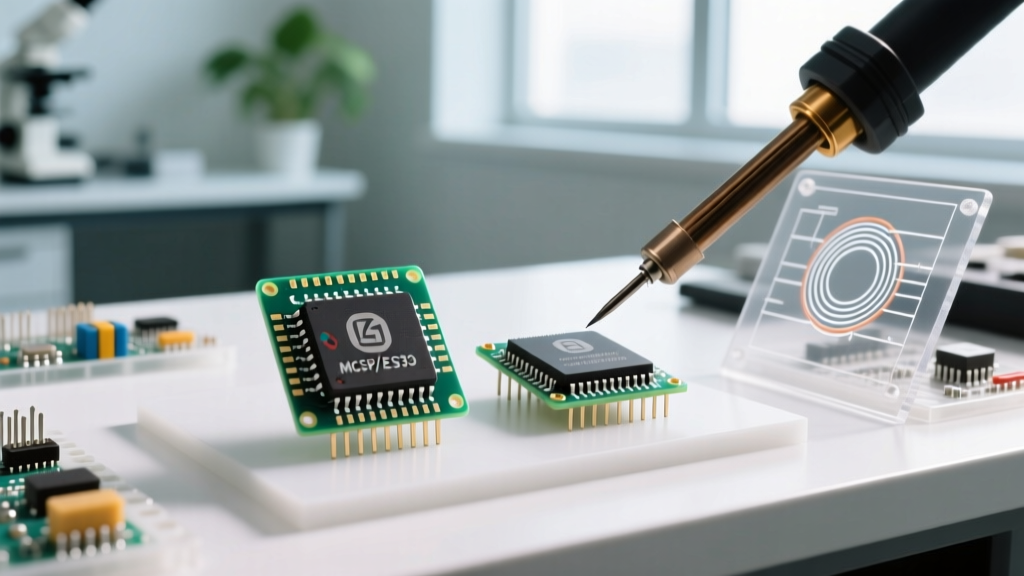
Place the IC under a stereo microscope. You are looking for three primary red flags:
- Blacktopping: Counterfeiters sand down the original markings of a cheaper IC and paint over it with a black epoxy mixture to laser-etch new, premium part numbers. The Acetone Swab Test: Vigorously rub the IC surface with a cotton swab soaked in pure acetone or Methyl Ethyl Ketone (MEK). Genuine epoxy will not degrade. Blacktopping will smear, revealing the original markings underneath.
- Pin Oxidation and Scratches: Genuine parts have uniform matte tin or gold plating. Fakes harvested from recycled PCBs often show microscopic scrape marks near the package body (from desoldering tools) or uneven, overly bright re-tinning meant to hide oxidation.
- Laser Etching Depth: Authentic laser etching creates a micro-texture that feels slightly rough to a fingernail. Fakes often use shallow ink printing or low-power lasers that look flat and lack the precise depth of factory tooling.
3. Electrical Parameter Testing
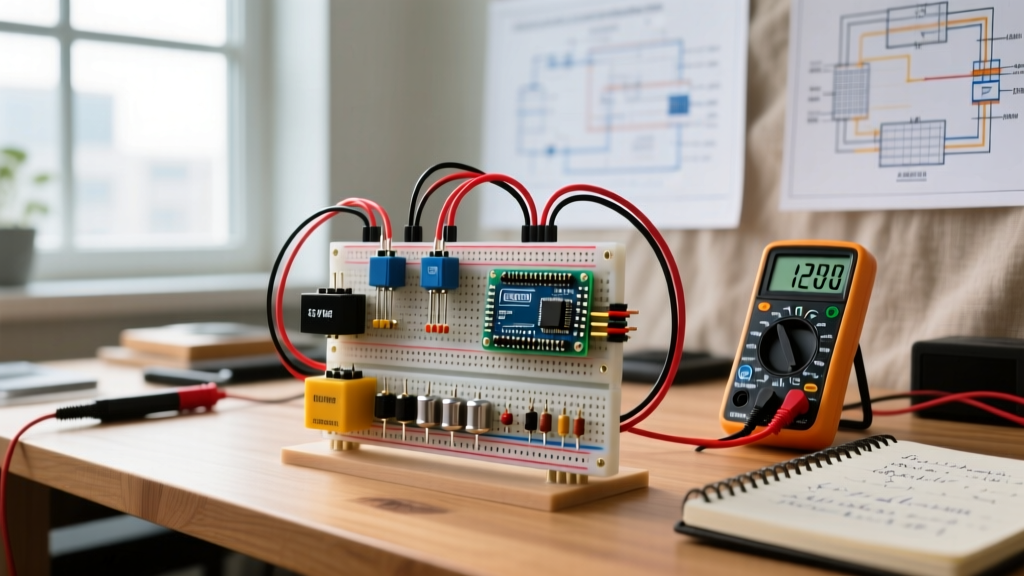
Visuals can deceive; physics cannot. For discrete components like the IRFZ44N MOSFET, a simple multimeter diode test isn't enough. You must measure the Drain-Source On-Resistance (Rds(on)). A genuine Infineon IRFZ44N will measure approximately 17.5mΩ at Vgs=10V. Counterfeit clones frequently use undersized silicon dies that measure between 45mΩ and 80mΩ. At 20 amps, this excess resistance generates enough heat to melt the TO-220 package and destroy your PCB traces.
For ICs, utilize a Curve Tracer (such as a Huntron Tracker). By applying an AC signal and measuring the voltage-current (V-I) signature across the pins, you can compare the footprint against a known "golden" genuine sample. Cloned microcontrollers will exhibit entirely different internal capacitance and diode junction signatures.
4. Destructive Decapsulation (The Acid Test)
When procuring high-value FPGAs or aerospace-grade microcontrollers, destructive testing is mandatory. Decapsulation involves using fuming nitric acid (HNO3) or heated sulfuric acid (H2SO4) to dissolve the epoxy package without damaging the silicon die or gold/copper bond wires. Once the die is exposed, inspect it under a high-powered metallurgical microscope. You are verifying the manufacturer's proprietary logo, the specific die revision code, and the physical dimensions of the silicon. Counterfeiters cannot fake the physical layout of a 5nm or 28nm silicon die.
Expert Warning: Never attempt decapsulation without a certified chemical fume hood, proper PPE (including a face shield and acid-resistant apron), and specialized training. Fuming nitric acid is highly corrosive and reacts violently with organic materials.
Sourcing Strategy: Authorized vs. Independent Brokers
The only 100% foolproof method to avoid electronic components counterfeit parts is to buy exclusively from the supply chain's origin. However, when parts go End-of-Life (EOL) or face 52-week lead times, you must use independent brokers. Use this decision matrix:
- Tier 1: Authorized Distributors (Zero Risk): Digi-Key, Mouser, Arrow, Farnell, and direct manufacturer stores. Always default here for production runs.
- Tier 2: Vetted Independent Brokers (Moderate Risk): Brokers who are ERAI members, adhere to AS5553/AS6081 standards, and provide traceability documentation (Certificate of Conformance, original manufacturer packing slips). Require incoming inspection for all Tier 2 purchases.
- Tier 3: Gray Market / E-Commerce (Extreme Risk): AliExpress, eBay, and unverified Amazon third-party sellers. Only use for non-critical prototyping where a $50 loss and a two-week delay will not derail your project. Assume 100% of power ICs and high-end MCUs here are cloned or salvaged.
Real-World Failure Modes: Why It Matters
In 2025, a prominent DIY solar inverter community reported widespread failures in 3kW off-grid builds. The root cause? Counterfeit LM2596S-5.0 buck converters sourced from unverified marketplaces. The fake ICs utilized internal switching transistors rated for only 1A instead of the specified 3A. Under the continuous load of driving cooling fans and control logic, the internal silicon junctions shorted, sending 12V directly into the 5V logic rail, instantly frying the $40 microcontrollers they were powering. The $1.50 saved per voltage regulator resulted in hundreds of dollars in collateral damage.
Frequently Asked Questions (FAQ)
Can I trust LCSC for genuine components?
LCSC is a massive Chinese distributor. While they are generally reliable for their own vetted brands (like CJ Microelectronics) and have improved their supply chain auditing, buying Western brands (TI, STMicroelectronics, Analog Devices) through their marketplace third-party sellers carries the same gray-market risks as any other platform. Always check if the specific part is marked as "LCSC Official" or sold directly by the manufacturer's authorized agent.
Are counterfeit parts always completely non-functional?
No. The most dangerous counterfeits are "marginally functional." A cloned op-amp might work perfectly at room temperature and low frequencies, but fail catastrophically when subjected to industrial temperature ranges (-40°C to 85°C) or high-frequency noise. This leads to intermittent field failures that are notoriously difficult to debug.
How do I report a counterfeit component?
If you confirm a part is counterfeit, report it immediately to ERAI and the Semiconductor Industry Association (SIA). Do not simply return the parts to the broker for a refund; returning them allows the broker to resell the fakes to another unsuspecting buyer. Quarantine and destroy the components, or hold them as evidence if you are pursuing legal recourse for a production-line failure.