
Why Exact Electronic Components Names Matter in Circuit Design
When transitioning from a beginner hobbyist to a proficient DIY electronics engineer, one of the most critical hurdles is mastering precise electronic components names. Referring to a part as a 'blue cylinder' or a 'black chip with legs' leads to catastrophic ordering errors, improper circuit biasing, and frustrating debugging sessions. In 2026, with the global semiconductor supply chain fully stabilized and component distributors like Mouser and Digi-Key stocking over 15 million unique SKUs, knowing the exact nomenclature, package types, and standard part numbers is non-negotiable.
This fundamentals explainer breaks down the core electronic components names, their specific functions, real-world part numbers, and common failure modes you will encounter on the workbench.
Passive Components: The Foundation of Every Circuit
Passive components cannot introduce net energy into a circuit. They dissipate, store, or release energy. Understanding their exact classifications is vital for impedance matching and signal filtering.
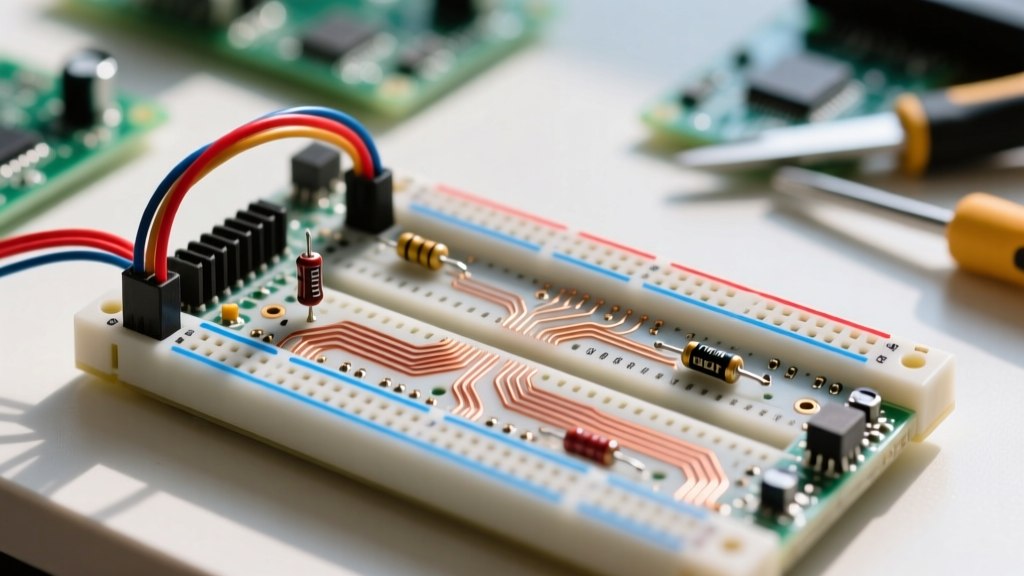
1. Resistors: Current Limiting and Voltage Division
Resistors restrict electron flow. While beginners often start with generic carbon composition resistors, professional designs demand metal film resistors for their low temperature coefficients (typically 50 ppm/°C) and tight tolerances (1% or 0.1%).
- Standard Through-Hole Model: Vishay MRS25 series (0.6W, 1% tolerance). Costs roughly $0.08 per unit in small quantities.
- Standard SMD Model: Yageo RC series (e.g., RC0603FR-0710KL for a 10kΩ 0603 package). Costs under $0.01 per unit on tape-and-reel.
- Failure Mode: Resistors rarely fail short. They typically fail open due to thermal overstress, or their resistance drifts upward if operated continuously near their maximum power rating.
For a deep dive into resistor color codes and the math behind series/parallel networks, consult the foundational guides at Electronics Tutorials.
2. Capacitors: Energy Storage and Decoupling
Capacitors store electrical energy in an electric field. The two most common types you must know by name are Multi-Layer Ceramic Capacitors (MLCCs) and Aluminum Electrolytic Capacitors.
- MLCCs (Ceramic): Used for high-frequency decoupling. The Murata GRM series is the industry standard. A 100nF (0.1µF) X7R dielectric in a 0805 package is the universal bypass capacitor for almost every IC VCC pin.
- Electrolytic: Used for bulk energy storage and low-frequency filtering. The Rubycon ZL series offers low Equivalent Series Resistance (ESR), crucial for switching power supplies.
- Failure Mode: MLCCs suffer from flex-cracking if the PCB bends, leading to dead shorts. Electrolytics dry out over time (especially near heat sinks), causing their ESR to spike and leading to power supply ripple.
3. Inductors: Magnetic Field Storage
Inductors resist changes in current. They are heavily used in switch-mode power supplies (SMPS) and RF matching networks. A common power inductor is the Bourns SRP series (e.g., SRP1265A-100M, a 10µH shielded power inductor rated for 9A).
Active Components: Amplification and Switching
Active components rely on a source of energy to control electron flow, enabling amplification and digital logic.
1. Diodes: One-Way Valves
Diodes allow current to flow in only one direction. Knowing the specific electronic components names for different diode types prevents immediate destruction upon power-up.
- Standard Rectifier: 1N4007 (1A, 1000V PIV). Used in low-frequency AC to DC power supplies.
- Small Signal Switching: 1N4148 (300mA, 100V). Used for logic gating and fast switching.
- Schottky Diode: BAT54 or 1N5819. Features a low forward voltage drop (0.2V - 0.3V), essential for preventing reverse polarity damage in battery-powered devices without wasting precious voltage headroom.
For comprehensive semiconductor theory and diode biasing equations, refer to the SparkFun Electronics learning library.
2. Transistors: The Building Blocks of Modern Electronics
Transistors act as electrically controlled switches or amplifiers.
- Bipolar Junction Transistors (BJTs): The 2N3904 (NPN) and 2N3906 (PNP) in TO-92 packages are the undisputed kings of general-purpose through-hole switching. For surface mount, the MMBT3904 (SOT-23 package) is the direct equivalent.
- MOSFETs: Metal-Oxide-Semiconductor Field-Effect Transistors are used for high-current switching. The IRLZ44N is a classic logic-level N-channel MOSFET capable of handling 47A and fully turning on with just 5V at the gate, making it perfect for Arduino-driven motor controls.
3. Integrated Circuits (ICs): Complex Systems on Silicon
ICs pack thousands to billions of transistors into a single package. Three fundamental IC names every builder should have in their parts bin include:
- NE555 (Timer IC): Generates precise time delays or oscillations. Still widely used in 2026 for PWM generation and astable multivibrator circuits.
- LM358 (Dual Operational Amplifier): A low-power, dual op-amp perfect for sensor signal conditioning and basic analog math.
- ESP32-WROOM-32 (Microcontroller): The modern standard for IoT projects, featuring dual-core processing, Wi-Fi, and Bluetooth LE, typically costing around $3.50 per module.
Component Identification Matrix
Use this quick-reference table to match electronic components names with their primary functions and standard 2026 market pricing.
| Component Name | Category | Primary Circuit Function | Standard Part Number | Avg Unit Cost (2026) |
|---|---|---|---|---|
| Metal Film Resistor | Passive | Current limiting, voltage division | Vishay MRS25 (10kΩ) | $0.08 |
| Ceramic Capacitor (MLCC) | Passive | High-frequency decoupling | Murata GRM21BR71H104K | $0.01 |
| Schottky Diode | Active | Low-drop rectification, polarity protection | BAT54S (SOT-23) | $0.05 |
| N-Channel MOSFET | Active | High-current load switching | IRLZ44N (TO-220) | $1.15 |
| Optocoupler | Electro-Optical | Galvanic isolation between circuits | PC817 | $0.25 |
Electromechanical Components: Bridging Physical and Electrical
Electromechanical parts use physical movement to make or break electrical connections.
Relays and Switches
A relay allows a low-power microcontroller to switch a high-power AC or DC load. The Songle SRD-05VDC-SL-C is a ubiquitous 5V coil, 10A contact relay found in countless DIY smart home modules. For user inputs, C&K PTS series tactile switches provide the crisp, reliable mechanical feedback required for PCB-mounted pushbuttons.
Reading SMD Codes: A Crucial Skill
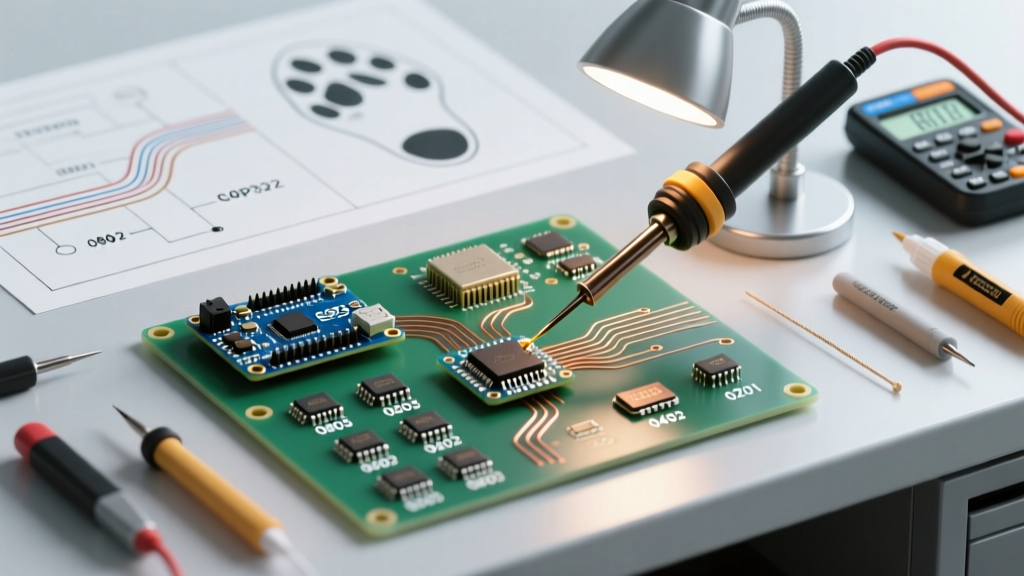
As you move from through-hole prototyping to designing custom PCBs, you will encounter Surface Mount Devices (SMDs). Because SMD resistors are too small for standard color bands, they use printed alphanumeric codes.
- 3-Digit Code (5% tolerance): The first two digits are significant figures, the third is the multiplier. '103' means 10 × 10^3 = 10,000Ω (10kΩ).
- 4-Digit Code (1% tolerance): The first three digits are significant figures. '1002' means 100 × 10^2 = 10,000Ω (10kΩ).
- EIA-96 Code (1% tolerance, 0603 size): Uses two numbers and a letter. For example, '01C' translates to a base value of 100 (from the EIA-96 lookup table) multiplied by 10^2 (C), resulting in exactly 10kΩ.
Troubleshooting and Failure Analysis
Knowing electronic components names is only half the battle; you must know how to test them when a circuit fails.
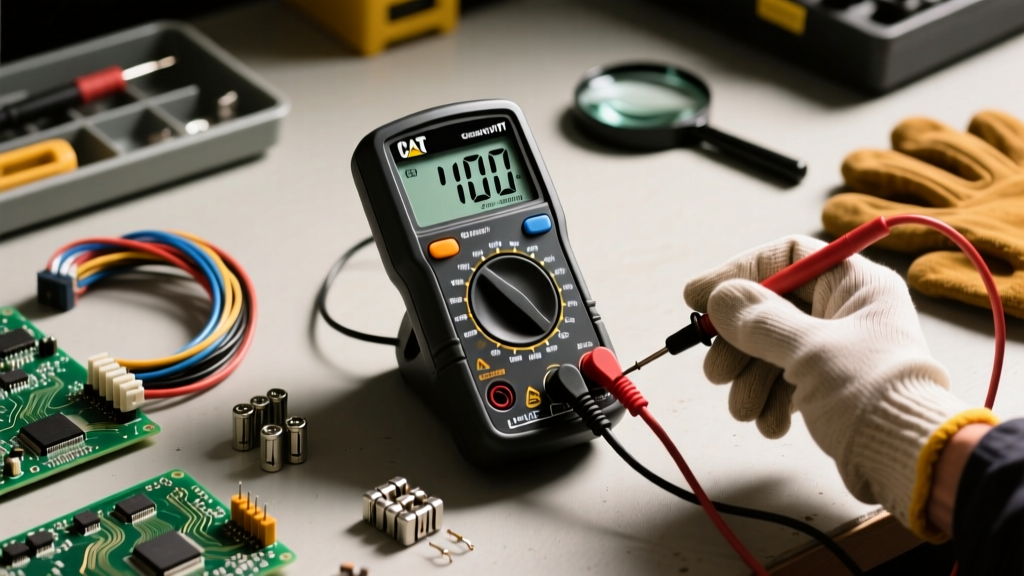
The Multimeter Diode Test
Never test a diode or LED using the resistance (Ohms) setting. Always use the Diode Test mode (indicated by a diode symbol on your multimeter). A healthy silicon diode (like the 1N4007) will show a forward voltage drop between 0.5V and 0.7V, and an 'OL' (Open Loop) when the probes are reversed. If it reads near 0.0V in both directions, the junction has shorted.
Testing Capacitors for ESR
A standard multimeter can measure capacitance, but it cannot detect a dried-out electrolytic capacitor. For power supply troubleshooting, you must use an ESR (Equivalent Series Resistance) meter. A healthy 1000µF 16V capacitor should have an ESR below 0.1Ω. If your meter reads 2.5Ω, the capacitor is chemically degraded and must be desoldered and replaced, even if it looks physically perfect.
For advanced troubleshooting techniques and schematic analysis, the Electronics Notes capacitor guide provides excellent baseline specifications for dielectric absorption and leakage currents.
Conclusion
Mastering electronic components names is the bridge between copying a tutorial and actually engineering a reliable circuit. By memorizing standard part numbers like the 2N3904, understanding the difference between X7R and Y5V ceramic dielectrics, and knowing how to read SMD EIA-96 codes, you drastically reduce assembly errors and debugging time. Keep your component bins labeled, stock up on the universal passives (10kΩ resistors, 100nF MLCCs), and always verify your active components with a multimeter before soldering them into your final PCB.