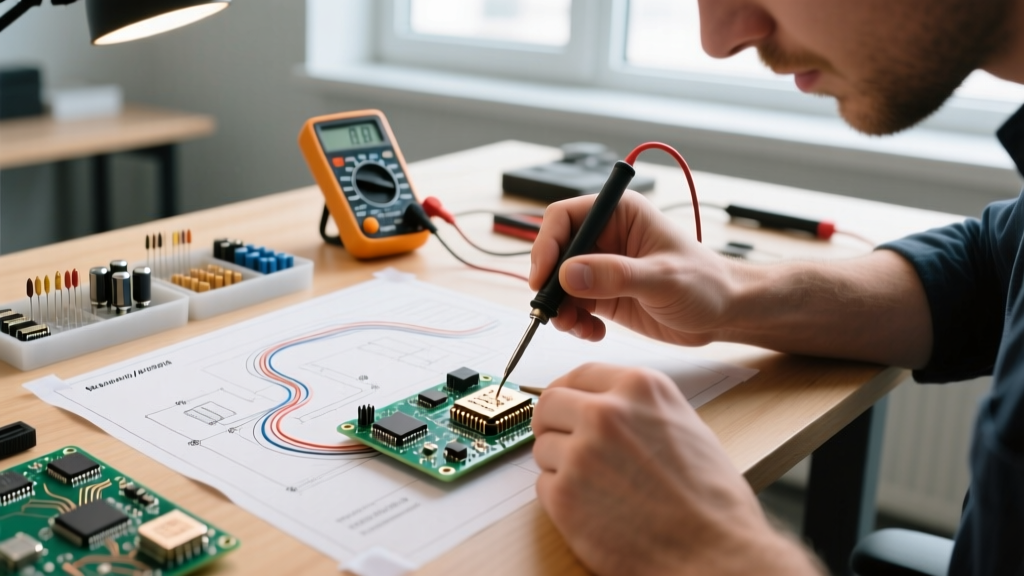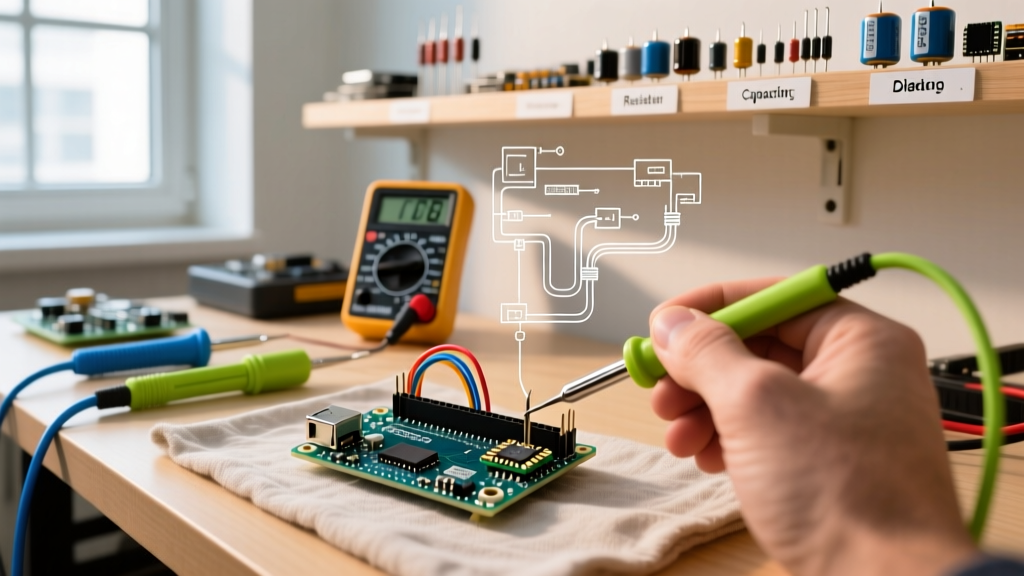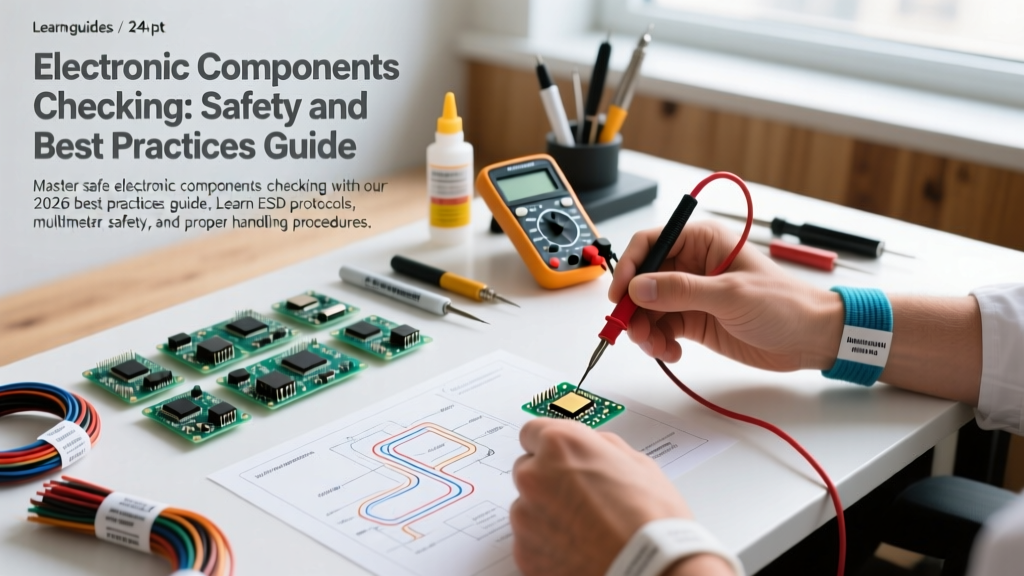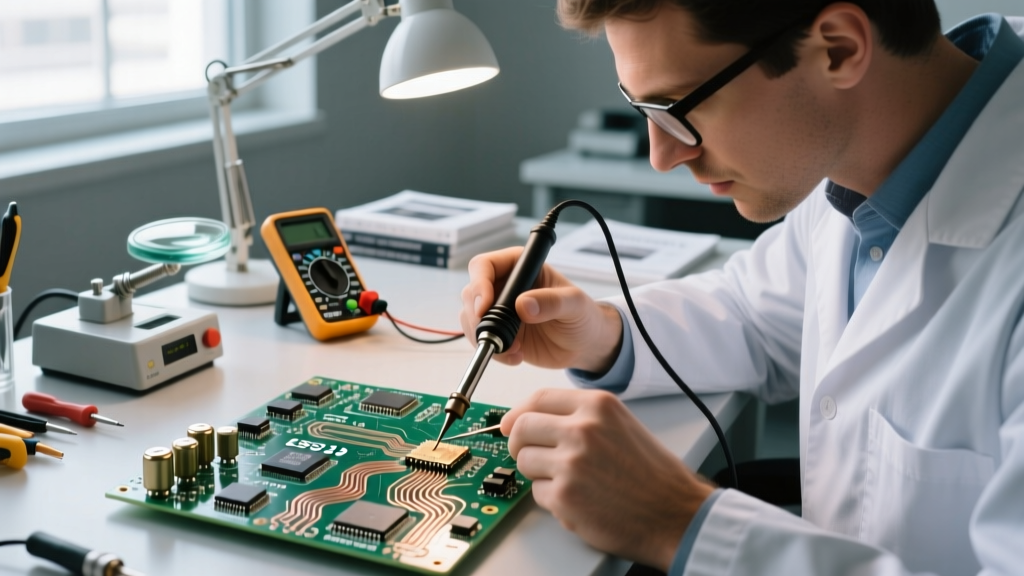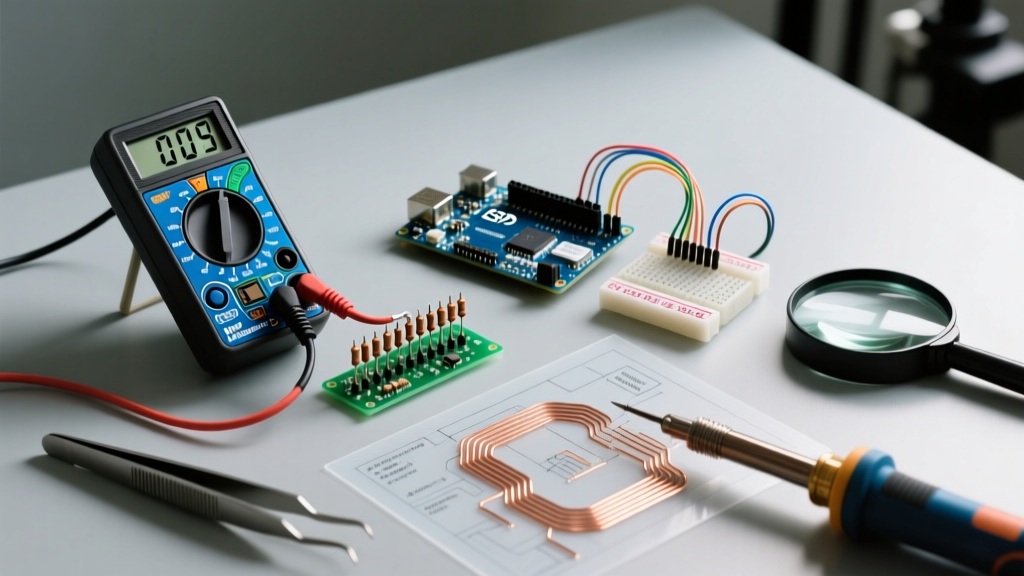

The Challenge of Identifying Common Electronic Components
Every electronics workbench eventually devolves into a chaotic graveyard of unmarked parts. Whether you are salvaging parts from old PCBs or trying to remember if a specific ceramic capacitor is 100nF or 10nF, properly identifying and testing common electronic components is a fundamental skill for any DIYer or professional engineer. In 2026, the market for component testers and assortment kits has matured significantly, offering everything from basic ATmega-based testers to advanced multi-function oscilloscopes.
In this guide, we review the most effective tools for testing, sorting, and stocking common electronic components, focusing on real-world accuracy, pricing, and specific edge cases that budget tools often fail to catch.
Top Component Testers Reviewed for 2026
A standard digital multimeter (DMM) can measure resistance and continuity, but it falls short when you need to identify the pinout of a JFET, measure the hFE of a BJT, or check the Equivalent Series Resistance (ESR) of an electrolytic capacitor. Here are the top dedicated testers we recommend.
1. Peak Atlas DCA75 Pro (The Professional Standard)
The Peak Atlas DCA75 remains the gold standard for bench-top component identification. Priced around $139.00, it automatically identifies semiconductors and displays pinouts on a high-contrast LCD.
- Strengths: Accurately distinguishes between NPN/PNP BJTs, N/P-channel MOSFETs, JFETs, and triacs. It measures leakage current and identifies protection diodes built into power MOSFETs.
- Weaknesses: It is strictly a semiconductor tester; it will not measure passive components like resistors or capacitors (you need the companion LCR45 for that).
- Best For: Repair technicians and advanced hobbyists sorting through bins of unmarked transistors and ICs.
2. FNIRSI DSO-TC3 (The Best 3-in-1 Budget Tool)
Retailing for approximately $48.50, the FNIRSI DSO-TC3 combines a component tester, a signal generator, and a basic oscilloscope into one handheld device.
- Strengths: The component testing module handles resistors, capacitors, inductors, and diodes rapidly. The 10MHz bandwidth oscilloscope is a massive bonus for visualizing PWM signals or checking crystal oscillators.
- Weaknesses: The 50MSa/s sampling rate is insufficient for high-frequency SMPS (Switch-Mode Power Supply) ripple analysis. The ZIF socket feels somewhat fragile under heavy daily use.
- Best For: Students, beginners, and field technicians who need a versatile, all-in-one diagnostic tool.
3. LCR-T4 Mega328 (The Bulk Sorting Workhorse)
At just $16.99, the generic LCR-T4 (based on the ATmega328P microcontroller) is the most popular budget tester on the market.
- Strengths: Unbeatable price-to-performance ratio for basic passives. Excellent for quickly verifying resistor values and sorting bulk diodes.
- Weaknesses: It completely fails to measure ESR, making it useless for diagnosing faulty electrolytic capacitors in power supplies. It also struggles with ceramic capacitors below 100pF due to parasitic lead inductance.
- Best For: Hobbyists who need a disposable, cheap tool for sorting bulk resistor and LED kits.
Comparison Matrix: Tester Specifications & Pricing
| Feature | Peak Atlas DCA75 | FNIRSI DSO-TC3 | Generic LCR-T4 |
|---|---|---|---|
| Price (2026) | $139.00 | $48.50 | $16.99 |
| Semiconductor ID | Excellent (Leakage, hFE, Pinout) | Good (Basic Pinout) | Fair (Basic Pinout) |
| Passive Testing | No | Yes (R, L, C) | Yes (R, L, C) |
| ESR Measurement | No (Requires LCR45) | No | No |
| Oscilloscope | No | Yes (10MHz, 50MSa/s) | No |
Recommended Assortment Kits for Common Electronic Components
Testing tools are only half the battle; you also need a well-stocked inventory. When buying assortment kits, pay close attention to the tolerance and chemistry of the included parts. Many ultra-cheap kits on Amazon pad their component counts with useless 5% carbon film resistors and low-grade 555 timers that drift under thermal load.
RexQualis 2420-Piece Component Kit
Priced at $36.99, this kit is our top recommendation for a foundational workbench stock. It includes 1/4W metal film resistors (1% tolerance), which are vastly superior for precision voltage dividers and analog sensor circuits compared to carbon film. It also features genuine Texas Instruments NE555P timers and LM317T adjustable voltage regulators, alongside a wide array of 2N2222A and BC547 transistors.
Elegoo EL-CP-003 (1860-Piece Kit)
At $28.50, the Elegoo kit is slightly smaller but offers better organization. The inclusion of a dedicated, compartmentalized plastic case is a major advantage. However, be aware that its ceramic capacitors are mostly Class 2 dielectrics (X7R/Y5V). As noted in advanced analog design, X7R MLCCs exhibit a piezoelectric effect, meaning they can generate microphonic noise in high-gain audio preamplifier circuits. For audio projects, you will still need to source specific C0G/NP0 capacitors separately.
Storage & Organization Tools
Do not store common electronic components in the flimsy ziplock bags they ship in. We highly recommend the Plano 1374-00 StowAway utility box (approx. $8.50). Its adjustable dividers allow you to create custom widths for TO-220 packages, DIP ICs, and axial resistors. Label the bins with a thermal label maker using both the component value and its primary use-case (e.g., '10kΩ - I2C Pull-up').
Failure Modes & Testing Edge Cases
Understanding how components fail is just as important as knowing how to test them. Here are critical edge cases to keep in mind when working with common electronic components:
Pro-Tip: Never trust a capacitance reading on a standard multimeter when diagnosing a failing power supply. A bad electrolytic capacitor will often read its correct capacitance value while possessing a catastrophically high ESR, rendering it useless for filtering high-frequency noise.
1. Electrolytic Capacitor ESR Degradation
Electrolytic capacitors dry out over time, especially in high-heat environments like LED drivers and ATX power supplies. This increases their Equivalent Series Resistance (ESR). According to Electronics Notes on ESR, a high ESR prevents the capacitor from responding quickly to transient current demands. To test this properly, you must use an ESR meter that injects a high-frequency AC signal (typically 100kHz) to bypass the capacitive reactance and measure only the resistive losses.
2. MOSFET Gate Threshold and Static Damage
Small-signal MOSFETs (like the 2N7000) are highly susceptible to Electrostatic Discharge (ESD). A component tester might identify the part as a MOSFET, but if the gate oxide has been micro-punctured by static, the threshold voltage (Vgs) will drift, and the part will exhibit severe leakage current. Always cross-reference the tester's leakage current reading against the manufacturer's datasheet before installing MOSFETs in high-impedance battery-powered circuits.
3. Diode Forward Voltage (Vf) Anomalies
When sorting diodes, do not rely solely on the 'diode test' mode of a cheap DMM, which often applies insufficient current to accurately measure the forward voltage drop of Schottky diodes. As detailed in SparkFun's Transistor and Semiconductor Tutorials, testing at a realistic operating current (e.g., 10mA to 20mA) using a dedicated component tester provides a much more accurate Vf reading, allowing you to reliably separate standard silicon rectifiers (1N4007, Vf ~0.7V) from Schottky diodes (1N5819, Vf ~0.3V).
Frequently Asked Questions
Can I use a standard multimeter to test common electronic components?
You can use a DMM for basic continuity, resistance, and diode drops. However, a DMM cannot identify the pinout of an unknown transistor, measure inductance, or determine the ESR of a capacitor. For comprehensive identification, a dedicated LCR or semiconductor tester is required.
Why do my ceramic capacitors measure lower than their rated value?
Class 2 ceramic capacitors (X7R, X5R, Y5V) exhibit a strong DC bias effect. When a DC voltage is applied across them, their actual capacitance can drop by 50% or more compared to their zero-bias rated value. Budget component testers apply very low test voltages, so they will read the nominal value, but the part will behave differently in a real 5V or 12V circuit.
What is the best way to store moisture-sensitive components?
While standard resistors and capacitors are fine in open bins, moisture-sensitive devices (MSDs) like certain SMD ICs and LEDs should be stored in sealed ESD bags with desiccant packs and humidity indicator cards to prevent the 'popcorn effect' during reflow soldering.