
Introduction: Why Categorization Accelerates Learning
For makers and electrical engineering students, staring at a distributor's catalog can be paralyzing. DigiKey and Mouser list tens of millions of parts, but they all fall into predictable electronic components categories. Approaching these categories as a structured skill-building path—rather than a random assortment of parts—transforms how you design, troubleshoot, and optimize circuits. As we navigate the component supply chain landscape in 2026, where lead times for specialized silicon can still fluctuate, deeply understanding the fundamental behavior of each category allows you to design with second-source alternatives confidently.
This guide maps out a progressive skill-building path through the primary electronic components categories, moving from foundational passives to complex electromechanical interfaces, complete with real-world part numbers, failure modes, and benchmark projects.
Phase 1: Passive Components (The Foundation)
Passive components cannot introduce net energy into a circuit, but they dictate signal integrity, power stability, and timing. Mastering them requires moving beyond idealized textbook models to understand parasitic effects.
Resistors: Beyond the Color Code
Beginners start with carbon composition or basic thick-film resistors, but skill-building demands understanding thermal noise and temperature coefficients (TCR). For precision analog front-ends, you must graduate to metal film resistors (e.g., the Yageo MFR-25 series). These offer 1% tolerance and a TCR of ±50ppm/°C, costing roughly $0.12 per unit in bulk.
- Failure Mode: High-voltage pulse applications can cause thick-film resistors to crack or drift. For snubber circuits or gate-drive paths, specify pulse-withstanding wirewound or specialized thick-film variants.
- Parasitic Reality: Every resistor has parallel capacitance (typically 0.1pF to 0.5pF) and series inductance. In RF circuits operating above 100MHz, a standard 1/4W axial resistor behaves more like an inductor.
Capacitors: Dielectric Selection and the DC Bias Trap
The most critical skill in the passive category is understanding Multi-Layer Ceramic Capacitor (MLCC) dielectrics. Class 1 dielectrics (C0G/NP0) are linear and stable, making them mandatory for LC filters and timing circuits. Class 2 dielectrics (X7R, X5R) offer higher volumetric efficiency for decoupling but suffer from severe non-linearities.
Expert Insight: The DC Bias Effect
A common trap for intermediate designers is specifying a 10µF, 6.3V X7R 0805 MLCC for a 5V rail decoupling network. Under a 5V DC bias, the actual capacitance of that Murata GRM series part can drop by up to 70%, leaving you with only 3µF of effective capacitance. Always consult the manufacturer's DC bias curves, or step up to a 1206 package or a higher voltage rating (e.g., 10V or 16V) to mitigate this drop.
Phase 2: Active Components (Signal Control and Amplification)
Active components rely on external power to amplify signals or act as switches. This category demands an understanding of semiconductor physics, thermal management, and dynamic switching characteristics.
Transistors: BJT vs. MOSFET Realities
While Bipolar Junction Transistors (BJTs) like the 2N3904 are excellent for learning current-controlled amplification, modern power electronics rely heavily on Metal-Oxide-Semiconductor Field-Effect Transistors (MOSFETs). The skill milestone here is understanding Gate Charge (Qg) and Rds(on).
Take the classic IRLZ44N logic-level MOSFET. It boasts an Rds(on) of roughly 22mΩ at Vgs = 5V, making it ideal for microcontroller-driven loads up to 10A. However, its total gate charge is around 63nC. If you attempt to switch it at 100kHz using a standard GPIO pin (which can only source ~20mA), the switching transitions will be sluggish, leading to massive thermal dissipation in the linear region. The skill-building solution? Implement a dedicated gate driver IC (like the Microchip MCP1402) to source the peak currents required to charge the Miller capacitance rapidly.
Integrated Circuits: The Op-Amp Leap
Moving from discrete transistors to Integrated Circuits (ICs) requires understanding internal compensation and slew rates. The LM358 is a ubiquitous, low-cost dual op-amp (~$0.30), but it suffers from crossover distortion and a sluggish slew rate of 0.3V/µs. Upgrading your skill set means knowing when to deploy a modern rail-to-rail alternative like the Texas Instruments OPA333, which offers zero-drift chopper stabilization for microvolt-level sensor amplification.
For a deeper theoretical foundation on how these active components interact at the silicon level, the MIT OpenCourseWare Circuits and Electronics curriculum remains an unparalleled, authoritative resource for bridging the gap between physics and circuit design.
Phase 3: Electromechanical and Optoelectronics (The Interface)
This category bridges the digital/analog domain with the physical world. It introduces mechanical wear, contact physics, and photonics.
Relays and Switches: Contact Bounce and Arcing
Mechanical switches and relays do not transition cleanly from open to closed. When the contacts meet, they physically bounce, creating a series of rapid electrical spikes lasting anywhere from 1ms to 10ms. In a microcontroller interrupt routine, a single button press can register as a dozen inputs.
- Hardware Debouncing: Implement an RC low-pass filter (e.g., 10kΩ resistor and 100nF capacitor) paired with a Schmitt trigger inverter (74HC14) to clean the signal before it hits the MCU.
- Inductive Kickback: When driving a relay coil (like the Omron G5LE series), the collapsing magnetic field generates a high-voltage reverse spike that will destroy your driving MOSFET. A flyback diode (1N4007) placed in reverse bias across the coil is non-negotiable.
For comprehensive data on how mechanical and environmental stresses degrade electromechanical components over time, the NASA Electronic Parts and Packaging (NEPP) Program provides extensive, publicly available research on component failure modes and reliability testing.
Optoelectronics: Beyond Basic LEDs
Skill-building in optoelectronics means moving past standard 5mm indicator LEDs to high-power illumination and optical isolation. When designing with high-power LEDs (e.g., Cree XLamp series), you must manage thermal throttling. Furthermore, for signal isolation across different ground domains, optocouplers (like the Vishay CNY17) introduce propagation delays and Current Transfer Ratio (CTR) degradation over time, which must be accounted for in high-speed digital isolator designs.
The Skill-Building Progression Matrix
Use the following matrix to benchmark your current abilities and plan your next laboratory investment. Pricing reflects typical 2026 hobbyist and small-batch maker rates.
| Phase | Component Category | Core Skill Milestone | Benchmark Project | Est. Kit Cost |
|---|---|---|---|---|
| 1 | Passives | Impedance matching & DC bias derating | Active 2nd-Order Low-Pass Audio Filter | $25 - $40 |
| 2 | Discrete Actives | MOSFET thermal management & gate driving | 10A PWM DC Motor Speed Controller | $45 - $70 |
| 3 | Linear ICs | Op-amp stability, phase margin, & noise | Thermocouple Microvolt Amplifier | $60 - $90 |
| 4 | Electromechanical | Inductive flyback & contact debouncing | Multi-Channel Relay Sequencer Box | $50 - $80 |
| 5 | Optoelectronics | Thermal throttling & galvanic isolation | Isolated I2C Sensor Bus Extender | $35 - $55 |
Strategic Inventory Building for Makers
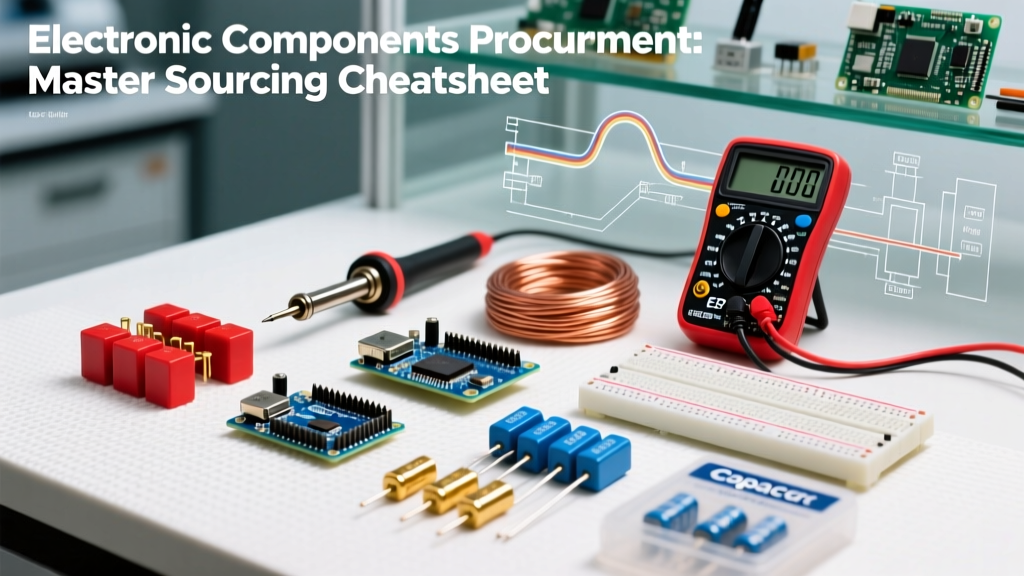
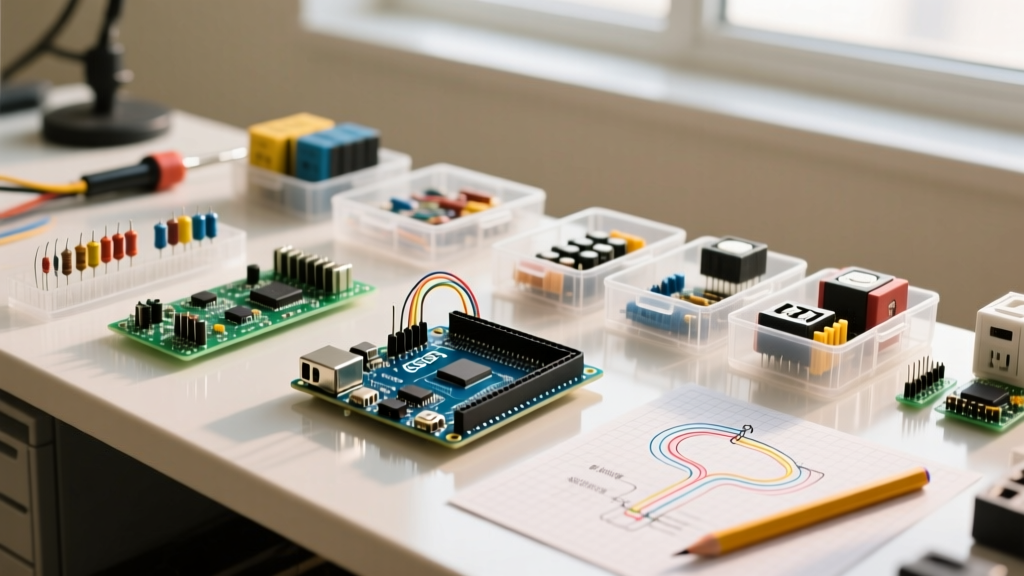
As you progress through these electronic components categories, your lab inventory must evolve. Avoid buying cheap, unbranded component kits from generic marketplaces; their tolerances are often unverified, and their moisture sensitivity levels (MSL) are unknown, leading to cracked MLCCs during soldering.
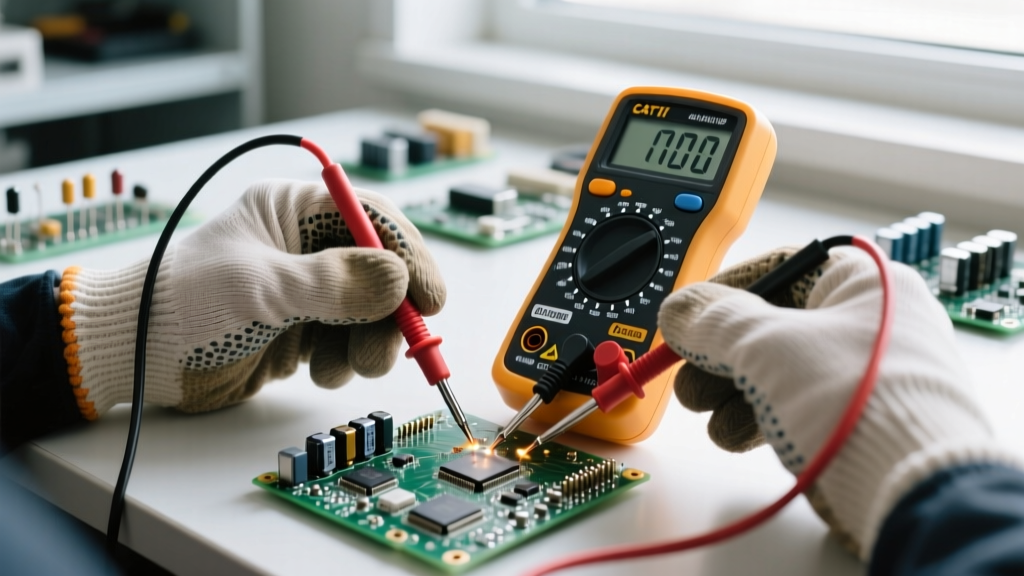
Instead, build a 'lab standard' inventory. Purchase E12/E24 resistor and capacitor kits from authorized distributors. Invest in a calibrated LCR meter (such as the Uni-T UT612, roughly $120) to verify capacitance, equivalent series resistance (ESR), and inductance. Being able to empirically measure the ESR of an aging electrolytic capacitor is a hallmark skill that separates intermediate hobbyists from advanced electronics technicians.
For further reading on practical component selection and application notes, the All About Circuits online textbook offers an excellent, continuously updated repository of tutorials that align perfectly with this skill-building path.
Conclusion
Mastering electronic components categories is not about memorizing part numbers; it is about internalizing the physical behaviors, parasitic realities, and failure modes of each component class. By following this structured skill-building path—from the subtle DC bias effects in MLCCs to the Miller plateau in MOSFETs—you will transition from simply copying schematics to engineering robust, reliable, and optimized electronic systems.