
The Hidden Complexity of Passive Components in Electronics
When designing, building, or repairing circuits, it is dangerously easy to take resistors, capacitors, and inductors for granted. In textbook theory, a 100 nF capacitor is purely capacitive. In the real world, however, every passive component is a complex network of parasitic elements. A physical capacitor possesses Equivalent Series Resistance (ESR), Equivalent Series Inductance (ESL), and parallel leakage resistance. As we move through 2026, with high-speed digital designs and RF applications pushing into the gigahertz range, understanding and measuring these parasitics is no longer optional—it is a fundamental requirement for reliable electronics.
Standard digital multimeters (DMMs) are woefully inadequate for this task. They typically measure capacitance at a single, low frequency using a basic DC-charge method, completely ignoring ESR and high-frequency behavior. To truly master passive components in electronics, you need dedicated LCR (Inductance, Capacitance, Resistance) meters, precision component testers, and systematic organization tools. This guide reviews the best equipment available to test, verify, and manage your passive inventory.
Benchtop Precision: When to Invest in High-End LCR Meters
If you are designing switched-mode power supplies (SMPS), RF filters, or high-speed memory decoupling networks, you need benchtop accuracy. Benchtop LCR meters utilize an auto-balancing bridge method, offering 4-terminal (Kelvin) measurements that eliminate lead resistance errors.
Keysight E4980A Precision LCR Meter
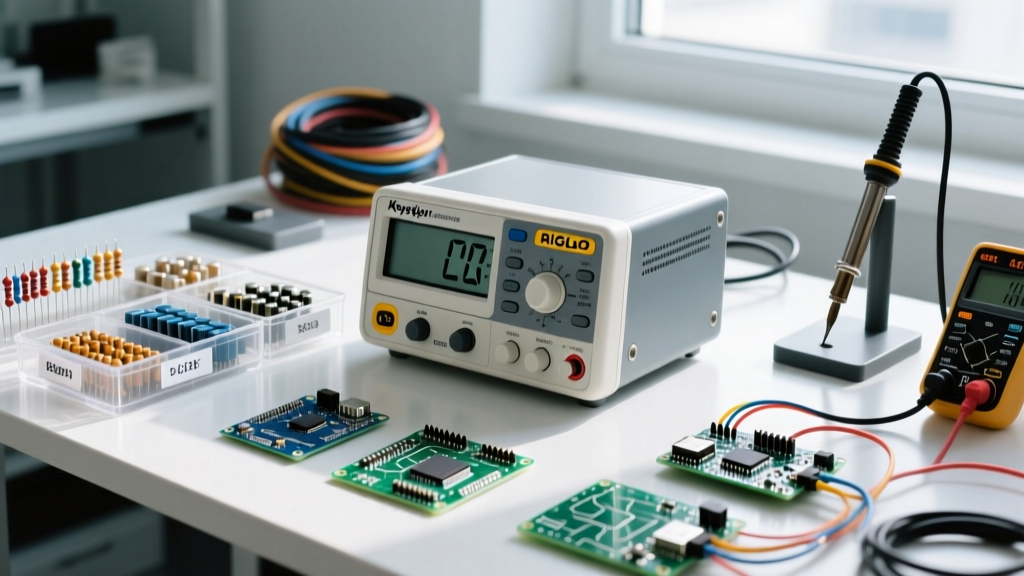
The Keysight E4980A Precision LCR Meter remains the gold standard for professional labs. Covering a frequency range from 20 Hz to 2 MHz, it allows you to characterize components exactly at their operating frequency.
- Price: ~$2,800 - $3,200 (depending on frequency and bias options)
- Accuracy: 0.05% basic accuracy
- Key Feature: 201-point frequency sweep and DC bias up to 40V (with option 001), which is critical for measuring the DC bias dependence of Class II ceramic capacitors (like X7R and Y5V dielectrics) that lose up to 80% of their capacitance under voltage.
The Sweet Spot: Mid-Range Handheld LCR Testers
For field service engineers, advanced hobbyists, and small production QA stations, a high-quality handheld LCR meter provides the perfect balance of portability, price, and performance.
DER EE DE-5000 Handheld LCR Meter
The DER EE DE-5000 is widely considered the best value in handheld LCR testing. It offers selectable test frequencies (100 Hz, 120 Hz, 1 kHz, 10 kHz, and 100 kHz) and measures series/parallel equivalents, D (dissipation factor), and Q (quality factor).
- Price: ~$110 - $130
- Accuracy: 0.1% basic accuracy
- Best For: Verifying bulk electrolytic capacitors at 120 Hz and checking high-frequency ceramic bypass caps at 100 kHz.
Peak Atlas LCR45
The Peak Atlas LCR45 takes a different approach. It is designed for rapid, automated identification and testing. You simply attach the component, press 'Test', and the LCR45 auto-selects the optimal test frequency (1 kHz, 15 kHz, or 100 kHz) and displays the component type, value, and ESR.
- Price: ~$135 USD
- Accuracy: 0.5% basic accuracy
- Key Feature: The 'In-Circuit' capability allows you to measure ESR and capacitance of capacitors without desoldering them from the PCB, provided the surrounding parallel impedance is sufficiently high.
Budget & DIY: Component Testers for Quick Sorting
Mega328 Multi-Function Tester (TC1 / LCR-T4 Variants)
Found on Amazon and AliExpress for $15 to $25, these open-source based testers use a microcontroller to apply test waveforms and calculate component values. While they are excellent for quickly identifying the pinout of transistors, triacs, and diodes, they are not precision LCR meters.
Expert Warning: Do not rely on Mega328 testers for measuring the ESR of low-impedance polymer capacitors or the exact value of sub-100pF RF capacitors. The test signal amplitude and frequency stability on these budget boards are too inconsistent for precision work. Use them strictly for rough sorting and binning of through-hole components.
Comparison Matrix: Choosing the Right Tool
| Model | Type | Freq Range | Basic Accuracy | Est. Price | Best Application |
|---|---|---|---|---|---|
| Keysight E4980A | Benchtop | 20 Hz - 2 MHz | 0.05% | $2,800+ | R&D, RF design, DC bias testing |
| DER EE DE-5000 | Handheld | 100 Hz - 100 kHz | 0.1% | $120 | Bench QA, SMPS repair, general lab |
| Peak Atlas LCR45 | Handheld | 1k/15k/100 kHz | 0.5% | $135 | Field repair, in-circuit ESR checks |
| Mega328 (TC1) | DIY Tester | Fixed (Low) | ~5% | $20 | Quick binning, transistor pinout |
Organization: Managing Your Passive Inventory
Testing is only half the battle; organizing passive components in electronics is equally critical. Mixing up a 10kΩ and a 100kΩ resistor can lead to hours of debugging.
Through-Hole Storage: Akro-Mils 10164
The Akro-Mils 10164 (64-drawer steel cabinet) is the industry standard for through-hole passives. Pro-Tip: Use a label maker to print standard E12/E24 series values, and always store components with their color bands or value markings facing UP. Never mix 1/4W and 1/2W resistors in the same drawer.
SMD Storage: Tape-Cutout Organizers
As 0402 (1.0mm x 0.5mm) and 0603 (1.6mm x 0.8mm) SMD components dominate modern designs, traditional drawer systems fail. The best method for 2026 is the 'Tape-Cutout' system. Cut the component tape 3-4 holes behind the part, fold it, and store it in specialized SMD organizer books (like those from Velleman or generic grid-foil binders). This keeps the parts in their anti-static, moisture-barrier packaging until the exact moment they hit the pick-and-place machine or your tweezers.
Expert Techniques: Measuring Parasitics Accurately
To extract meaningful data from your LCR meter, you must follow strict measurement protocols:
- Perform Open/Short Compensation: Every time you change test leads, tweezers, or frequencies, you must run an Open/Short calibration. This mathematically subtracts the parasitic capacitance (Open) and series resistance/inductance (Short) of your test fixture.
- Select the Correct Test Frequency:
- 120 Hz: Use for bulk aluminum electrolytic and tantalum capacitors (filtering).
- 1 kHz: Use for general-purpose film and ceramic capacitors.
- 100 kHz / 1 MHz: Use for high-frequency bypass/decoupling MLCCs and RF inductors.
- Mind the Test Voltage: High-K dielectric ceramics (X5R, X7R, Y5V) exhibit severe voltage coefficients. A 10 µF X5R 0805 capacitor might measure 10 µF at the LCR meter's default 1Vrms test signal, but drop to 2 µF when subjected to its 10V rated DC bias in-circuit. Always check the manufacturer's DC bias graphs.
Frequently Asked Questions (FAQ)
Can a standard multimeter measure capacitance accurately?
Standard DMMs can give a rough baseline for large capacitors (e.g., verifying a 1000 µF electrolytic isn't completely dead), but they cannot measure ESR, ESL, or Dissipation Factor. Furthermore, DMMs often struggle to discharge large capacitors safely before measuring, which can blow the internal meter fuse or damage the ADC.
Why does my capacitor read a lower value at 100kHz than at 100Hz?
This is a common characteristic of electrolytic capacitors. Due to the physical construction of the wound foil and the electrolyte's ionic mobility, the effective capacitance drops as frequency increases. Conversely, for some ceramic capacitors, parasitic inductance (ESL) can cause the impedance curve to bottom out at the self-resonant frequency (SRF), making the component appear inductive rather than capacitive above that point.
What is the difference between Series (Cs) and Parallel (Cp) measurement modes?
Use Series mode (Cs-Rs) for low-impedance components (large capacitors, small inductors, and low-value resistors). Use Parallel mode (Cp-Rp) for high-impedance components (small capacitors, large inductors, and high-value resistors). Choosing the wrong model on your LCR meter will result in significant calculation errors, especially when the Dissipation Factor (D) is high.