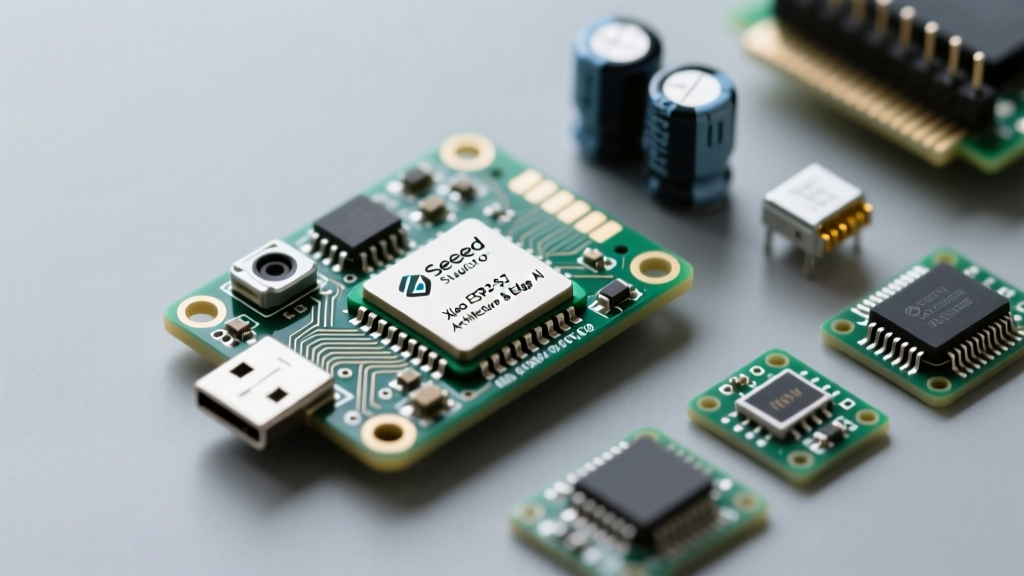

The maker market is saturated with development boards, but the Seeed Studio XIAO ESP32-S3 carves out a distinct niche by packing high-performance edge computing capabilities into a 21x17.5mm footprint. While standard microcontrollers are excellent for reading sensors and toggling relays, the XIAO ESP32-S3 is engineered for a different paradigm: local machine learning, computer vision, and complex IoT routing. Understanding the silicon architecture, memory mapping, and hardware quirks of this board is essential before you integrate it into your next edge AI project.
The Silicon Heart: Understanding the ESP32-S3 Architecture
At the core of the XIAO ESP32-S3 is the Espressif ESP32-S3 SoC. Unlike the original ESP32 which utilized the Xtensa LX6 architecture, the S3 variant upgrades to the dual-core Xtensa 32-bit LX7 microprocessor, clocking in at up to 240 MHz. This architectural shift is not merely a bump in clock speed; it fundamentally changes how the chip handles mathematical workloads. The LX7 core introduces native vector instructions to the instruction set architecture (ISA). For embedded developers, this means the MCU can perform Single Instruction, Multiple Data (SIMD) operations, drastically reducing the CPU cycles required for matrix multiplications and convolutional neural network (CNN) inference.
Furthermore, the ESP32-S3 integrates native USB OTG (On-The-Go) support. This eliminates the need for external USB-to-UART bridge chips like the CP2102 or CH340, reducing the board's physical footprint and power draw while enabling native HID (Human Interface Device) emulation directly from the microcontroller.
Why AI and Machine Learning Matter on a Thumb-Sized Board
Running AI models on microcontrollers—often referred to as TinyML—requires aggressive optimization. Frameworks like TensorFlow Lite for Microcontrollers rely heavily on quantized 8-bit integer math. The vector instructions in the ESP32-S3 allow the processor to execute multiple 8-bit MAC (Multiply-Accumulate) operations in a single clock cycle. In practical terms, this allows the XIAO ESP32-S3 to run keyword spotting, gesture recognition, and basic person-detection models locally, without the latency, privacy risks, or bandwidth costs associated with sending raw sensor data to the cloud.
Hardware Deep Dive: Power, Memory, and the Camera Interface
Seeed Studio made specific component choices to support AI and vision workloads. The most critical addition is the inclusion of external PSRAM (Pseudo-Static RAM). While the internal SRAM of the ESP32-S3 is limited to 512KB, the XIAO board integrates an 8MB PSRAM chip alongside 8MB of SPI Flash. This external memory is mapped into the MCU's address space and is absolutely mandatory when working with camera frame buffers or loading larger TensorFlow Lite model weights.
| Specification | XIAO ESP32-S3 Details |
|---|---|
| Microcontroller | ESP32-S3 (Dual-core Xtensa LX7 @ 240MHz) |
| Wireless | Wi-Fi 4 (802.11 b/g/n) & Bluetooth 5 (LE) |
| Memory | 512KB SRAM, 8MB Flash, 8MB PSRAM |
| Camera Interface | DVP (Digital Video Port) via FPC connector |
| Battery Management | BQ21040 Mopic Li-Ion Charging IC |
| Dimensions | 21 x 17.5 x 3.95 mm |
The DVP Camera Interface Trade-offs
The XIAO ESP32-S3 features a 24-pin FPC (Flexible Printed Circuit) connector designed for the OV2640 camera module. This utilizes the ESP32-S3's dedicated DVP (Digital Video Port) peripheral, which is vastly superior to software-based I2S camera polling. However, makers must understand the GPIO tax. The XIAO form factor only breaks out 11 usable digital/analog GPIO pins to the user. Routing the 8-bit DVP data bus, VSYNC, HREF, and I2C control lines to the camera consumes almost all available internal pins. If your project requires both computer vision and multiple external I2C/SPI sensors, you will quickly hit a pinout bottleneck, requiring the use of I2C multiplexers or shifting to a larger board.
Practical Gotchas: Bootloader Modes and Antenna Selection
Working with the XIAO ESP32-S3 in the Arduino IDE or ESP-IDF environment comes with specific hardware quirks that frequently trap beginners.
Entering UART Download Mode
Unlike boards with dedicated auto-reset circuitry for flashing, the XIAO ESP32-S3 requires manual intervention to enter the serial bootloader if the auto-flash sequence fails. GPIO0 dictates the boot mode. To force the chip into download mode, you must bridge the 'BOOT' button (which pulls GPIO0 to GND) and press the 'RESET' button while holding BOOT down. Release RESET, then release BOOT. Failing to do this results in the dreaded 'Failed to connect to ESP32: Timed out waiting for packet header' error in the Arduino IDE.
The Antenna Bridge Trap
The board ships with a high-efficiency onboard ceramic antenna. However, it also features a U.FL connector for external high-gain antennas. A common failure mode in DIY deployments is poor Wi-Fi range, caused by developers plugging in a U.FL antenna without modifying the RF routing. The board utilizes a 0-ohm resistor (or solder bridge pad) near the antenna trace to select the RF path. By default, it routes to the ceramic antenna. To use the U.FL connector, you must desolder or cut the trace to the ceramic antenna and bridge the alternate pads to route the signal to the U.FL port. Ignoring this results in severe signal attenuation and packet loss.
XIAO ESP32-S3 vs. XIAO RP2040 vs. XIAO ESP32C3
Choosing the right XIAO board depends entirely on your project's computational and connectivity requirements. Below is a functional comparison to aid in component selection.
| Feature | XIAO ESP32-S3 | XIAO RP2040 | XIAO ESP32C3 |
|---|---|---|---|
| Core Architecture | Dual-core LX7 (240MHz) | Dual-core Cortex-M0+ (133MHz) | Single-core RISC-V (160MHz) |
| Wireless | Wi-Fi + BLE 5 | None | Wi-Fi + BLE 5 |
| AI / ML Suitability | High (Vector Instructions) | Low (No FPU/Vector) | Medium (RISC-V, no vector) |
| Camera Support | Native DVP (OV2640) | Software I2S (Slow) | None |
| Best Use Case | Edge AI, Vision IoT | Low-power sensors, HID | Basic Wi-Fi IoT nodes |
Final Verdict for Makers and Edge AI Developers
The Espressif ESP32-S3 architecture represents a massive leap forward for embedded machine learning, and Seeed Studio's implementation in the XIAO form factor is arguably the most accessible way to deploy it. The inclusion of 8MB PSRAM and a native DVP camera connector transforms what would normally be a complex, multi-board vision system into a single, thumb-sized module. However, developers must respect the hardware constraints: plan your GPIO allocation carefully before committing to the camera module, and always verify your RF antenna bridge configuration before sealing your project in an enclosure. When leveraged correctly, the XIAO ESP32-S3 bridges the gap between simple microcontroller automation and true edge intelligence.