
The Core Definition: What Is a Ground Conductor?
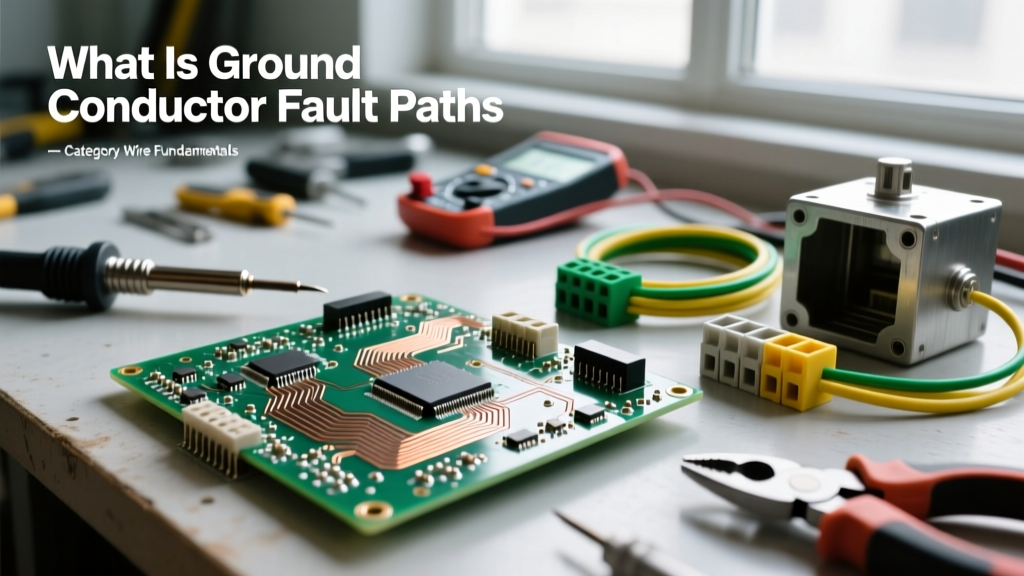
When DIYers and apprentice electricians ask, "what is ground conductor," they are usually referring to the bare copper or green-insulated wire found inside standard NM-B (Romex) cable. In electrical engineering and National Electrical Code (NEC) terminology, this specific wire is formally known as the Equipment Grounding Conductor (EGC).
The EGC is a dedicated, non-current-carrying safety pathway designed to connect the exposed, non-current-carrying metal parts of electrical equipment (like appliance chassis, metal junction boxes, and receptacle yokes) back to the electrical service source. Under normal operating conditions, the ground conductor carries exactly zero amperes. Its sole purpose is to spring into action during a catastrophic failure—a ground fault—to provide a low-impedance path that allows enough current to flow to instantly trip the circuit breaker.
The Great Misconception: Earth vs. Source
To truly understand what a ground conductor is, we must dismantle the most dangerous myth in residential wiring: the idea that electricity wants to "go to the dirt."
"Current does not seek the earth; it seeks its source. The earth is a terrible conductor and cannot reliably clear a lethal fault."
If a live 120V wire frays and touches the metal casing of your washing machine, the fault current does not travel down the ground wire into the soil to dissipate. Instead, the fault current travels back through the EGC to the main service panel, where it jumps to the neutral bus bar, and returns to the utility transformer. This creates a massive, instantaneous short circuit (a "fault loop"). The resulting spike in amperage forces the breaker to trip in a fraction of a second, removing the voltage before a human touching the washer can become the alternate path to the source.
For a comprehensive breakdown of this physics principle, the Mike Holt Enterprises Grounding vs Bonding guide remains one of the most authoritative resources in the electrical trade.
Decoding the "Big Three" Grounding Terms
The NEC uses highly specific language that frequently trips up hobbyists. To size and install wiring correctly, you must differentiate between three distinct conductors:
1. Equipment Grounding Conductor (EGC)
This is the safety wire we are discussing. It bonds metal equipment to the service panel. It is typically bare copper, green, or green with a yellow stripe. It does not carry current unless a fault occurs.
2. Grounded Conductor (The Neutral)
Often confused with the ground, the neutral is the white or gray wire that does carry current under normal operation. It is the intentional return path for the 120V/240V circuit. It is "grounded" at the main panel (bonded to earth), which is why it shares the name, but its function is entirely different from the EGC.
3. Grounding Electrode Conductor (GEC)
This is the heavy-gauge wire (usually #4 to #2/0 AWG copper) that connects the main service panel's neutral bus bar to the physical earth—specifically to ground rods, ufer grounds, or municipal metal water pipes. Its primary job is to bleed off high-voltage transient surges (like lightning strikes or transformer cross-phasing) into the earth, stabilizing the system voltage.
The Physics of a Fault: Impedance and Trip Curves
Why does the NEC care so much about the sizing and routing of the EGC? The answer lies in Ohm's Law and the magnetic trip curve of a standard thermal-magnetic circuit breaker.
A standard 20-amp breaker requires a massive spike in current—typically between 100A and 200A (5x to 10x its rated capacity)—to trigger the electromagnetic latch and trip in under 0.1 seconds. If your ground conductor is too thin, too long, or poorly connected, its impedance (Z) will be too high.
Consider a 120V fault on a circuit with a high-impedance ground path of 8 ohms. Using Ohm's Law (I = V / Z), the fault current will only be 15 amps (120V / 8Ω). Because 15A is below the instantaneous magnetic trip threshold of a 20A breaker, the breaker will not trip immediately. The metal casing of the appliance will remain energized at a lethal 120V potential, waiting for a human to touch it and complete the circuit. The NFPA 70 National Electrical Code mandates strict EGC sizing in Article 250.122 specifically to keep fault loop impedance low enough to guarantee instantaneous breaker clearing.
NEC Sizing Rules: Minimum Ground Wire Gauges
Unlike ungrounded (hot) conductors, which are sized based on the continuous load of the appliances, the Equipment Grounding Conductor is sized based entirely on the rating of the Overcurrent Protective Device (OCPD)—the breaker or fuse protecting the circuit.
Below is a simplified reference chart based on NEC Table 250.122 for standard branch circuits:
| OCPD Rating (Amps) | Minimum Copper EGC (AWG) | Minimum Aluminum EGC (AWG) |
|---|---|---|
| 15A | 14 AWG | 12 AWG |
| 20A | 12 AWG | 10 AWG |
| 30A | 10 AWG | 8 AWG |
| 40A | 10 AWG | 8 AWG |
| 60A | 10 AWG | 8 AWG |
| 100A | 8 AWG | 6 AWG |
| 200A | 6 AWG | 4 AWG |
The Proportionality Rule: Upsizing for Voltage Drop
Here is where many intermediate DIYers fail their rough-in inspections. According to NEC 250.122(B), if you are required to upsize your hot and neutral wires to compensate for voltage drop on a long run, you must proportionally upsize the ground conductor as well.
For example, if you are wiring a detached garage 150 feet away on a 20A breaker. Normally, 12 AWG copper is sufficient. However, to keep voltage drop under 3%, you calculate that you need to upsize to 8 AWG copper for the hot and neutral. Because you increased the cross-sectional area of the ungrounded conductors by two standard sizes (12 to 10, 10 to 8), you must increase the EGC by the exact same proportion. Your ground wire must also be upgraded from 12 AWG to 8 AWG. Failing to do this leaves the circuit with a high-impedance fault path relative to the breaker's capacity.
Grounding vs. Bonding: A Critical Distinction
You cannot fully grasp what a ground conductor is without understanding bonding.
- Grounding is the physical connection of an electrical system to the earth (via the GEC and ground rods). It protects against extreme overvoltages and lightning.
- Bonding is the intentional connection of all exposed metal parts together to create a continuous, low-impedance fault path back to the source.
The EGC is technically a bonding conductor. When you attach a bare copper wire to a metal junction box and a receptacle yoke, you are bonding those components together so they share the same electrical potential. If a fault occurs, the bond ensures the breaker trips. Earth grounding does not clear faults; metallic bonding does.
Real-World Troubleshooting: Spotting Bootleg Grounds
In older homes (pre-1960s), true equipment grounding conductors were not required. Unscrupulous sellers or amateur handymen sometimes install "bootleg grounds" to trick modern 3-prong receptacle testers. A bootleg ground involves placing a small jumper wire between the neutral terminal and the ground screw on the back of a 2-prong to 3-prong receptacle upgrade.
This is incredibly dangerous. If the neutral wire ever breaks upstream, the metal chassis of whatever you plug into that outlet will instantly become energized with 120V, and the breaker will not trip.
How to test for a bootleg ground without tearing open the walls:
- Plug in a high-draw appliance (like a hair dryer or heat gun) to the suspect outlet and turn it on.
- Using a high-quality digital multimeter (like a Fluke 116), measure the AC voltage between the Neutral slot and the Ground slot.
- Under load, if you read a measurable voltage (e.g., 1V to 5V), the ground is likely tied to the neutral somewhere in the circuit, confirming a bootleg or a neutral-ground bond downstream of the main panel.
- A true, dedicated EGC back to the panel should read less than 0.5V to the neutral under normal residential loading conditions.
Understanding the precise function, physics, and code requirements of the equipment grounding conductor separates safe, code-compliant electrical work from hazardous guesswork. Always verify your fault paths, respect the proportionality rules, and remember that the ground wire's ultimate loyalty is to the source, not the soil.