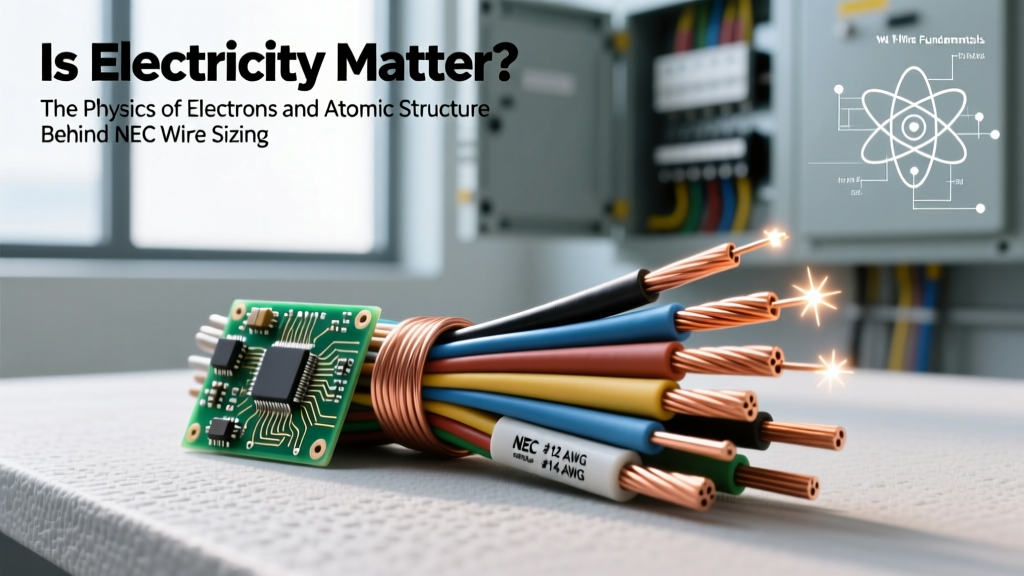

The Core Question: Is Electricity Matter?
When students, apprentices, and even seasoned engineers ask, "is electricity matter?", the answer requires a precise distinction between physics and electrical engineering. In strict physical terms, electricity itself is not matter; it is a physical phenomenon associated with the presence and motion of matter that possesses an electric charge. However, the carriers of electricity—electrons—are indeed matter. They are subatomic fermions with a specific rest mass (9.109 × 10⁻³¹ kg) and physical volume.
From the perspective of electrical codes and standards, this distinction is not merely academic. The National Electrical Code (NEC) does not regulate the flow of energy itself; rather, it strictly regulates the matter used to contain, conduct, and insulate that energy. Understanding how atomic matter interacts with electrical energy is the foundational premise of NEC Article 310 (Conductors for General Wiring) and global IEC standards.
Defining the Boundary: Electrons (Matter) vs. Current (Energy)
To understand how electrical codes are written, we must separate the medium from the mechanism. According to the U.S. Department of Energy, electricity is the flow of electrical power or charge. The charge itself is a fundamental property of matter, but the flow (current, measured in Amperes) and the pressure (voltage, measured in Volts) are forms of energy transfer.
- Matter (The Medium): Copper (Cu), Aluminum (Al), Cross-Linked Polyethylene (XLPE), and Polyvinyl Chloride (PVC). These have atomic structures, mass, thermal expansion coefficients, and melting points.
- Energy (The Mechanism): Electromotive force (Voltage), Current (Amperage), and Wattage. These do not have mass or volume; they are measurable states of the matter they interact with.
When an inspector evaluates a commercial switchgear installation, they are verifying that the physical properties of the installed matter are rated to withstand the thermal and magnetic forces generated by the energy passing through it.
How the NEC Regulates Matter to Control Electricity
The NEC is essentially a massive catalog of material science limitations. Because electricity is not matter, it cannot be "contained" in a vacuum without extreme conditions (like particle accelerators). It requires physical matter to travel. The code dictates exactly which types of matter are legally and safely permitted for this task.
Conductor Materials: Atomic Structure and NEC Article 310
NEC Section 310.14 explicitly dictates conductor materials: "Conductors shall be of copper, aluminum, or copper-clad aluminum." Why these specific forms of matter? It comes down to atomic valence shells.
Copper (Atomic Number 29) has a single free electron in its outermost 4s orbital. This atomic structure allows electrons to drift through the metallic lattice with minimal resistance (1.68 × 10⁻⁸ Ω·m at 20°C). Aluminum (Atomic Number 13) has a different crystalline structure and higher resistivity (2.82 × 10⁻⁸ Ω·m), meaning it generates more thermal energy (heat) when current flows through it. Consequently, the NEC requires aluminum conductors to be sized larger than copper for the exact same ampacity. The code is directly adjusting for the physical limitations of aluminum matter.
Insulation Matter: Dielectric Strength and Thermal Limits
If the conductor is the highway for electrons, the insulation is the guardrail. Insulation materials are dielectrics—matter engineered to resist the flow of electricity. The NEC classifies insulation matter based on its thermal and chemical resilience.
Code Insight: A 90°C rating on THHN (Thermoplastic) wire does not mean the electricity is 90°C. It means the physical PVC and nylon matter comprising the jacket will not melt, degrade, or lose its dielectric strength until it reaches 90°C. Ampacity tables (NEC Table 310.16) are entirely based on the thermal limits of insulating matter.
Cross-linked polyethylene (XLPE), used in XHHW-2 wiring, undergoes a chemical vulcanization process that alters its molecular matter from a thermoplastic to a thermoset. This change in matter allows it to withstand higher fault currents and wet environments without breaking down, a distinction heavily regulated by UL safety standards and the NEC.
Matter vs. Energy: A Code Compliance Comparison Table
Understanding the interplay between matter and energy is critical for proper wire sizing and derating. The following table illustrates how physical properties of matter dictate electrical code requirements.
| Physical Matter Property | Electrical Energy Interaction | NEC / Code Standard Response |
|---|---|---|
| Electrical Resistivity (Copper vs. Aluminum) | Higher resistance generates more I²R heat (energy loss). | NEC 310.15: Aluminum requires larger gauge (lower AWG number) than copper for equal ampacity. |
| Thermal Expansion Coefficient | Heat from current causes physical matter to expand and contract. | NEC 110.14: Mandates specific torque values on terminals to prevent matter from loosening under thermal cycling. |
| Dielectric Breakdown Voltage | High voltage energy forces electrons through insulating matter. | NEC Article 300: Dictates minimum insulation thickness and separation distances based on voltage stress. |
| Galvanic Reactivity (Dissimilar Metals) | Moisture + dissimilar matter creates a battery effect (corrosion). | NEC 110.14(A): Prohibits direct connection of copper to aluminum without antioxidant compounds and rated bimetallic lugs. |
Real-World Failure Modes When Matter Fails the Energy
When electrical systems fail, it is almost always because the physical matter was subjected to energy levels beyond its atomic or molecular tolerances. As a domain expert troubleshooting field failures, I categorize these into three primary matter-energy conflicts:
1. Aluminum Creep and Thermal Mismatch
Aluminum matter exhibits a property called "creep"—a slow, permanent deformation under continuous mechanical stress (like the pressure of a screw terminal). When alternating current (AC) energy flows, it causes thermal cycling. The aluminum matter expands, pushes against the terminal, and then contracts as it cools. Over time, the matter physically deforms, the connection loosens, resistance increases, and the resulting arc-fault energy causes a fire. This physical behavior is why the NEC outlawed small-gauge solid aluminum branch-circuit wiring in the 1970s.
2. Dielectric Breakdown and Corona Discharge
In high-voltage applications (above 2000V, governed by NEC Article 490), the electrical energy can become so intense that it ionizes the air surrounding the conductor. This plasma energy attacks the insulating matter (like EPR or XLPE), creating micro-fractures known as electrical trees. Eventually, the matter completely fails, resulting in a phase-to-ground fault.
3. The Skin Effect in AC Matter
Because alternating current reverses direction 120 times a second (in a 60Hz system), magnetic fields push the electron flow toward the outer surface of the conductor matter. This "skin effect" means the core of a thick copper wire carries almost no energy. To combat this, code standards for large feeders mandate the use of stranded wire or hollow tubular busbars—optimizing the physical shape of the matter to match the behavior of AC energy.
Summary for Engineers and Electricians
So, is electricity matter? No. Electricity is the energy of moving charges. But without matter, electricity has no pathway, no containment, and no utility. The entire framework of the National Electrical Code, IEC standards, and UL listings is dedicated to managing the physical limitations of conductive and insulating matter. By mastering the material science behind your wires, lugs, and insulation, you move beyond simply memorizing code tables and begin to understand the fundamental physics that keep electrical systems safe, efficient, and compliant.