
Demystifying Type MC Cable: Armor, Conductors, and Grounding
When commercial electricians and advanced DIYers need a wiring method that offers superior physical protection without the labor-intensive cost of rigid metal conduit, type mc cable (Metal Clad Cable) is the undisputed industry standard. Unlike older wiring methods, modern MC cable provides a robust, interlocking metal armor that shields the internal conductors from crush damage, rodent intrusion, and impact.
At its core, standard type MC cable consists of three or more THHN/THWN-2 insulated conductors, a bare or green-insulated equipment grounding conductor, and a paper or polyester binder wrap. This assembly is encased in an interlocking armor made of either galvanized steel or aluminum. According to Southwire's Metal Clad Cable catalog, the aluminum armor variant is increasingly popular in commercial builds due to its lighter weight, which significantly reduces installer fatigue during long overhead pulls.
Material Procurement: Selecting the Right Cable and Fittings
Choosing the correct materials goes far beyond simply picking a wire gauge. The environment and the termination points dictate your exact bill of materials.
Standard MC vs. MC-HL (Hazardous Locations)
Standard interlocking MC cable is approved for most commercial and industrial applications. However, if you are wiring in a Class I, Division 1 hazardous location (such as a fuel processing facility or chemical plant), you must source MC-HL (Hazardous Location) cable. MC-HL features a continuous, gas-tight corrugated aluminum sheath beneath the interlocking armor, preventing explosive gases from migrating through the cable core.
Termination Fittings: Compression vs. Set-Screw
The fitting connects the cable to the junction box and provides the vital mechanical bond. You generally have two choices:
- Set-Screw Fittings: Made from die-cast zinc, these use a small screw to bite into the metal armor. They are fast to install but can occasionally loosen under heavy vibration.
- Compression Fittings: These utilize a threaded compression nut that squeezes a ferrule tightly around the cable armor. As detailed in the Arlington Industries MC fittings guide, compression fittings provide a superior, concrete-tight mechanical bond and are highly recommended for high-vibration environments or when pulling heavy loads.
The Non-Negotiable Anti-Short Bushing
Often called 'red heads' in the trade, anti-short bushings are plastic inserts placed over the cut end of the cable armor before termination. The interlocking metal edges of cut MC cable are razor-sharp. If the cable shifts inside the connector, those sharp edges can slice through the THHN insulation, causing a dead short or ground fault. NEC Article 330.12 strictly requires these bushings to protect the conductors from abrasion.
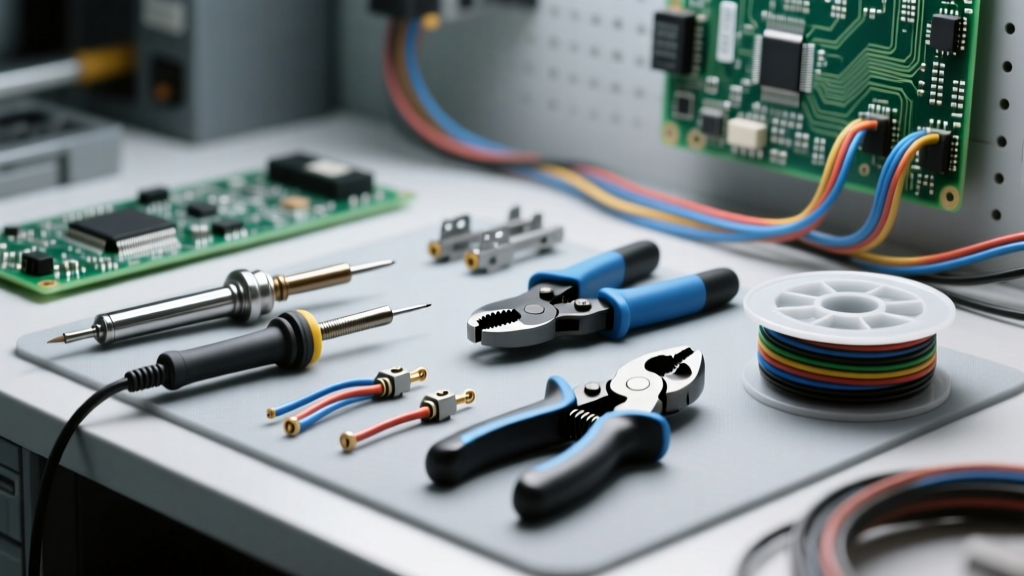
The Professional’s Tool Arsenal for MC Prep
Stripping type MC cable requires precision. Scoring the internal THHN insulation is a critical failure mode that can lead to catastrophic arc faults years after the wall is closed up. Ditch the side cutters and invest in purpose-built tools.
1. Manual MC Cable Rippers
For precision work in tight junction boxes, a manual ripper is essential. The Milwaukee 48-22-0116 MC Cable Ripper is a benchmark tool in the industry. It features an adjustable blade depth that scores the interlocking armor longitudinally without touching the internal paper wrap or wire insulation. You simply insert the tool, twist to split the armor, and peel it back.
2. Rotary MC Cutters
For high-volume rough-ins, a rotary cutter saves hours of labor. Tools like the Greenlee 8404 or the Malco MC9000 clamp onto the cable and spin a cutting wheel around the circumference. Pro-Tip: Always adjust the cutting depth to cut only 75% through the armor thickness. Snap the remaining 25% by bending the cable. Cutting 100% through with a rotary tool guarantees you will score the underlying copper conductors.
3. Torque Screwdriver
If you are using compression fittings or torque-sensitive lugs, a calibrated torque screwdriver (such as the Klein Tools 70900) ensures you meet the manufacturer's exact pound-inch requirements, preventing loose neutral connections that cause thermal imaging hotspots.
Failure Modes: Where Journeymen and DIYers Go Wrong
Even with the right type MC cable, poor installation techniques lead to failed inspections and fire hazards. Avoid these common pitfalls:
- Leaving the Paper Binder Inside the Connector: The paper wrap inside MC cable is highly flammable. If left protruding into the junction box or trapped inside a set-screw connector, a minor arc fault can ignite the paper, turning the cable armor into a chimney. Always strip the paper back at least 1/2 inch past the connector.
- Over-Tightening Set-Screws: Cranking down on a set-screw connector with a heavy-duty impact driver will dent the soft aluminum or copper conductors inside, increasing electrical resistance and generating excessive heat under load.
- Using NM-B Staples: You cannot use standard Romex (NM-B) nail plates or plastic staples for MC cable. The metal armor requires specific metal MC cable straps or stackable MC connectors to maintain proper grounding continuity and physical support.
Material Comparison Matrix: MC vs. AC vs. BX
Electricians often use the terms interchangeably, but the National Electrical Code (NEC) treats them very differently. Here is how type MC cable stacks up against its predecessors.
| Feature | Type MC Cable | Type AC (Armor Clad) | Old Work 'BX' |
|---|---|---|---|
| NEC Article | Article 330 | Article 320 | Pre-1959 (Obsolete) |
| Grounding Method | Dedicated bare/green wire | Armor + internal bonding strip | Armor only (Unsafe) |
| Internal Conductors | THHN/THWN-2 | THHN/THWN-2 | Rubber/Cloth (Fragile) |
| Anti-Short Bushing | Required (NEC 330.12) | Required (NEC 320.12) | N/A |
| Wet Location Use | Yes (with wet-rated conductors) | No | No |
Navigating NEC Article 330: Code Rules and Bending Limits
Compliance with the National Fire Protection Association (NFPA) guidelines is mandatory for passing commercial inspections. When routing type MC cable, pay strict attention to support and bending radius rules.
Securing and Supporting (NEC 330.30)
MC cable must be secured and supported at intervals not exceeding 6 feet. Furthermore, the cable must be secured within 12 inches of every outlet box, junction box, cabinet, or fitting. In vertical runs (like climbing up a commercial elevator shaft), the support intervals change based on the size of the conductors to prevent the internal wires from sagging and pulling away from their terminations.
The Bending Radius Rule (NEC 330.24)
You cannot bend MC cable at a sharp 90-degree angle like a coat hanger. The NEC mandates that the inner edge of any bend must not be less than 10 times the external diameter of the cable. For a standard 12/2 MC cable with an outer diameter of roughly 0.5 inches, your bending radius must be at least 5 inches. Bending the cable too sharply will permanently deform the interlocking armor, potentially pinching the internal conductors and compromising the dielectric strength of the THHN insulation.
Final Thoughts on MC Cable Mastery
Working with type MC cable bridges the gap between the flexibility of non-metallic sheathed cable and the brute-force protection of rigid conduit. By investing in dedicated rotary strippers, utilizing compression fittings for high-integrity bonds, and strictly adhering to NEC Article 330 support requirements, you ensure an installation that is both inspection-ready and built to last decades. Always verify local amendments to the NEC, as some municipalities require MC cable to be installed with isolated ground wires for sensitive medical or data equipment.