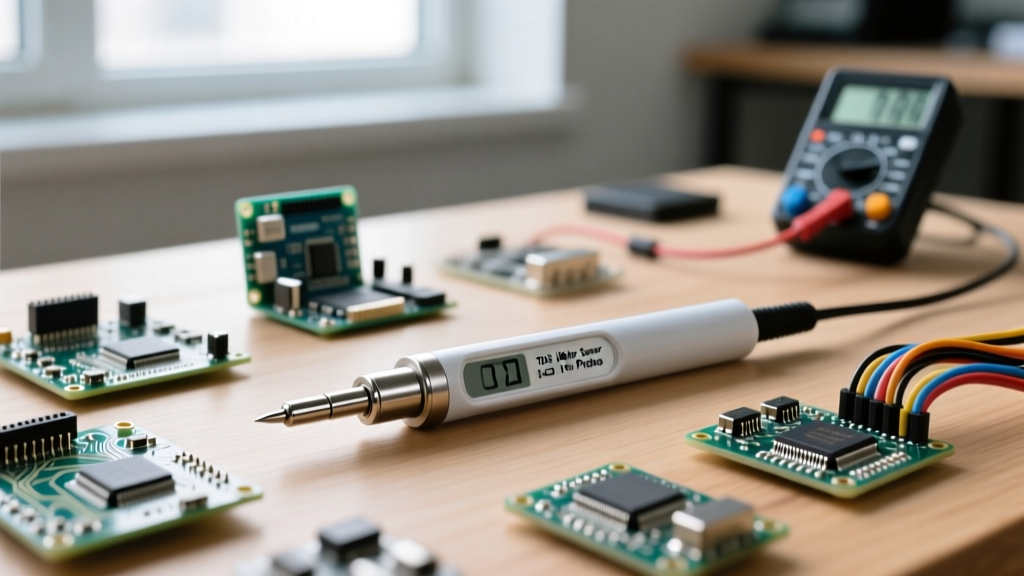

Water quality monitoring is a cornerstone of modern DIY electronics projects, from automated hydroponic nutrient dosing and aquarium management to reverse osmosis (RO) system tracking. At the heart of these systems lies the TDS meter sensor (Total Dissolved Solids). However, navigating the market can be treacherous. A quick search yields $5 generic modules that fail within a week, alongside $150 lab-grade probes that seem like overkill for a home setup.
This comprehensive buying guide cuts through the marketing noise. We will dissect the underlying physics of TDS measurement, evaluate the critical hardware specifications that dictate sensor lifespan, and provide a direct comparison of the best TDS sensor modules for microcontroller integration in 2026.
The Physics: Why TDS Sensors Actually Measure Conductivity
To make an informed purchase, you must first understand a fundamental truth: TDS sensors do not actually measure solids. Instead, they measure Electrical Conductivity (EC) and use a mathematical conversion factor to estimate the TDS. When salts, minerals, and metals dissolve in water, they split into positively and negatively charged ions. These ions conduct electricity.
The sensor applies a voltage across two or more electrodes submerged in the water and measures the resulting current. The microcontroller then calculates the EC (usually in µS/cm) and multiplies it by a K-factor (typically between 0.5 and 0.7) to output a TDS value in parts per million (ppm). As Hanna Instruments explains in their technical literature, this conversion is an estimation. It is highly accurate for standard NaCl solutions but can skew when measuring complex nutrient mixes or water with high organic content.
Critical Hardware Specs: Separating Lab-Grade from E-Waste
When evaluating a TDS meter sensor, the physical probe and the signal conditioning circuitry are equally important. Ignore the flashy packaging and look for these three non-negotiable specifications:
1. AC Excitation vs. DC Voltage
This is the most common failure point for budget sensors. If a sensor module applies a constant Direct Current (DC) to the probe, it triggers electrolysis. This causes ions to plate onto the electrodes (galvanic corrosion), rapidly altering the probe's surface area and permanently destroying its calibration. High-quality modules use Alternating Current (AC) or pulsed square-wave excitation to prevent ion buildup and polarization.
2. Electrode Material
- 316L Stainless Steel: Excellent for freshwater aquariums and standard hydroponics. It is cost-effective but can suffer from pitting corrosion in high-salinity or highly acidic environments.
- Titanium: The gold standard for continuous immersion. Titanium is highly resistant to corrosion and bio-fouling, making it mandatory for saltwater setups, aquaponics, and industrial RO monitoring.
3. Automatic Temperature Compensation (ATC)
Water conductivity changes by approximately 2% for every 1°C change in temperature. A TDS sensor without ATC will give you wildly inaccurate readings as your water heater or ambient room temperature fluctuates. Ensure your module either has a built-in thermistor or requires a paired external waterproof temperature probe (like a DS18B20) to apply software-based ATC compensation.
Top TDS Sensor Modules for Microcontroller Integration
Below is a comparison of the most popular TDS sensor architectures used by DIYers and engineers integrating with Arduino, ESP32, and Raspberry Pi platforms.
| Module / Probe | Interface | Probe Material | Excitation | Price Range | Best Application |
|---|---|---|---|---|---|
| DFRobot Gravity (SEN0244) | Analog (0-3.3V) | Stainless Steel | AC Square Wave | $35 - $45 | General DIY, Arduino |
| Generic LM393 TDS Module | Analog / Digital | Stainless Steel | DC / Pulsed | $4 - $8 | Disposable / Testing |
| Atlas Scientific EZO-TDS | I2C / UART | Titanium / SS | Advanced AC | $130 - $160 | Lab-grade, Commercial |
| Industrial RS485 Modbus | RS485 (UART) | Titanium | AC Isolated | $60 - $90 | Long-distance, noisy environments |
1. DFRobot Gravity: Analog TDS Sensor (SEN0244)
The DFRobot Gravity SEN0244 is widely considered the sweet spot for serious hobbyists. It features an onboard signal conditioning circuit that handles the AC excitation and outputs a clean, linear analog voltage (0 to 3.3V). The probe is waterproof, and the module includes a dedicated temperature sensor input for precise ATC. It works flawlessly with 5V Arduinos and 3.3V ESP8266 boards right out of the box.
2. Generic Analog TDS Modules (The Budget Route)
You will find these unbranded blue or red PCB modules on eBay and AliExpress for under $10. While tempting, they require heavy software filtering. Furthermore, if you are using an ESP32, you must be aware of its notorious ADC non-linearity. The ESP32's analog-to-digital converter is highly inaccurate near 0V and above 2.5V. To use a generic TDS sensor with an ESP32, you must either build an op-amp buffer circuit to shift the voltage into the linear range or use an external I2C ADC like the ADS1115.
3. Atlas Scientific EZO-TDS (Lab-Grade)
If you are building a commercial hydroponic controller or a system where a $50 error in nutrient dosing could ruin a crop, Atlas Scientific is the answer. The EZO-TDS operates on I2C or UART, completely bypassing the microcontroller's noisy internal ADC. It handles complex ATC, custom K-factor conversions, and continuous self-calibration in the background. It is expensive, but it offers true set-and-forget reliability.
Real-World Failure Modes and Troubleshooting
Even the best TDS meter sensor will fail if subjected to real-world environmental abuse. Here are the primary failure modes and how to engineer around them:
- Bio-Fouling: Algae and bacterial slime will coat the probe electrodes, acting as an insulator and causing TDS readings to artificially drop. Solution: Implement a mechanical wiper system for industrial setups, or schedule weekly manual cleanings with a soft brush and mild vinegar solution.
- Cable Capacitance: Analog TDS sensors output high-impedance signals. If you extend the cable length of a generic analog probe beyond 1 meter, the cable's capacitance will act as a low-pass filter, introducing massive noise and signal droop. Solution: Keep analog cables under 50cm, or mount the signal conditioning board directly at the probe and send a digital (I2C/RS485) signal back to your main controller.
- Air Bubbles: If the probe is mounted vertically facing up, micro-bubbles can become trapped between the electrodes, causing erratic spikes in conductivity readings. Solution: Always mount TDS probes horizontally or at a 45-degree downward angle.
The Calibration Protocol
Out of the box, most sensors are calibrated to a standard K-factor of 0.5 (meaning 1 µS/cm = 0.5 ppm). However, for precise hydroponic or aquarium work, you must perform a single-point calibration using a reference solution.
- Purchase a sealed packet of 342 ppm NaCl calibration solution (or a solution matching your expected operating range).
- Ensure the probe and the solution are at the exact same room temperature (ideally 25°C).
- Submerge the probe, gently stir to remove trapped air, and wait 60 seconds for the reading to stabilize.
- Adjust the calibration offset in your microcontroller code until the serial monitor reads exactly 342 ppm.
- Rinse the probe thoroughly with distilled water before returning it to your main reservoir.
Expert Warning: Remember that a TDS meter sensor cannot detect non-conductive dissolved solids. Sugars, alcohols, oils, and many organic pesticides will not register on a TDS probe. If your application requires monitoring organic pollutants or specific non-ionic compounds, you must supplement your TDS sensor with a dedicated TOC (Total Organic Carbon) sensor or optical turbidity sensor.
Final Verdict
Choosing the right TDS meter sensor comes down to balancing your budget against your tolerance for maintenance. For 90% of DIY electronics hobbyists building Arduino-based water monitors, the DFRobot Gravity SEN0244 offers the perfect blend of accuracy, AC excitation safety, and ease of coding. Avoid the ultra-cheap generic modules unless you are prepared to design custom op-amp buffering circuits and write extensive moving-average software filters. Invest in a quality probe, respect the physics of conductivity, and your water quality monitoring system will run reliably for years.