
The Core Question: Is Rubber an Insulator or a Conductor?
When asking is rubber an insulator or a conductor, the fundamental answer lies in material science: pure, natural rubber (polyisoprene) is a highly effective electrical insulator. In its unvulcanized, chemically pure state, natural rubber boasts a dielectric strength of approximately 20 to 40 kV/mm, making it exceptionally resistant to the flow of electrical current. However, in the context of electrical engineering and code compliance, the question is far more nuanced.
The electrical industry rarely uses pure, unadulterated natural rubber for modern wiring. To make rubber durable, heat-resistant, and UV-stable, manufacturers compound it with various fillers, most notably carbon black and sulfur (during vulcanization). While these additives drastically improve mechanical longevity, they alter the material's dielectric properties. Therefore, electrical codes and testing standards do not merely classify 'rubber' as a generic insulator; they rigorously test and categorize specific rubber-based elastomers based on their thermal tolerances, moisture resistance, and long-term dielectric integrity.
Material Science vs. Electrical Codes (NEC Article 310)
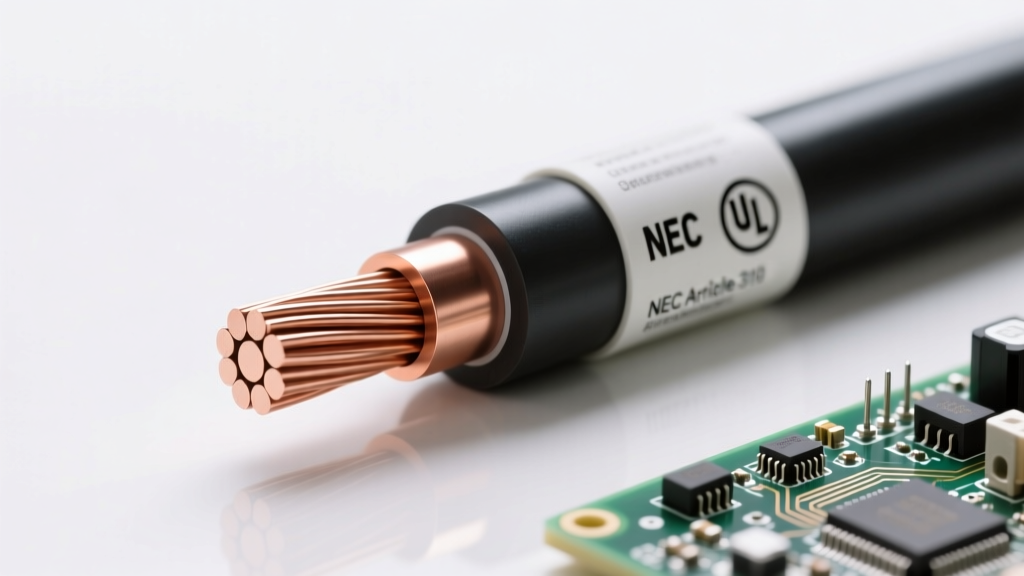
The National Electrical Code (NEC / NFPA 70) approaches insulation not just as a barrier, but as a dynamic component that dictates conductor ampacity. Under NEC Article 310, the allowable ampacity of a wire is directly tethered to the thermal rating of its insulation. If the insulation melts, degrades, or loses its dielectric strength, the conductor becomes a severe fire and shock hazard.
How the NEC Defines Insulation Materials
The NEC does not use the blanket term 'rubber' in modern installations. Instead, it utilizes specific letter designations that historically originated from rubber but now primarily refer to advanced thermoset elastomers. For example, designations like RHW (Rubber Heat Water-resistant) and RHH (Rubber Heat Heat-resistant) are deeply embedded in the code. Today, a cable marked 'RHH' is almost certainly insulated with Cross-Linked Polyethylene (XLPE) or Ethylene Propylene Rubber (EPR), rather than natural rubber. The code mandates these thermoset materials because they do not melt when exposed to high temperatures; instead, they char, maintaining a physical barrier longer than thermoplastics.
Rubber Insulation Types Recognized by Standards (UL & ASTM)
To be legally installed in a jurisdiction that enforces the NEC, rubber-based and thermoset-insulated wires must pass rigorous testing protocols outlined in UL 44 (Standard for Thermoset-Insulated Wires and Cables). This standard tests for dielectric withstand voltage, accelerated aging, and flammability. Furthermore, ASTM standards (such as ASTM D149 for dielectric breakdown voltage) govern the baseline material testing before a compound is even approved for wire manufacturing.
Below is a breakdown of how the NEC and UL classify 'rubber' and thermoset elastomer insulations:
| NEC Designation | Material Base (Modern) | Max Operating Temp | Approved Locations |
|---|---|---|---|
| RHW | EPR / Neoprene | 75°C (167°F) | Dry and Wet |
| RHH | EPR / Silicone | 90°C (194°F) | Dry and Damp |
| USE | EPR / Cross-linked | 75°C (167°F) | Underground / Direct Burial |
| XHHW | XLPE (Thermoset) | 90°C Dry / 75°C Wet | Dry and Wet |
As the table illustrates, the 'R' in the NEC designation is a historical nod to rubber, but the underlying chemistry is governed by strict synthetic elastomer standards to ensure consistent insulation resistance over decades.
When Rubber Fails: Code Violations and Degradation
Understanding the transition from insulator to conductor requires examining failure modes. Natural rubber and early synthetic rubbers are highly susceptible to environmental degradation. When exposed to ozone, ultraviolet (UV) light, and extreme thermal cycling, the polymer chains break down.
Carbon Tracking and the Conductor Transition
This is where the question 'is rubber an insulator or a conductor' takes a dangerous turn. To protect outdoor rubber cables from UV degradation, manufacturers heavily load the elastomer with carbon black. While carbon black is excellent for blocking UV rays, carbon itself is a conductor. If the rubber surface degrades, cracks, and becomes contaminated with moisture and industrial dust, a phenomenon known as dry band arcing or carbon tracking can occur.
The electrical leakage current heats the moisture, creating dry bands. Arcing across these dry bands burns the rubber, leaving behind a permanent, conductive carbon track. In this degraded state, the surface of the rubber effectively becomes a weak conductor, leading to ground faults, short circuits, and catastrophic fires. The NEC strictly prohibits the use of degraded insulation, and inspectors will immediately red-tag panels exhibiting 'alligator hide' cracking on legacy rubber wiring.
Modern Code Replacements: EPR and Silicone vs. Natural Rubber
Because of the inherent vulnerabilities of natural rubber, the electrical industry transitioned to advanced elastomers. Ethylene Propylene Rubber (EPR) and Silicone Rubber are the modern standards for high-voltage and high-temperature applications. EPR offers superior corona resistance and thermal stability compared to natural rubber, while Silicone Rubber provides extreme flexibility and can withstand temperatures up to 200°C without losing its dielectric properties.
Expert Code Insight: 'If you encounter true natural rubber insulation (often identifiable by a fabric braid outer jacket and a distinct sulfur odor when cut) in a pre-1950s commercial building, it is an immediate NEC Article 110.12 violation. The material has long surpassed its dielectric lifespan, and the insulation resistance is likely compromised, requiring a complete circuit replacement.'
Compliance Checklist for Inspectors and Electricians
When evaluating rubber or thermoset-insulated cables for code compliance, electrical professionals should adhere to the following diagnostic framework:
- Verify the UL Mark: Ensure the cable jacket bears the appropriate UL listing for its thermoset designation (e.g., RHH, RHW, XHHW).
- Inspect for Ozone Cracking: Check terminations in high-voltage switchgear for micro-fractures, which indicate elastomer breakdown and impending carbon tracking.
- Megger Testing: Perform insulation resistance testing (Megger test) on legacy rubber circuits. Readings below 1 Megohm indicate the insulation has absorbed moisture or degraded to the point of becoming semi-conductive.
- Temperature Matching: Confirm that the termination ratings (often 60°C or 75°C per NEC 110.14(C)) do not exceed the thermal limits of the specific rubber/elastomer insulation used.
- Bend Radius Compliance: Thermoset rubber insulations are stiffer than PVC. Adhere strictly to NEC Article 300.34 bending radius requirements to prevent microscopic tearing of the dielectric barrier.
Ultimately, while pure rubber is fundamentally an insulator, its real-world application in electrical systems is defined by synthetic chemistry, rigorous UL testing, and strict adherence to the National Electrical Code. Treating 'rubber' as a monolithic material is a critical error; compliance demands recognizing the specific elastomer, its thermal rating, and its environmental limitations.