
The Anatomy of Monophase Power Systems
Monophase electricity, universally known in North America as single-phase AC power, is the foundational electrical distribution method for residential and light commercial environments. Unlike three-phase power, which utilizes three alternating currents offset by 120 degrees, monophase systems rely on a single alternating voltage sine wave. Depending on your global region, this manifests as either a 230V line-to-neutral system (Europe, UK, Australia) or a 120V/240V split-phase system (North America).
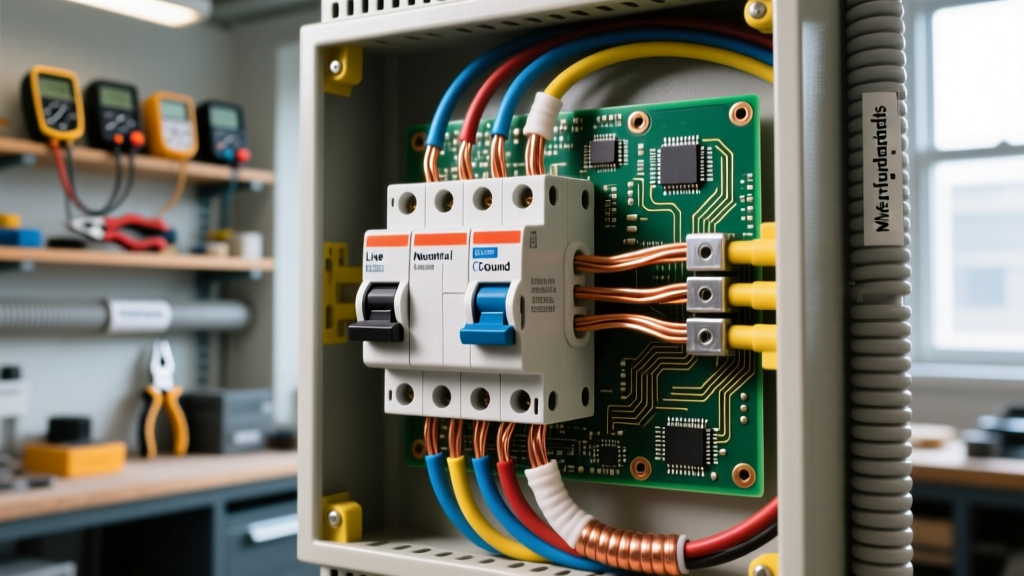
From a safety and wire-sizing perspective, understanding the exact topology of your monophase supply is critical. In a standard North American split-phase system, a center-tapped transformer secondary provides two 120V 'hot' legs (L1 and L2) that are 180 degrees out of phase, yielding 240V across both legs for heavy appliances. In a European 230V system, you have a single Line (L), a Neutral (N), and an Earth (E). Misidentifying these conductors or applying the wrong overcurrent protection is a primary cause of residential electrical fires.
Critical Shock and Arc Flash Hazards
Working on live monophase circuits exposes technicians and DIYers to two distinct, potentially lethal hazards: electric shock and arc flash. The human body's impedance varies based on moisture and contact area, but the physiological effects of monophase alternating current (50Hz or 60Hz) are well-documented.
- 1 mA: Barely perceptible threshold of sensation.
- 10-15 mA: 'Let-go' threshold; muscle contractions prevent the victim from releasing the conductor.
- 30-50 mA: Severe respiratory paralysis and extreme pain.
- 75-100 mA: Ventricular fibrillation begins; fatal without immediate defibrillation.
While shock is a persistent risk, arc flash incidents in monophase panels are increasingly common due to aging infrastructure and loose connections. A 240V split-phase arc fault can easily sustain a plasma ball exceeding 10,000°F. According to NFPA 70 (National Electrical Code), working inside energized panels requires specific Personal Protective Equipment (PPE). For standard 120V/240V residential panels, Category 1 or 2 PPE (including arc-rated face shields and insulated gloves) is mandatory when performing voltage testing or racking breakers.
The 'Floating Neutral' Catastrophe in MWBCs
One of the most dangerous, yet misunderstood, failure modes in North American monophase systems occurs in Multi-Wire Branch Circuits (MWBCs). An MWBC shares a single neutral conductor between two hot legs (L1 and L2) to carry only the unbalanced load. If the shared neutral becomes disconnected (a 'floating neutral') while both hot legs are energized, the circuit transforms from two parallel 120V circuits into a single 240V series circuit.
The voltage across each load will now divide inversely proportional to the load's resistance. A low-wattage LED light (high resistance) might suddenly receive 220V, causing it to explode, while a high-wattage space heater (low resistance) receives only 20V. This massive overvoltage on the lighting circuit frequently melts wire insulation inside the walls, igniting structural fires. Safety Rule: Always use a common-trip, double-pole breaker or handle-tied single-pole breakers for MWBCs to ensure simultaneous disconnection of both hot legs.
Wire Sizing and Overcurrent Protection Matrix
Proper wire sizing for monophase electricity is dictated by the ampacity of the conductor and the continuous vs. non-continuous nature of the load. The NEC mandates that continuous loads (operating for 3 hours or more) must be derated to 80% of the breaker's capacity. Below is a fundamental sizing matrix for copper conductors in standard residential monophase applications.
| AWG Size (Copper) | Max Ampacity (60°C/75°C) | Standard Breaker Size | Max Continuous Load (80%) | Typical Application |
|---|---|---|---|---|
| 14 AWG | 15A / 20A | 15 Amp | 12 Amps | General lighting, standard receptacles |
| 12 AWG | 20A / 25A | 20 Amp | 16 Amps | Kitchen small appliances, bathroom GFCI |
| 10 AWG | 30A / 35A | 30 Amp | 24 Amps | Electric water heaters, window AC units |
| 8 AWG | 40A / 50A | 40 Amp | 32 Amps | Electric ranges, heavy-duty EV chargers |
| 6 AWG | 55A / 65A | 50 Amp | 40 Amps | Subpanels, large tankless water heaters |
Sizing the Equipment Grounding Conductor (EGC)
Safety in monophase systems relies heavily on the Equipment Grounding Conductor to clear faults. The EGC does not carry current under normal operation; it provides a low-impedance path back to the source to ensure the breaker trips instantaneously during a ground fault. Per NEC Table 250.122, the ground wire must scale with the overcurrent device. For a 15A or 20A circuit, a 14 AWG or 12 AWG copper ground is sufficient. However, if you upsize the current-carrying conductors to mitigate voltage drop on a long 240V run (e.g., using 6 AWG instead of 10 AWG for a 30A well pump), you must proportionally upsize the grounding conductor to maintain the integrity of the fault-clearing path.
Mandatory Safety Devices: RCDs, GFCIs, and AFCIs
Overcurrent breakers protect the wire from melting, but they do not protect humans from electrocution. A 15A breaker will not trip if a person draws 50mA of current to ground—a lethal dose. Therefore, monophase circuits require specialized leakage detection.
- GFCI / RCD (Ground Fault Circuit Interrupter / Residual Current Device): Monitors the vector sum of current on the Line and Neutral. If an imbalance as small as 4mA to 6mA (North America) or 30mA (Europe) is detected, the device trips in under 25 milliseconds. Mandatory for all monophase circuits in wet locations, outdoors, and unfinished basements.
- AFCI (Arc Fault Circuit Interrupter): Uses digital signal processing to identify the high-frequency 'noise' signatures of parallel and series arcing. AFCIs are critical for preventing fires caused by pierced nails, frayed appliance cords, and loose terminal screws in 120V/230V branch circuits.
- Type B vs. Type C MCBs: In regions using miniature circuit breakers (MCBs), understanding trip curves is vital. Type C breakers (tripping at 5-10x rated current) are standard for general monophase lighting and sockets. Type B (3-5x) is used for sensitive electronics, while Type D (10-20x) is reserved for circuits with high inrush currents, like monophase industrial compressors or large transformers.
Step-by-Step Lockout/Tagout (LOTO) for Monophase Panels
Before performing any wire sizing calculations, terminations, or troubleshooting on a monophase system, the circuit must be definitively isolated. Relying solely on a wall switch or a smart breaker is a fatal error. Follow the OSHA Lockout/Tagout (LOTO) framework adapted for residential and commercial electrical work:
- Identify all energy sources: Trace the monophase circuit back to the main distribution board. Check for backfed sources like solar inverters or standby generators.
- Notify affected personnel: Inform anyone relying on the circuit that power will be severed.
- Switch off the breaker: Firmly move the single-pole or double-pole breaker to the OFF position.
- Apply physical lockout: Attach a breaker lockout device and secure it with a uniquely keyed padlock. If working in a shared facility, apply a multi-lock hasp.
- Verify Zero Energy (The Most Critical Step): Use a Category III or IV rated digital multimeter or a non-contact voltage tester (NCVT) verified on a known live source before and after testing the target circuit. Test Line-to-Neutral, Line-to-Ground, and Neutral-to-Ground. In older monophase systems, a bootleg ground or a crossed neutral can leave a circuit energized even when the hot leg is disconnected.
Expert Safety Warning: Never assume the Neutral wire is safe to touch bare-handed, even when the breaker is off. In shared-neutral MWBCs or multi-grounded neutral systems, return current from other active circuits can flow through the disconnected neutral, presenting a severe shock hazard. Always treat the neutral conductor as a potentially energized, live component until verified dead with a calibrated meter.
Mastering monophase electricity requires a synthesis of theoretical physics, rigorous adherence to code, and an uncompromising respect for the invisible hazards of alternating current. By correctly sizing your conductors, understanding the catastrophic potential of floating neutrals, and utilizing modern arc-fault and ground-fault protection, you ensure that your electrical infrastructure remains both functional and fundamentally safe.