
The Core Concept: Sniffing Drone Telemetry via BLE
As global aviation authorities enforce strict drone identification mandates, the radio frequency (RF) spectrum is increasingly populated with digital license plates. In the US, the FAA's Part 89 regulation and Europe's EASA frameworks require unmanned aircraft systems (UAS) to broadcast their identity, GPS coordinates, altitude, and pilot location. For makers and RF enthusiasts, building an ESP32 RemoteID scanner offers a fascinating, low-cost window into this telemetry data. Unlike commercial solutions like DJI AeroScope, which cost thousands of dollars, a properly configured ESP32 can sniff, decode, and log these broadcasts for under $15.
This quick reference guide and FAQ is designed for intermediate to advanced Arduino developers who want to bypass the basic tutorials and dive straight into the hardware traps, library configurations, and RF realities of scanning ASTM F3411 and EN 4709-002 payloads.
Hardware Selection Matrix: Classic ESP32 vs. ESP32-S3
The most common point of failure for DIY drone scanner projects is selecting the wrong microcontroller. Modern drones (such as the DJI Mini 3/4 series and Autel EVO Nano) heavily utilize Bluetooth 5.0 Long Range (Coded PHY) to extend their broadcast distance. The original, classic ESP32 only supports Bluetooth 4.2 (1M PHY), meaning it is physically blind to the majority of modern long-distance Remote ID broadcasts.
| MCU Variant | BLE Version | Long Range (Coded PHY S=8) | Typical Price (2026) | Scanner Verdict |
|---|---|---|---|---|
| ESP32-WROOM-32 (Classic) | 4.2 | No | $4.00 | Avoid. Misses 70% of modern drone broadcasts. |
| ESP32-S3-WROOM-1 | 5.0 | Yes | $7.50 | Highly Recommended. Best balance of dual-core processing and BLE 5.0. |
| ESP32-C3 | 5.0 | Yes | $3.50 | Good for ultra-budget, single-core logging nodes. |
| ESP32-C6 | 5.0 + 802.15.4 | Yes | $4.50 | Excellent for advanced mesh/networked scanner arrays. |
Rapid-Fire FAQ: Firmware, Libraries, and Payloads
Q: Which Arduino library decodes ASTM F3411 payloads?
A: You need a two-layer approach. First, use NimBLE-Arduino to handle the low-level BLE scanning. NimBLE is vastly superior to the default Arduino BLE library because it consumes significantly less RAM and handles BLE 5.0 Coded PHY advertising packets much more reliably on the ESP32-S3. Second, for decoding the raw byte arrays into human-readable telemetry, integrate the OpenDroneID Core C library. You will need to wrap the C-based OpenDroneID decoder functions within your Arduino C++ sketch, passing the raw payload bytes extracted from NimBLE's advertisedDevice.getPayload() method.
Q: Why is my scanner dropping packets when Wi-Fi is active?
A: This is a classic ESP32 RF coexistence issue. The ESP32's Wi-Fi and Bluetooth radios share the same 2.4 GHz RF frontend and antenna. When Wi-Fi is transmitting (e.g., uploading logs to an MQTT broker or a web server), it blanks out the Bluetooth receiver, causing you to miss the intermittent 1 Hz Remote ID beacon frames. Solution: If you must use Wi-Fi, configure NimBLE to use aggressive scan windows, or buffer your decoded telemetry locally on a microSD card (via SPI) and upload in batched bursts. For continuous, zero-drop scanning, disable Wi-Fi entirely and use an SD card or a serial UART connection to a secondary logging device like a Raspberry Pi Zero.
Q: Can I scan Wi-Fi Direct (NaN) Remote ID broadcasts?
A: Yes, but it requires a completely different firmware approach. While 90% of consumer drones use BLE, some enterprise and older Wi-Fi-based drones broadcast Remote ID via Wi-Fi Neighbor Awareness Networking (NaN) Action Frames. To capture these, you must put the ESP32's Wi-Fi radio into promiscuous mode using esp_wifi_set_promiscuous(true) and write a custom packet callback filter to inspect the 802.11 MAC headers for the specific ASTM-compliant vendor OUIs. Note that you cannot run BLE scanning and Wi-Fi promiscuous sniffing simultaneously on a single ESP32 chip due to hardware radio limitations.
Q: What are the optimal NimBLE scan parameters for drone tracking?
A: Remote ID mandates require broadcasts at least once per second (1 Hz). However, RF interference in the 2.4 GHz band is immense. Configure your NimBLE scanner with an interval of 0x20 (20ms) and a window of 0x10 (10ms). This provides a 50% duty cycle for listening, balancing power consumption with a high probability of catching the 1-second beacon window. Always enable activeScan(false)—you only need passive scanning to read advertising payloads, and sending scan requests wastes battery and clutters the RF spectrum.
Quick Reference: ASTM F3411 Message Types
When parsing the raw hex dumps from your ESP32 scanner, you will encounter specific Message Type identifiers in the first byte of the payload header. Here is the quick-reference map for your decoder logic:
- Type 0 (Basic ID): Contains the UAS ID (serial number or CAA-provided registration) and ID type.
- Type 1 (Location/Vector): The most critical packet. Includes drone latitude, longitude, barometric altitude, geometric height, speed, and heading.
- Type 2 (Authentication): Used for cryptographic signing of the broadcasts (rarely populated in standard consumer drones).
- Type 3 (Self-ID): Free-text field used by the pilot to declare the purpose of the flight (e.g., 'Emergency Response', 'Recreational').
- Type 4 (System): Contains the operator/pilot's GPS location and the overall system status (e.g., 'Airborne', 'Grounded').
- Type 5 (Operator ID): The specific registration ID of the human pilot, separate from the drone's hardware serial number.
Antenna Tuning and Range Expectations
Maker Insight: Do not rely on the PCB trace antenna for field scanning. The human body acts as a massive 2.4 GHz RF sink. If you hold a standard ESP32-S3 dev board in your hand, your body will absorb up to 40% of the incoming signal, cutting your effective range in half.
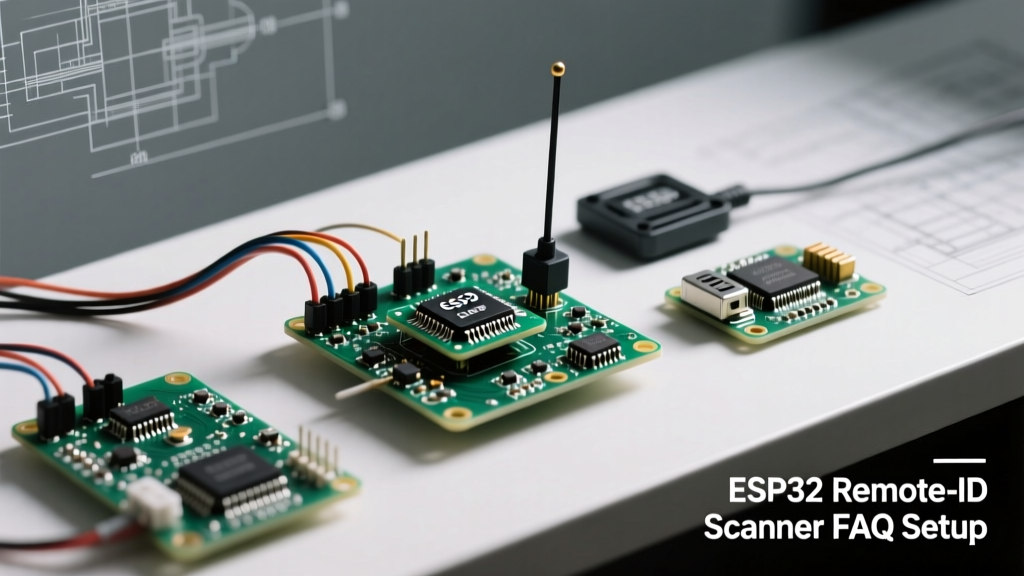
To build a viable ESP32 RemoteID scanner for outdoor use, you must bypass the onboard PCB antenna. Purchase an ESP32-S3 module with a U.FL (IPEX) connector. Attach a 2.4 GHz omni-directional antenna with at least 5 dBi gain. For maximum range (pushing past 1 kilometer under clear line-of-sight conditions), integrate an external LNA (Low Noise Amplifier) like the Mini-Circuits PSA4-5043+ between the antenna and the ESP32's RF pin. Remember that BLE 5.0 Long Range (Coded PHY S=8) provides a 12 dB link budget improvement over standard BLE, but only if your receiving antenna is tuned correctly to capture the spread-spectrum signal.
Power Optimization for Field Scanners
If you are deploying your scanner in a remote area or mounting it to a bicycle for urban drone mapping, power consumption is critical. Scanning BLE continuously keeps the ESP32's radio active, drawing roughly 110mA to 140mA. To extend battery life on a standard 18650 Li-Ion cell:
- Disable the onboard RGB LED and power LEDs via GPIO or physical desoldering.
- Use the
esp_sleep_enable_timer_wakeup()function to put the ESP32 into light sleep for 500ms between 1-second scan windows, though this requires advanced state-management to avoid missing the beacon. - Drop the CPU clock speed to 80 MHz. Decoding ASTM F3411 payloads is not computationally heavy; running the S3 at 240 MHz is a waste of milliamps.
Legal and Ethical Boundaries for Makers
Building an ESP32 RemoteID scanner is entirely legal in most jurisdictions, as you are merely passively receiving unencrypted, publicly broadcasted RF telemetry. However, the ethical application of this data is paramount. According to the FAA Remote ID guidelines, the data is intended for situational awareness and security. Using your DIY scanner to physically track, stalk, or harass drone pilots based on their Type 4 (System) GPS coordinates is a severe violation of privacy laws and federal harassment statutes. Makers should use this technology for RF research, spectrum analysis, and building automated 'geofence' alerts for restricted airspace, ensuring all logged MAC addresses and GPS coordinates are anonymized or deleted after short-term debugging sessions.