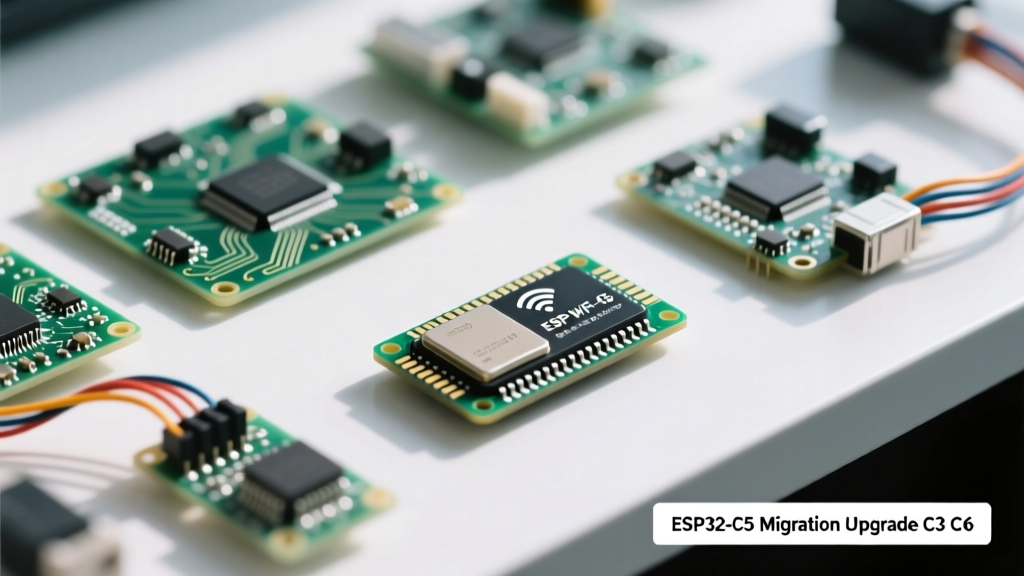

The transition from the ubiquitous ESP32-C3 or the IEEE 802.15.4-capable ESP32-C6 to the newly minted ESP32-C5 represents a massive paradigm shift for IoT hardware engineers in 2026. While the C-series has traditionally been Espressif's answer to low-cost, single-core RISC-V applications, the ESP32-C5 breaks the mold by introducing Wi-Fi 5 (802.11ac) support and a blistering 240 MHz clock speed. For makers and commercial product designers looking to escape the congested 2.4 GHz ISM band, migrating to the C5 is no longer just an option—it is a competitive necessity for high-throughput applications like IP cameras, smart displays, and real-time telemetry.
The Wi-Fi 5 Catalyst: Escaping the 2.4GHz Traffic Jam
The primary driver for migrating from an ESP32-C3 to an ESP32-C5 is the desperate need for spectral efficiency. The 2.4 GHz band is notoriously saturated with Bluetooth, Zigbee, and legacy Wi-Fi 4 traffic. By integrating dual-band 2.4 GHz and 5 GHz Wi-Fi 5 capabilities, the ESP32-C5 allows IoT devices to leverage wider 80 MHz channels, significantly reducing latency and increasing raw TCP/UDP throughput. However, this upgrade is not a simple drop-in replacement; it requires a fundamental rethinking of both your PCB RF topology and your firmware architecture.
RISC-V Clock Speed and Memory Bumps
Beyond the RF improvements, the ESP32-C5 features a 32-bit RISC-V single-core processor clocked at up to 240 MHz, a 50% increase over the 160 MHz ceiling of the C3 and C6. This extra headroom is critical when handling the AES-128/256 and RSA hardware accelerators required for secure MQTT over TLS handshakes on high-speed networks. Furthermore, the C5 expands the internal SRAM to 512 KB (excluding the 802.11 MAC layer buffer), giving developers more room for local audio buffering or lightweight edge-inference models without relying on external PSRAM.
Silicon Showdown: C3 vs. C6 vs. C5 Specifications
Before initiating a hardware migration, it is crucial to understand the exact silicon deltas. The table below highlights the architectural differences that will impact your bill of materials (BOM) and firmware logic.
| Feature | ESP32-C3 | ESP32-C6 | ESP32-C5 |
|---|---|---|---|
| CPU Core | RISC-V @ 160 MHz | RISC-V @ 160 MHz | RISC-V @ 240 MHz |
| Wi-Fi Standard | Wi-Fi 4 (2.4 GHz) | Wi-Fi 6 (2.4 GHz) | Wi-Fi 5 (2.4 & 5 GHz) |
| Bluetooth | BT 5 (LE) | BT 5 (LE) | BT 5 (LE) |
| 802.15.4 (Thread/Zigbee) | No | Yes | No |
| Internal SRAM | 400 KB | 512 KB | 512 KB+ |
| Typical Package | QFN32 (5x5mm) | QFN32 (5x5mm) | QFN40 / QFN48 |
Hardware Migration: Navigating the 5GHz RF Minefield
The most severe point of failure when migrating from a C3 to a C5 is the physical RF layout. Designing for 2.4 GHz is relatively forgiving; designing for 5 GHz Wi-Fi is not. The shorter wavelengths of the 5 GHz spectrum (UNII bands) mean that trace impedance discontinuities, poorly placed vias, and inadequate ground plane clearance will result in catastrophic signal attenuation and packet loss.
Dual-Band Antenna Matching and Diplexers
If your previous C3 design utilized a simple 2.4 GHz meandered PCB antenna or a basic ceramic chip antenna, you must discard it. The ESP32-C5 requires a dual-band antenna solution. You have two primary migration paths:
- Integrated Diplexer: Use an RF diplexer IC on the PCB to split the 2.4 GHz and 5 GHz signals from the C5's single RF pin to two separate, optimized matching networks and antennas. This is ideal for space-constrained wearables or compact sensors.
- Wideband Dual-Band Antenna: Route the 50-ohm coplanar waveguide with ground (CPWG) to a high-quality off-board SMA connector or a specialized dual-band SMD ceramic antenna. Ensure your transmission line maintains strict 50-ohm impedance across both 2.4 GHz and 5.8 GHz frequencies, which often requires a 4-layer PCB stackup with controlled dielectric heights (e.g., Rogers 4350B prepreg or tightly tolerance FR4).
For comprehensive layout rules, always consult the official Espressif ESP32-C5 hardware design guidelines to verify via stitching distances and keep-out zones around the RF path.
Pinout Remapping and Peripheral Matrix
The ESP32-C5 typically ships in a larger QFN40 or QFN48 package to accommodate the additional I/O and RF grounding requirements. If you are migrating an existing C3 QFN32 footprint, you will need to redesign your PCB. Fortunately, Espressif's GPIO matrix allows you to map internal peripherals (UART, SPI, I2C) to almost any digital pin. However, be mindful of the dedicated strapping pins and the new JTAG routing defaults, which differ slightly from the C3's USB-Serial/JTAG peripheral implementation.
Firmware Porting: ESP-IDF and Arduino Core Shifts
Migrating your codebase requires updating your toolchain. The ESP32-C5 requires ESP-IDF v5.4 or later. If you are relying on the Arduino ESP32 Core, you must ensure you are using version 3.1.x or newer, which includes the necessary board definitions and Wi-Fi 5 PHY abstractions for the C5.
Configuring the 802.11ac PHY and Band Modes
In legacy C3 code, Wi-Fi initialization was straightforward because the chip was locked to the 2.4 GHz band. With the C5, you must explicitly define the band mode using the updated ESP-IDF Wi-Fi API. Failing to configure the band mode will result in the radio defaulting to 2.4 GHz, negating the primary reason for your hardware upgrade.
#include "esp_wifi.h"

void configure_wifi_5ghz() {
    // Enable dual-band capability
    wifi_band_mode_t band_mode = WIFI_BAND_MODE_2G_5G;
    esp_wifi_set_band_mode(band_mode);

    // Set specific channel and protocol for 5GHz
    wifi_config_t wifi_config = {
        .sta = {
            .threshold.authmode = WIFI_AUTH_WPA3_PSK,
            .sae_pwe_h2e = WPA3_SAE_PWE_BOTH,
        },
    };
    // Additional band-specific configuration logic here
    esp_wifi_set_config(WIFI_IF_STA, &wifi_config);
}
Expert Insight: When migrating to Wi-Fi 5 on the ESP32-C5, always enforce WPA3-SAE in your firmware configuration. The 5 GHz bands are highly regulated, and many modern enterprise routers will reject 802.11ac connections that do not support modern forward-secrecy handshakes. The C5's hardware RSA accelerator handles the WPA3 cryptographic overhead with minimal CPU penalty.
Power Profiling: The 5GHz Current Tax
A frequently overlooked aspect of the C3 to C5 migration is the power budget. Transmitting data over 5 GHz requires higher EVM (Error Vector Magnitude) linearity from the power amplifier (PA). Consequently, the ESP32-C5 draws significantly more peak current during 5 GHz TX bursts compared to 2.4 GHz TX on the C3.
If your C3 design utilized a basic 3.3V LDO rated for 300mA, it will likely brownout and trigger a watchdog reset when the C5 attempts to negotiate a high-throughput 5 GHz AC connection. You must upgrade your power delivery network (PDN). We recommend using a DC-DC buck converter capable of delivering at least 600mA continuous current, paired with a 100uF low-ESR ceramic capacitor placed within 2mm of the ESP32-C5's VDD3P3 pin to handle the microsecond-scale RF current spikes.
The 2026 Migration Decision Framework
Should you migrate your existing product line to the ESP32-C5? Use this decision matrix:
- Upgrade to C5 if: Your device streams audio/video, requires local web servers with fast asset loading, operates in dense urban RF environments, or relies on rapid cloud-syncing of large JSON payloads.
- Stay on C3/C6 if: Your device is a simple battery-powered sensor sending <1KB of telemetry per hour, requires Thread/Matter (Zigbee/802.15.4) mesh networking, or operates under a strict sub-$1.50 BOM constraint.
The ESP32-C5 is a powerhouse that bridges the gap between low-cost IoT and high-performance edge computing. By respecting the stringent 5GHz RF layout rules and updating your firmware to handle dual-band PHY configurations, you can unlock a new tier of IoT performance in your 2026 product roadmap.