
Demystifying the Core Concept: What is Electric Charge?
When DIYers, hobbyists, and engineering students first search for the electric charge meaning, they are often met with dense academic jargon that obscures the practical reality of how electricity actually works. At its most fundamental level, electric charge is a basic physical property of matter that causes it to experience a force when placed in an electromagnetic field. It is the foundational 'currency' of all electrical and electronic systems.
Whether you are calculating voltage drop for a 12 AWG copper wire, soldering a delicate surface-mount MOSFET, or designing a custom PCB for an ESP32 microcontroller, every action you take is governed by the movement and interaction of these charges. Understanding this concept bridges the gap between abstract physics and practical, real-world electrical troubleshooting.
The Anatomy of an Atom: Where Charge Lives
To truly grasp the electric charge meaning, we must zoom in to the atomic level. All matter is composed of atoms, which contain three primary subatomic particles:
- Protons: Carry a positive (+) electric charge and reside in the dense nucleus of the atom.
- Neutrons: Carry no charge (neutral) and also reside in the nucleus.
- Electrons: Carry a negative (-) electric charge and orbit the nucleus in various energy shells.
In a stable, uncharged atom, the number of protons exactly equals the number of electrons, resulting in a net charge of zero. However, when an electron is stripped from its orbit or added to an atom, the atom becomes an ion with a net positive or negative charge. According to the National Institute of Standards and Technology (NIST), the elementary charge of a single electron is exactly -1.602176634 × 10⁻¹⁹ Coulombs. This minuscule value is the fundamental building block of all electrical current.
Measuring Charge: The Coulomb Explained
In the International System of Units (SI), electric charge is measured in Coulombs (C). Because a single electron's charge is incomprehensibly small, the Coulomb was defined to represent a massive aggregation of electrons. Specifically, one Coulomb is equivalent to the charge of approximately 6.242 × 10¹⁸ (over six quintillion) electrons.
This is where the concept of charge directly intersects with current. One Ampere (Amp) of electrical current is defined as exactly one Coulomb of charge flowing past a specific cross-sectional point in a conductor per second. Therefore, if you are wiring a 20-Ampere household circuit using 12 AWG THHN wire, you are facilitating the movement of 20 Coulombs—or roughly 1.24 × 10²⁰ electrons—through that copper wire every single second.
Static vs. Dynamic: How Charge Behaves in the Real World
Electric charge manifests in two primary ways in DIY electronics and electrical wiring: static electricity (stationary charge) and current electricity (moving charge).
Static Charge and the Triboelectric Effect
Static electricity occurs when an imbalance of electric charges builds up on the surface of a material. This is often caused by the triboelectric effect, where friction between two dissimilar materials (like rubber soles and a nylon carpet) causes electrons to transfer from one surface to another. The material that gains electrons becomes negatively charged, while the material that loses electrons becomes positively charged.
As noted by Georgia State University's HyperPhysics database, these stationary charges create an electrostatic field that will eventually discharge to reach equilibrium. In a DIY setting, this discharge is known as Electrostatic Discharge (ESD).
Protecting Your Microcontrollers from Static Charge
Understanding the electric charge meaning is critical for component survival. The human body can easily accumulate a static charge of 3,000 to 5,000 volts simply by walking across a dry room. While the total charge (Coulombs) is tiny and harmless to human tissue, the voltage is high enough to arc across microscopic semiconductor junctions.
Modern microcontrollers, such as the ATmega328P or STM32 series, feature gate oxides that are only a few nanometers thick. An ESD event of just 30 to 100 volts can puncture these oxides, instantly destroying the IC or causing latent damage that leads to premature failure in the field. Always use an ESD-safe mat, a grounded wrist strap, and anti-static bags when handling bare PCBs and sensitive logic chips.
Quick Reference: Electric Charge vs. Voltage vs. Current
Beginners often confuse charge, voltage, and current. Here is a structured comparison to clarify how these fundamental concepts interact in your circuits:
| Property | Symbol | Unit | Practical Analogy (Water Pipe) | DIY Application |
|---|---|---|---|---|
| Electric Charge | Q | Coulomb (C) | The actual water molecules | The physical electrons moving through a copper trace. |
| Voltage | V | Volt (V) | Water pressure (PSI) | The 'push' from a 9V battery or 120V AC mains supply. |
| Current | I | Ampere (A) | Flow rate (Gallons per minute) | The rate of charge flow; dictates wire gauge sizing. |
| Resistance | R | Ohm (Ω) | Pipe diameter / friction | Opposition to flow; causes heat (I²R losses) in wires. |
Common Misconceptions About Electrical Charge
To solidify your foundational knowledge, it is vital to debunk a few persistent myths that plague novice electricians and makers.
Myth 1: Electrons travel through wires at the speed of light.
Reality: The actual physical movement of electrons, known as drift velocity, is incredibly slow—often less than a millimeter per second in standard DC copper wiring. What travels near the speed of light is the electromagnetic field (the signal) that pushes the electrons. Think of a long tube filled with marbles; if you push one marble in, another pops out the other end almost instantly, even though the individual marbles barely moved.
Myth 2: Power supplies 'create' electric charge.
Reality: The Law of Conservation of Charge dictates that charge can neither be created nor destroyed. A battery or generator does not create electrons; it merely acts as a pump, providing the electromotive force (Voltage) to move the free electrons that already exist within the conductive material of your wires and components.
Applying Charge Fundamentals to Wire Sizing
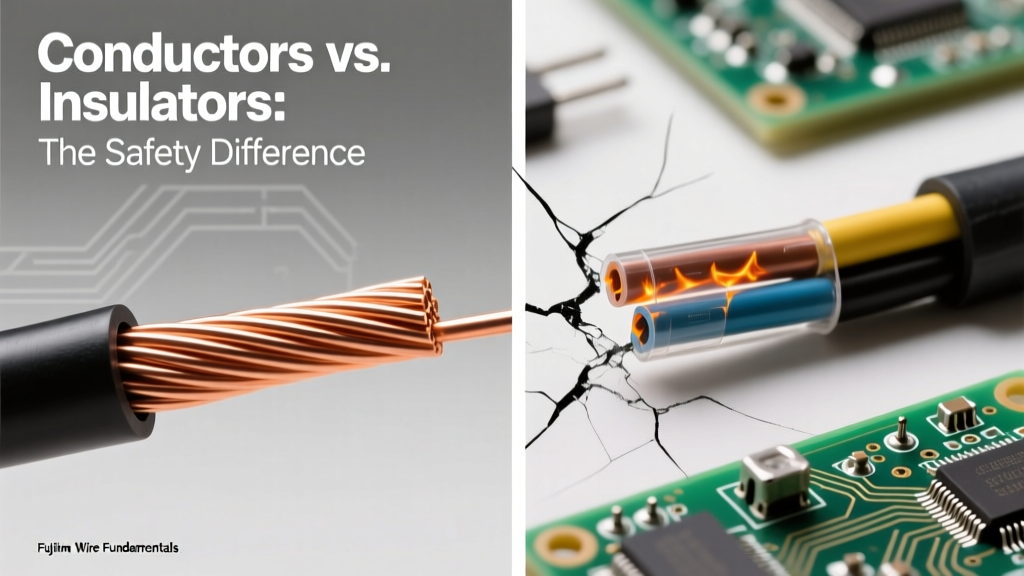
When you size a wire for a specific application, you are essentially calculating the physical capacity of the conductor to handle a specific volume of charge per second without overheating. Copper is the standard for DIY and residential wiring because its atomic structure features a single 'free' electron in its outermost valence shell. These free electrons require very little energy to break their atomic bonds and flow as current.
If you force too many Coulombs per second (too high an Amperage) through a wire with a small cross-sectional area (like using 18 AWG wire for a 30A load), the electrons collide more frequently with the copper lattice. These collisions generate kinetic energy, which manifests as heat. If the heat exceeds the thermal rating of the wire's insulation (e.g., 60°C for standard NM-B Romex), the insulation melts, leading to short circuits or electrical fires.
Further Reading and Authoritative Standards
For those looking to dive deeper into the physics of charge and its implications for electrostatic control in manufacturing and DIY environments, the ESD Association provides comprehensive guidelines on managing static charge in electronics workspaces. Mastering the electric charge meaning is not just an academic exercise; it is the first step toward designing safer, more efficient, and more reliable electronic systems.