
The Great UAV Misconception: Defining the Terminology
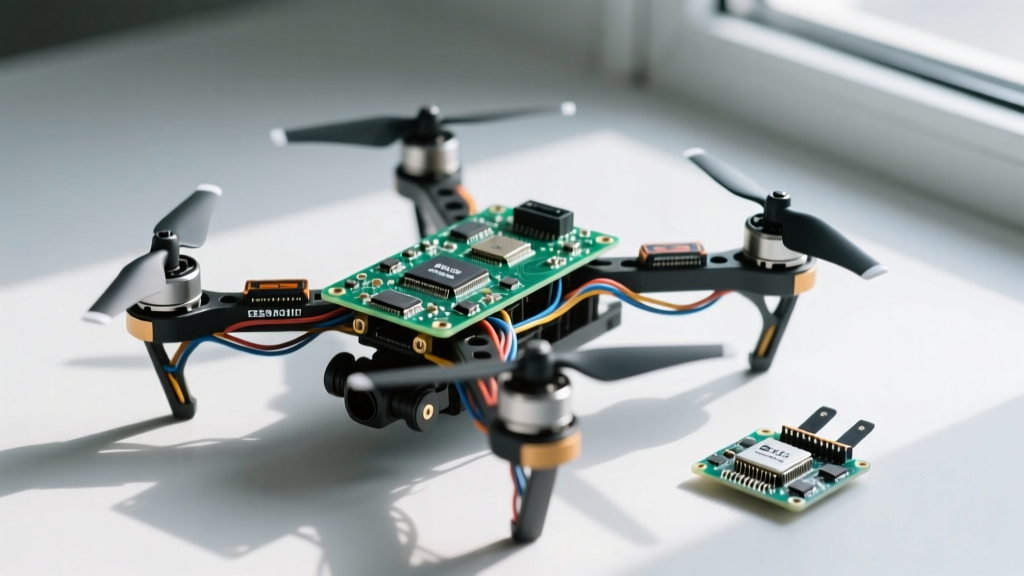
When beginners enter the world of unmanned aerial vehicles, a common misconception takes root: the belief that all drones are quadcopters. While the four-rotor configuration dominates consumer photography, toy markets, and FPV racing, it represents only a single fraction of the broader Unmanned Aircraft Systems (UAS) ecosystem. As a DIY electronics enthusiast or microcontroller programmer, limiting your perspective to quadcopters means missing out on the vast engineering landscape of fixed-wing UAVs, VTOL (Vertical Take-Off and Landing) quadplanes, hexacopters, and autonomous rovers.
The term 'drone' is a colloquialism. In engineering and regulatory contexts—such as those defined by the FAA Unmanned Aircraft Systems (UAS) division—the correct terminology is UAS or UAV. A quadcopter is simply a multirotor architecture that uses four fixed-pitch propellers to generate lift and control attitude via differential motor speeds. Understanding the distinction is the first step in selecting the right airframe, flight controller, and firmware for your specific automation project.
Beyond Four Rotors: UAV Architecture Matrix
Before you start soldering ESCs (Electronic Speed Controllers) and crimping JST connectors, you must match your project's goals to the correct physical architecture. Hovering requires immense energy, whereas forward flight relies on aerodynamic lift. Here is a breakdown of the primary UAV configurations you will encounter in open-source autopilot communities like ArduPilot and PX4 Autopilot.
| Architecture | Lift Mechanism | Efficiency & Flight Time | Primary Use Case | Recommended Beginner FCU |
|---|---|---|---|---|
| Quadcopter (X4) | 4x Brushless Motors | Low (15-25 mins) | Inspection, FPV, Hovering | Matek F405-SE |
| Hexacopter (X6) | 6x Brushless Motors | Medium (20-35 mins) | Heavy Payload, Redundancy | Holybro Pixhawk 6C |
| Fixed-Wing | Aerodynamic Wings | High (60-120+ mins) | Mapping, Long-Range Survey | Matek F405-Wing |
| VTOL QuadPlane | Multirotor + Wings | Medium-High (40-60 mins) | Precision Delivery, Survey | CuPilot Pixhawk 4 |
Selecting the Brain: Flight Controller Hardware
The heart of any autonomous UAV is the Flight Controller Unit (FCU). If you are transitioning from simple Arduino Uno projects to advanced robotics, you will quickly realize that standard 8-bit microcontrollers lack the processing power required for sensor fusion, Kalman filtering, and PID loop stabilization running at 8kHz.
The STM32H743 vs STM32F405 Debate
Modern open-source autopilots rely heavily on STMicroelectronics ARM Cortex-M processors. For a beginner building a standard quadcopter, an STM32F405-based board (like the widely available Matek or SpeedyBee F405 stacks) is more than sufficient. These boards typically cost between $45 and $65, feature built-in OSD (On-Screen Display) chips, and handle DShot600 ESC protocols flawlessly.
However, if you are building a fixed-wing mapping drone or a heavy-lift hexacopter where safety and sensor redundancy are paramount, you must step up to an STM32H743 board, such as the Holybro Pixhawk 6C (priced around $230). The H7 processor offers triple-redundant IMUs (Inertial Measurement Units), meaning if one gyroscope experiences thermal drift or vibration-induced clipping mid-flight, the EKF (Extended Kalman Filter) algorithm seamlessly isolates the faulty sensor and relies on the remaining two.
Expert Hardware Tip: Never mount your FCU directly to a carbon fiber frame without vibration-dampening foam or silicone grommets. High-frequency vibrations from unbalanced propellers cause 'IMU clipping,' leading to erratic attitude estimation and catastrophic fly-aways. Always check your vibration logs in Mission Planner; X and Y axis values should remain below 15 m/s², and Z below 30 m/s².
Wiring Your First Autopilot: UART & Protocol Mapping
A major hurdle for beginners is understanding UART (Universal Asynchronous Receiver-Transmitter) allocation. Unlike standard Arduino I2C or SPI sensor wiring, UAV telemetry and GPS modules require precise serial port mapping. Here is a standard wiring schema for a DIY quadcopter using ArduPilot firmware:
- UART 1 (Telemetry): Connect your SiK Radio (915MHz or 433MHz) here. Set baud rate to 57600 for MAVLink2 protocol.
- UART 2 (GPS/Compass): Wire your M8Q-5883 GPS module. The TX/RX lines cross (GPS TX to FCU RX). Baud rate defaults to 115200. The I2C lines (SDA/SCL) handle the external magnetometer.
- UART 3 (ESC Telemetry): If using BLHeli_32 ESCs, wire one ESC's telemetry pad to UART 3 RX to monitor real-time motor RPM and temperature.
- I2C Bus: Reserved for external peripherals like the TF-Luna LiDAR for precision altitude holding or obstacle avoidance.
Troubleshooting Matrix: Real-World Failure Modes
When your project refuses to arm or behaves erratically, do not immediately blame the firmware. Hardware integration errors cause 90% of beginner UAV failures. Use this diagnostic matrix to identify your issue:
| Symptom | Probable Cause | Diagnostic Solution |
|---|---|---|
| RC Failsafe triggers immediately upon arming | Magnetic interference on internal compass | Calibrate compass away from power wires; use external GPS mast |
| Quadcopter drifts violently in Loiter mode | GPS Multipath error or low HDOP | Wait for 3D Fix with HDOP < 2.0; ensure ceramic patch faces sky |
| Motor desync at high throttle | DShot protocol mismatch or EMI noise | Drop from DShot600 to DShot300; add electrolytic capacitor to ESC |
| Fixed-wing stalls in auto-mode | Incorrect pitch trim or CG (Center of Gravity) | Perform manual glide test; adjust TECS tuning parameters |
Final Thoughts on UAV Automation
Breaking free from the assumption that all drones are quadcopters opens up a massive frontier in DIY robotics. While a quadcopter is the ultimate sandbox for learning PID tuning, motor mixing, and basic MAVLink telemetry, transitioning to fixed-wing or VTOL platforms will challenge your understanding of aerodynamics, energy management, and advanced state estimation. Start with a robust F405 stack, master the ArduPilot parameter tree, and always prioritize redundant power distribution in your electrical designs. Your microcontroller skills are the only limit to the autonomous systems you can engineer.