
The Actuator Dilemma: Continuous Drive vs. Precision Positioning
When engineering a custom robotics chassis or an automated pan-tilt camera system, the actuator selection phase often becomes a bottleneck. Makers and electrical engineering students frequently find themselves caught in the dc motor servo motor debate, trying to balance continuous rotational speed with closed-loop positional accuracy. While a standard brushed DC gearmotor excels at driving wheels over rough terrain, it lacks the internal feedback mechanisms required to hold a specific angle. Conversely, a hobby servo integrates a DC motor, a reduction gearbox, and a potentiometer into a single package, enabling precise PWM-controlled positioning—but at the cost of continuous rotation and high-speed torque.
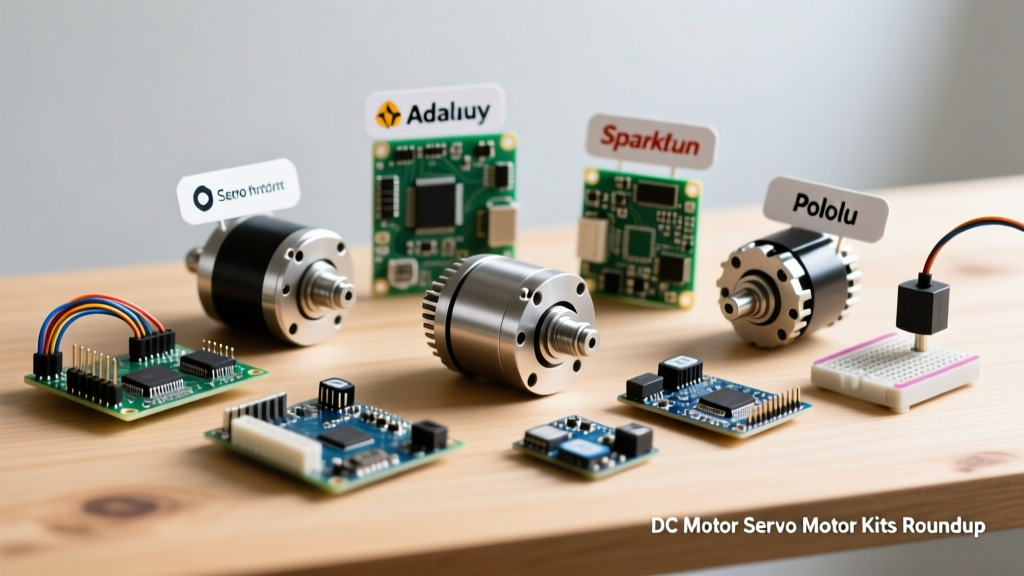
In this 2026 equipment roundup, we are bypassing the generic theory and diving straight into the workbench. We have evaluated the most reliable robotics kits and standalone components available today, analyzing their motor driver architectures, stall currents, and mechanical failure modes. Whether you are building an autonomous rover or a bipedal walking robot, understanding the electrical nuances of these actuators is critical to preventing microcontroller brownouts and stripped gears.
Top Tier Robotics Kits Featuring Hybrid Actuator Setups
Buying a bundled kit is often the most cost-effective way to source matched actuators, motor drivers, and microcontrollers. However, not all kits are created equal. Below are the top three platforms that effectively demonstrate the interplay between DC traction motors and servo-based steering or articulation.
1. Elegoo Smart Robot Car Kit V4.0 (Best All-in-One Rover)
The Elegoo Smart Robot Car V4.0 remains a dominant force in the educational robotics space. It utilizes four standard TT brushed DC gearmotors for locomotion and a single SG90 micro servo for an ultrasonic sensor pan-tilt mechanism. What elevates this kit from a toy to a serious learning tool is its motor driver architecture. Instead of the outdated, heat-generating L298N H-bridge, Elegoo employs the TB6612FNG dual motor driver. This MOSFET-based driver boasts a significantly lower voltage drop (around 0.5V compared to the L298N's 2V drop), ensuring that your TT motors receive maximum voltage and torque from the 18650 lithium-ion battery pack.
2. SunFounder Sloth Arduino Bipedal Robot (Best Servo Focus)
If your project requires complex inverse kinematics rather than continuous driving, the SunFounder Sloth is a masterclass in servo utilization. This bipedal kit relies entirely on eight SG90 9g servos to articulate the hips, knees, and ankles. While the SG90 is a budget-friendly actuator with nylon gears rated for roughly 1.8 kg-cm of torque, the Sloth's lightweight stamped-aluminum chassis keeps the mechanical load well within safe operating limits. The kit includes a custom Arduino Nano shield that routes external 5V power directly to the servo rails, a crucial design choice that prevents the ATmega328P from resetting during high-current walking gaits.
3. DFRobot Devastator Tank Platform (Best Heavy-Duty DC)
For outdoor rovers and heavy-payload applications, standard TT motors will quickly strip their plastic gears. The DFRobot Devastator platform solves this by utilizing heavy-duty, metal-geared DC motors paired with a robust aluminum suspension system. While it does not include servos out of the box, its expansive top plate and integrated high-current motor controllers make it the ideal base for adding high-torque digital servos for robotic arms or sensor masts. The platform handles stall currents exceeding 3A per motor without breaking a sweat, provided you are using a high-discharge LiPo battery.
Standalone Component Deep Dive: Upgrading Your Actuators
Pre-packaged kits are excellent for starting out, but advanced DIYers eventually need to source individual components to meet specific torque and speed requirements. Here is a breakdown of the standalone motors that dominate the workbenches of professional prototypers.
TowerPro MG996R vs. DS3218 (High-Torque Servos)
The MG996R is legendary in the RC and robotics community, offering an impressive 13 kg-cm of torque at 6V thanks to its brass-bushed metal gears. However, it suffers from a well-documented flaw: the internal potentiometer is prone to jitter and dead-band drift over time, leading to oscillating feedback loops in PID-controlled arms. For a modern upgrade, the DS3218 20kg-cm Digital Servo is vastly superior. It features a wider 270-degree operational range, a digital processing circuit that eliminates centering jitter, and a heavy-duty CNC aluminum gear train. When designing a robotic gripper, the DS3218's ability to hold position under heavy load without drawing continuous stall current makes it worth the premium price tag.
Pololu Micro Metal Gearmotors (Precision DC)
When space is at a premium and precision is paramount, standard yellow TT motors are far too bulky and noisy. Pololu Micro Metal Gearmotors are the industry standard for compact rovers and animatronics. Available in gear ratios ranging from 5:1 up to 1000:1, these 6V DC motors feature all-metal gear trains and can be paired with magnetic encoders for closed-loop speed control. The 100:1 HP (High Power) version, for instance, delivers a stall torque of 125 oz-in (9 kg-cm) while drawing roughly 1.6A at stall. Because they are pure DC motors, you must pair them with an external H-bridge and, ideally, a PID algorithm in your firmware to maintain straight-line tracking.
Technical Showdown: Electrical Characteristics & Failure Modes
Understanding the electrical boundaries of your actuators is the difference between a successful build and a fried microcontroller. Below is a comparative data table outlining the critical specifications you must factor into your power supply and wiring diagrams.
| Actuator Model | Type | Nominal Voltage | Stall Torque | Stall Current | Common Failure Mode |
|---|---|---|---|---|---|
| SG90 Micro 9g | Analog Servo | 4.8V - 6.0V | 1.8 kg-cm | ~250 mA | Nylon gear stripping under shock loads |
| TowerPro MG996R | Analog Servo | 4.8V - 7.2V | 13.0 kg-cm | ~2.5 A | Potentiometer drift causing PID oscillation |
| TT Gearmotor (Standard) | Brushed DC | 3.0V - 6.0V | 0.8 kg-cm | ~1.2 A | Plastic gear tooth shearing at high PWM |
| Pololu 100:1 HP Micro | Brushed DC | 6.0V | 9.0 kg-cm | ~1.6 A | Motor burnout if stalled without current limiting |
Wiring, PWM, and Power Supply Pitfalls
The most common point of failure in DIY robotics is not mechanical; it is electrical. A frequent mistake made by beginners is attempting to power multiple servos or high-torque DC motors directly from the Arduino's 5V pin. According to the Arduino Servo Motor Documentation, the onboard linear voltage regulator is typically rated for a maximum of 500mA to 800mA, and that capacity drops significantly as the chip heats up.
Expert Rule of Thumb: Never route actuator power through your microcontroller's logic rails. A single MG996R servo can pull 2.5A at stall. If you connect even two of these to an Arduino's 5V rail, the resulting voltage sag will instantly trigger a brownout reset on the ATmega328P, potentially corrupting your EEPROM or causing erratic PWM signals that command your robot to drive off a table.
The Solution: Implement a dedicated Battery Eliminator Circuit (BEC) or a high-efficiency buck converter (like the LM2596 module) to step down your main battery voltage (e.g., 12V from a 3S LiPo) to a stable 5V or 6V rail specifically for your actuators. Ensure that the ground (GND) of your external power supply is tied directly to the GND of your microcontroller to establish a common reference voltage for the PWM control signals.
Furthermore, when driving raw DC motors via relays or basic H-bridges, always ensure flyback diodes are installed across the motor terminals. Brushed DC motors generate significant back-EMF (electromotive force) when power is cut or reversed. Without a diode to safely dissipate this voltage spike, the inductive kickback will arc across your motor driver's MOSFETs, permanently destroying the silicon.
Final Verdict: Which Setup Fits Your Bench?
Choosing between a dc motor servo motor combination ultimately depends on your project's kinematic requirements. If you are building an indoor educational rover or a line-following robot, the Elegoo V4.0 Kit provides an unbeatable introduction to MOSFET-based DC motor control and basic servo steering. For those delving into biomechanics, robotic arms, or multi-legged walking algorithms, investing in standalone digital servos like the DS3218 and powering them via a dedicated external BEC will save you hours of troubleshooting mechanical slop and electrical noise.
Remember that actuators are only as good as the power delivery and control logic supporting them. Respect the stall current ratings, isolate your logic from your motor power, and your robotic builds will operate reliably for years to come.