
The Shift from Photocells to Dedicated Color Sensing Sensors
For decades, hobbyists and engineers relied on simple cadmium sulfide (CdS) photocells or basic RGB LEDs used in reverse-bias mode to detect light intensity. While these methods worked for basic dark/light detection, they completely failed at accurate chromaticity measurement. Today, the integration of advanced optical ICs has democratized precision colorimetry. Whether you are building an automated pill-sorting robot, a hydroponic nutrient analyzer, or a smart home ambient lighting sync system, selecting the right color sensing sensor is critical to your project's success.
In this comprehensive tool review, we evaluate the three most prominent color sensing modules available to makers and embedded engineers. We will bypass the marketing fluff and dive straight into I2C bus behavior, spectral response curves, physical housing requirements, and the real-world failure modes that datasheets often gloss over.
Under the Hood: How RGB and Spectral ICs Capture Light
At the core of every modern color sensing sensor is an array of photodiodes covered by specialized optical filters. Unlike a standard camera sensor that uses a Bayer filter mosaic, dedicated color ICs typically utilize discrete, highly calibrated Red, Green, Blue, and Clear (unfiltered) channels.
The Clear channel is arguably the most important for calculating overall illuminance (Lux) and Color Temperature (CCT). When light hits the photodiodes, the sensor's internal analog-to-digital converter (ADC) integrates the charge over a specific time window (Integration Time) and applies a multiplier (Gain). Understanding the relationship between integration time and gain is the difference between a sensor that works perfectly on your desk and one that completely saturates when moved near a window.
Top 3 Color Sensing Sensors Reviewed for Embedded Builds
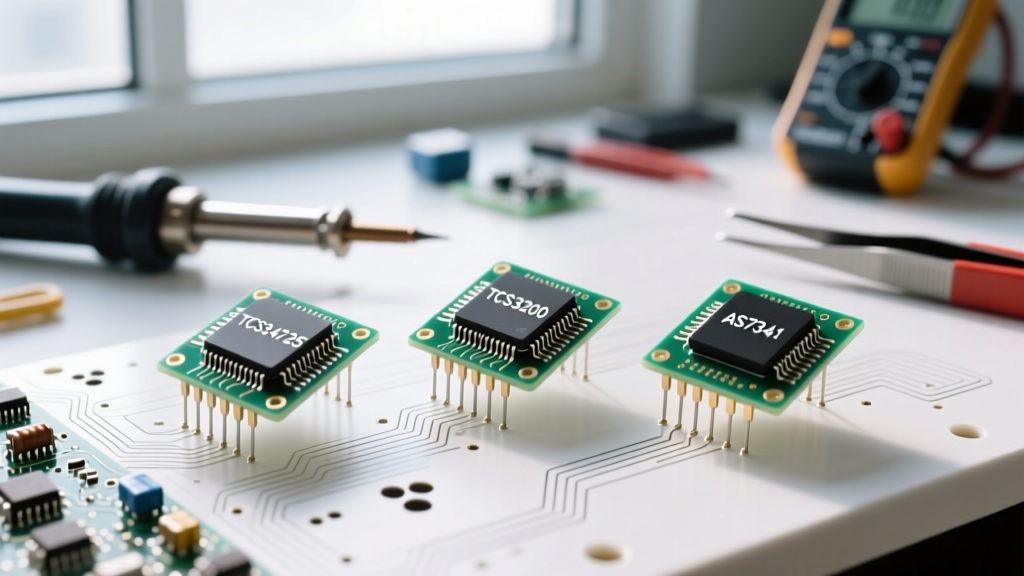
1. Adafruit TCS34725 (Best Overall for I2C Reliability)
Based on the ams OSRAM TCS34725 IC, this breakout board is the gold standard for intermediate to advanced Arduino and Raspberry Pi projects. The standout feature of the TCS34725 is its integrated IR-blocking filter. In the real world, incandescent bulbs and direct sunlight emit massive amounts of infrared light, which standard silicon photodiodes detect as false red/clear signals. The IR filter ensures that the RGB ratios remain stable regardless of the light source.
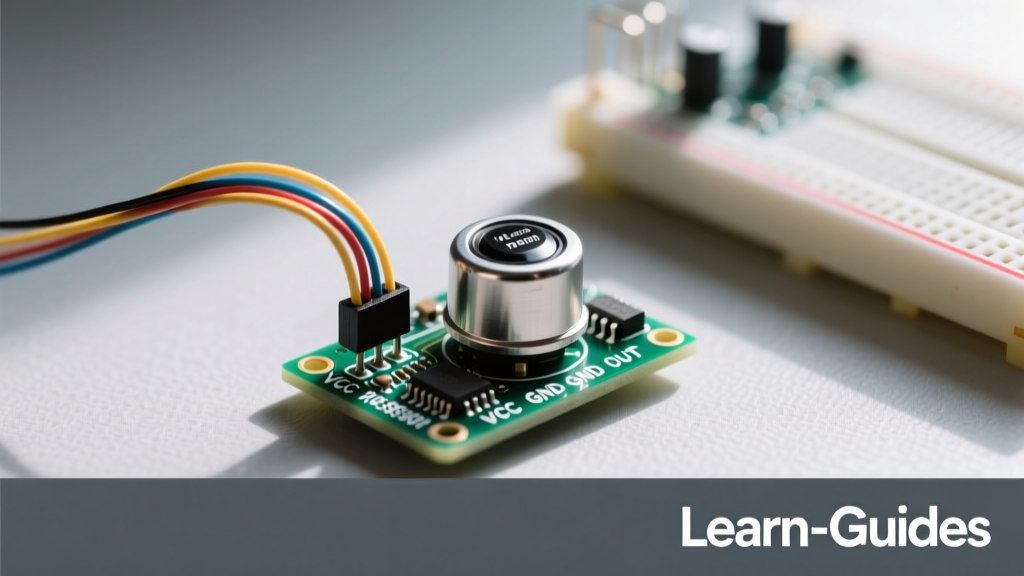
Wiring & Integration: It communicates via I2C (default address 0x29). Adafruit’s breakout includes a 3.3V voltage regulator and level-shifting circuitry, making it completely safe for 5V Arduino Unos and 3.3V ESP32s. The onboard LED can be toggled via a digital pin to provide consistent illumination for close-range object scanning.
Expert Tip: To get accurate Lux and CCT calculations, you must implement the cgf (Clear Gain Factor) formula provided in the ams OSRAM TCS34725 Product Page application notes. Relying solely on raw 16-bit register reads will yield useless data for color matching.
2. Generic TCS3200 / TCS230 Modules (Best Budget Analog Option)
If you have ever bought a bulk sensor kit online, you have likely encountered the TCS3200 module. Recognizable by its 4-pin photodiode array surrounded by four bright white surface-mount LEDs, this sensor uses a fundamentally different approach: frequency output. Instead of an I2C digital register, the sensor outputs a square wave whose frequency is strictly proportional to light intensity.
The Good: It requires no specialized I2C libraries. You simply use the pulseIn() function or hardware timers on your microcontroller to measure the frequency. It is incredibly cheap (often under $4) and operates natively at 5V.
The Bad: It lacks an IR-blocking filter and has poor ambient light rejection. The four white LEDs are meant to act as a controlled light source, but they cause massive specular reflection (glare) on shiny objects. Furthermore, scaling the output frequency via pins S0 and S1 requires manual toggling, making rapid sequential RGB reads prone to timing artifacts.
3. SparkFun AS7341 (Best for Multi-Spectral Precision)
When standard RGB isn't enough, you step up to spectral sensing. The SparkFun AS7341 breakout utilizes an 11-channel IC (8 visible light channels, 1 Near-Infrared, 1 Clear, and 1 dedicated Flicker detection channel). This is not just a color sensor; it is a mini-spectrometer.
According to the SparkFun AS7341X Hookup Guide, the distinct channels (F1 through F8) map to specific nanometer wavelengths (e.g., F1 at 415nm, F4 at 515nm, F7 at 630nm). This allows engineers to detect chemical compositions in fluids, measure plant health via NDVI proxies, or identify specific fluorescent dyes that would look identical to a standard RGB sensor.
Trade-offs: The data payload is massive. Reading 11 16-bit channels over I2C requires careful clock-stretching management, especially on faster microcontrollers like the ESP32 or Raspberry Pi Pico.
Spec Sheet Showdown: Hardware Comparison
| Sensor Model | Interface | Channels | IR Blocking Filter | Avg. Price | Best Application |
|---|---|---|---|---|---|
| TCS34725 | I2C | 4 (R, G, B, C) | Yes (Integrated) | $8.00 - $10.00 | Object sorting, ambient light UI sync |
| TCS3200 | Frequency (Pulse) | 4 (R, G, B, C) | No | $2.50 - $4.50 | Educational demos, basic color gates |
| AS7341 | I2C | 11 (Spectral + Flicker) | Yes (Advanced) | $12.00 - $15.00 | Fluid analysis, agriculture, flicker detect |
Real-World Failure Modes and Calibration Fixes
Hardware is only half the battle. As detailed in extensive maker community logs and the Adafruit Color Sensor Guide, optical sensors are notoriously fragile in uncontrolled environments. Here is how to troubleshoot the most common failure modes.
Failure Mode 1: Ambient Light Washout
The Symptom: Your sensor reads pure white (max saturation) or completely random RGB ratios when testing objects on your workbench, even if the object is dark blue.
The Root Cause: The sensor is integrating overhead room lighting alongside the target object's reflection. The TCS3200 is the worst offender here due to its lack of an optical shroud.
The Fix: You must build a physical light-tight shroud. 3D print a matte-black enclosure that physically blocks ambient light and positions the sensor's onboard LEDs exactly 2mm to 4mm from the target surface. For I2C sensors, lower the integration time (e.g., from 700ms down to 50ms) and increase the gain (e.g., 16x or 60x) to prioritize the close-range LED reflection over slow ambient photons.
Failure Mode 2: I2C Bus Lockups and Clock Stretching
The Symptom: Your ESP32 or Arduino freezes completely when polling the TCS34725 or AS7341, requiring a hard physical reset.
The Root Cause: Optical sensors often use "clock stretching"—they hold the SCL line LOW while the internal ADC finishes integrating the light data. If your microcontroller's I2C hardware implementation does not support clock stretching (a known issue with some older ESP8266 Arduino core versions), the bus deadlocks.
The Fix: Ensure you are using pull-up resistors (4.7kΩ to 3.3V) on both SDA and SCL lines. Many cheap clone modules omit these. If using an ESP32, switch to the Wire library's software I2C fallback or ensure you are on the latest Arduino core that handles hardware stretching correctly.
Failure Mode 3: Color Temperature Shift Under Different Illuminants
The Symptom: A red LEGO brick reads perfectly under your desk lamp, but registers as orange or brown when moved near a sunny window.
The Root Cause: The sensor is accurately measuring the light hitting it, but the source light has a different Color Correlated Temperature (CCT). A 2700K incandescent bulb is heavy in red/yellow wavelengths, while 5600K daylight is heavy in blue.
The Fix: Implement a software White Balance routine. Before taking your actual measurement, place a known 18% grey card or pure white PTFE reference under the sensor. Read the Clear, Red, Green, and Blue values. Calculate the scaling factors required to force the RGB values to equal 1.0. Apply these multipliers to all subsequent object reads to mathematically cancel out the illuminant's color bias.
Final Verdict: Wiring Up the Right Sensor
If you are building a commercial IoT product, a high-reliability sorting machine, or an ambient smart-lighting system, the TCS34725 is the undisputed champion. The integrated IR filter and robust I2C implementation save hundreds of hours of software compensation.
For university labs, agricultural tech, or chemical analysis where you need to see between the primary colors, invest the extra capital into the AS7341. Its spectral data provides a level of information gain that RGB simply cannot match.
Finally, reserve the TCS3200 for quick weekend prototypes, teaching children basic frequency-to-color concepts, or ultra-low-budget builds where a 3D-printed shroud and heavy software averaging can mask its optical shortcomings.