
Meet the Maker: Julien’s Autonomous 'Drone Robotique'
Welcome to this month's ElectricalFlux Community Showcase, where we highlight exceptional DIY engineering from our forum members. Today, we are featuring Julien, a robotics engineer from Lyon, who recently completed his fully autonomous mapping platform—a true drone robotique. Unlike standard FPV racers or off-the-shelf camera drones, Julien’s build is designed for heavy-lift agricultural mapping and LiDAR scanning, requiring absolute flight stability, redundant telemetry, and edge-computing capabilities.
Julien's project bridges the gap between raw hardware assembly and advanced software integration. By pairing an enterprise-grade flight controller with a custom ESP32-based companion computer, he created a robust system capable of operating beyond visual line of sight (BVLOS) with LTE failover. Below, we break down his architecture, component selection, and the hard-won troubleshooting lessons he learned during the initial flight testing phase.
The Core Architecture: Cube Orange+ Meets ESP32
At the heart of any serious drone robotique is the flight controller (FC). Julien opted for the Cube Orange+, an industry-standard autopilot featuring triple-redundant IMUs and dual-redundant barometers. This hardware is critical for heavy-lift platforms where a single sensor failure could result in a catastrophic crash.
The ESP32 Companion Node
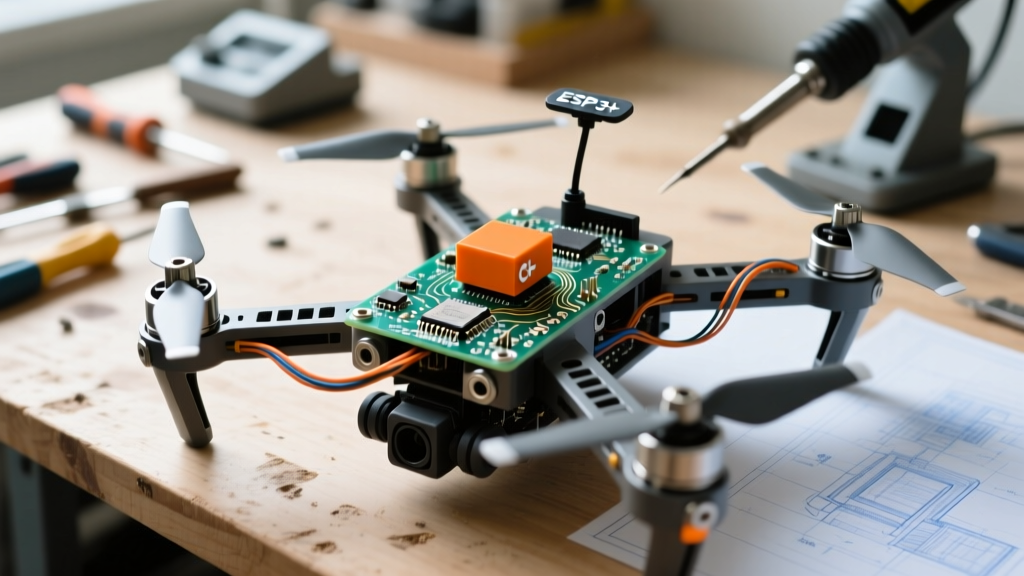
While the Cube Orange+ handles the real-time PID loops and navigation, Julien needed a secondary system to handle high-bandwidth telemetry routing and LTE failover without burdening the FC's STM32 processor. He chose the ESP32-WROOM-32 development board. Running at 240MHz with dual cores, the ESP32 is more than capable of parsing MAVLink packets, buffering data, and pushing it to an MQTT broker via a connected SIM7600 4G LTE module.
- Core 0: Dedicated to reading the UART serial stream from the FC's Telem2 port (57600 baud) and parsing MAVLink2 messages.
- Core 1: Handles the Wi-Fi/LTE stack, managing the MQTT connection to Julien's ground station server, and triggering local failsafe alerts if the connection drops for more than 5 seconds.
Propulsion and Power: Lifting the Payload
A robotic drone is only as good as its powertrain. To lift a 3.5kg LiDAR payload and a 12S battery, Julien needed high-torque, low-KV motors. He selected the T-Motor U8 II KV100 brushless motors paired with 28-inch carbon fiber propellers. This combination provides massive static thrust while keeping the amp draw manageable, ensuring the ESCs operate well within their thermal limits.
Power is managed by a custom 12S 22000mAh Tattu Plus 2.0 LiPo pack, feeding into a 120A-rated power distribution board (PDB) with integrated current and voltage sensing. The PDB outputs clean 5V and 12V regulated power to the ESP32 companion computer and the LTE modem, isolated via optocouplers to prevent ground loops.
Component BOM and Weight Budget Analysis
Weight management is the silent killer of endurance in custom drone builds. Julien maintained a strict weight budget to ensure a minimum flight time of 35 minutes with a full payload. Below is the detailed Bill of Materials (BOM) and weight breakdown for the core avionics and propulsion systems.
| Component | Model / Specification | Weight (g) | Est. Cost (USD) | Purpose |
|---|---|---|---|---|
| Flight Controller | Cube Orange+ (with ADS-B carrier) | 115g | $240 | Primary navigation and IMU sensor fusion |
| Companion Computer | ESP32-WROOM-32 + SIM7600 LTE | 42g | $35 | MAVLink routing and BVLOS telemetry |
| Motors (x4) | T-Motor U8 II KV100 | 680g | $440 | High-torque heavy-lift propulsion |
| ESCs (x4) | T-Motor Flame 80A OPTO | 320g | $360 | Motor commutation and DShot600 signaling |
| Battery | Tattu Plus 2.0 12S 22000mAh | 3850g | $310 | Primary high-discharge power source |
| Frame | Tarot X8 Carbon Fiber (Modified) | 1450g | $280 | Structural chassis and payload mounting |
Overcoming the 'Silent Killers' of Custom Robotic Drones
Building a drone robotique is rarely plug-and-play. Julien encountered two major hardware-level issues during his initial tuning flights that grounded the project for three weeks. His troubleshooting process offers invaluable lessons for our community.
IMU Clipping and Harmonic Resonance
During a high-wind hover test, Julien experienced an uncommanded yaw drift followed by a failsafe Return-to-Launch (RTL) event. Downloading the flash logs and reviewing the ArduPilot vibration troubleshooting guide, he discovered severe Z-axis IMU clipping. The vibration levels were spiking to 85 m/s², well above the safe threshold of 60 m/s².
'The stock foam dampeners provided with the Cube carrier board were completely ineffective against the low-frequency 45Hz harmonic resonance generated by the 28-inch props. I had to machine custom aluminum standoffs and isolate the FC using Sorbothane dampeners rated at 70 durometer. Post-fix FFT logs showed vibrations dropping to a pristine 12 m/s² across all axes.' — Julien
I2C and UART EMI from High-Current PDBs
The second issue was intermittent telemetry drops between the Cube Orange+ and the ESP32. When the motors spooled up past 60% throttle, the ESP32 would reset or drop MAVLink packets. Julien used an oscilloscope to probe the UART TX/RX lines and found massive electromagnetic interference (EMI) noise induced by the 80A current spikes on the nearby PDB traces.
The Fix: Julien replaced the standard silicone jumper wires with twisted-pair, shielded cables. He grounded the braided shield exclusively at the flight controller side to prevent ground loops, and added 4.7k pull-up resistors to the I2C bus used by the external GPS/compass module. This completely eliminated the packet loss, even during aggressive ascent profiles.
Software Stack: ArduPilot and MQTT Telemetry
On the software side, the drone runs ArduCopter 4.4. The ESP32 firmware was written in C++ using PlatformIO. Julien utilized the official MAVLink C library to parse incoming serial data. Instead of relying solely on traditional RF telemetry (which struggles with range and bandwidth), the ESP32 formats critical telemetry data (GPS coordinates, battery voltage, IMU health, and mission waypoint progress) into lightweight JSON payloads.
These payloads are published to an AWS IoT Core MQTT broker. This allows Julien to monitor the drone robotique from a custom React-based web dashboard on his laptop, complete with real-time map tracking and voltage trend graphs. If the primary 900MHz RF link fails, the LTE bridge seamlessly maintains command and control authority.
Final Flight Metrics and Community Takeaways
After 40 hours of bench testing, firmware iterations, and vibration tuning, Julien’s drone robotique achieved its design goals. With a 3.5kg LiDAR payload, the platform consistently logs 28 minutes of flight time, maintaining a stable hover at 42% throttle. The ESP32 telemetry bridge has proven 100% reliable over a 5km BVLOS test range, dropping zero critical packets.
Key Takeaways for Builders:
- Never skip FFT analysis: Heavy-lift drones with large propellers generate unique low-frequency vibrations. Always log pre-filter IMU data and tune your notch filters accordingly.
- Shield your data lines: High-current power distribution boards emit massive EMI. Treat your UART and I2C wiring like sensitive audio equipment—use twisted pairs and proper shielding.
- Offload the FC: Using an ESP32 as a companion computer for telemetry and LTE routing frees up the flight controller to focus entirely on flying, drastically improving system stability and safety.
We want to thank Julien for sharing his build logs, schematics, and failures with the ElectricalFlux community. If you are building your own autonomous robotic platforms, head over to our forums to share your telemetry setups and MAVLink routing strategies!