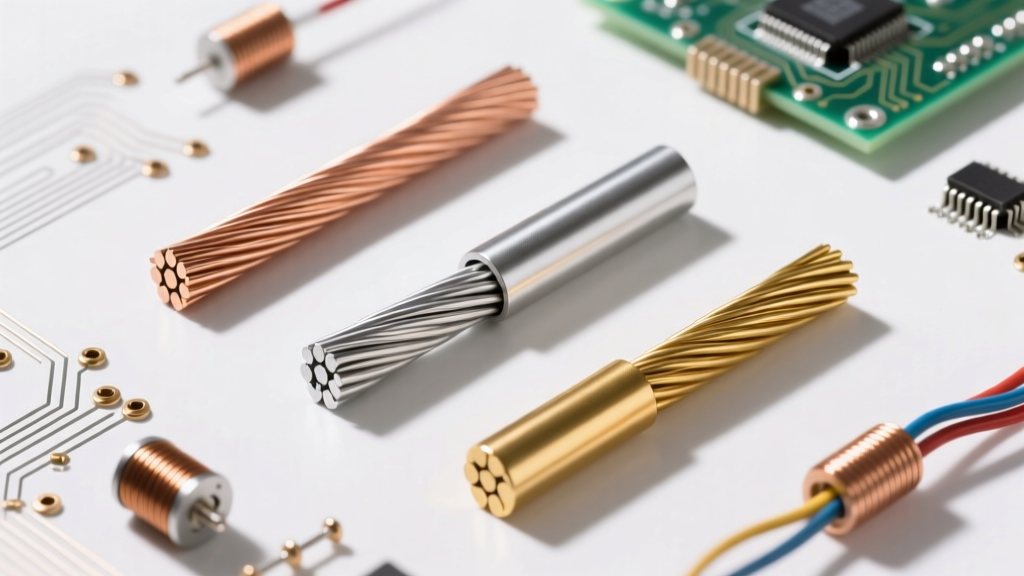

The Atomic Reality: Defining Electrical Conductors
When students, DIYers, and junior engineers first ask, what are some conductors, they usually expect a simple list of common metals. However, in electrical engineering and wire sizing, understanding conductors requires looking past the periodic table and into the quantum mechanical behavior of valence electrons. A conductor is fundamentally a material that possesses a high density of free charge carriers—usually electrons—that can move through a crystalline lattice with minimal resistance when an electromotive force (voltage) is applied.
According to the band theory of solids, conductors have overlapping valence and conduction bands. This means electrons require virtually zero additional energy to jump into a state where they can flow as current. While metals are the most obvious answer to 'what are some conductors', the practical selection of a conductive material for wiring, PCB traces, or high-voltage transmission depends on a complex matrix of electrical resistivity, tensile strength, thermal expansion, and economic viability.
Answering the Core Question: What Are Some Conductors?
To truly grasp wire fundamentals, we must evaluate the specific metallurgical properties of the materials that actually make it into commercial and industrial electrical systems. Below is a deep dive into the primary conductors used in modern electrical engineering.
Copper (C11000 / ETP) - The Industry Benchmark
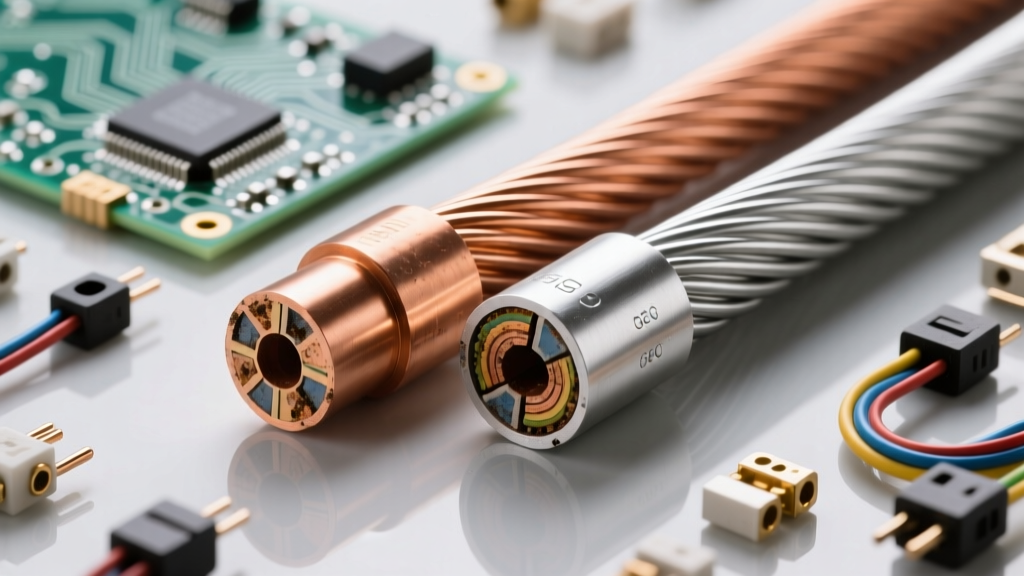
Copper is the undisputed king of electrical wiring. Specifically, Electrolytic Tough Pitch (ETP) copper, designated as C11000, is the standard against which all other conductors are measured. The International Annealed Copper Standard (IACS) sets the conductivity of annealed ETP copper at exactly 100% (or a resistivity of 17.1 nΩ·m at 20°C).
Copper's dominance isn't just about conductivity; it's about mechanical reliability. It boasts high tensile strength, meaning it can be pulled through long conduit runs without snapping. Furthermore, copper forms a relatively stable oxide layer that is still somewhat conductive, unlike the highly insulating oxides formed by other metals. For branch circuits, motor windings, and busbars, copper remains the default choice, as extensively documented by the Copper Development Association.
Aluminum (AA-8000 Series) - The High-Voltage Workhorse
If copper is the king, aluminum is the heavy-lifting workhorse of the power grid. Aluminum possesses roughly 61% of the conductivity of copper by volume, but it has a massive advantage: density. Aluminum is about one-third the weight of copper. For high-voltage overhead transmission lines, the weight savings drastically reduce the structural requirements for towers and poles, making aluminum the only economically viable choice.
Historically, aluminum was used in residential branch circuits in the 1960s and 70s, leading to widespread failures due to 'thermal creep' (the metal expanding and contracting under load, loosening terminal connections) and galvanic corrosion. Today, the National Electrical Code (NEC) mandates the use of AA-8000 series aluminum alloys for branch wiring. By alloying aluminum with trace amounts of iron and copper, manufacturers drastically increased its tensile strength and reduced creep, making modern aluminum wire safe for residential feeders and large commercial loads when paired with CO/ALR rated terminals and anti-oxidant paste.
Silver and Gold - Niche, High-Frequency, and Corrosion-Proof
When answering 'what are some conductors' in the realm of high-end electronics and aerospace, silver and gold enter the conversation. Silver is actually the most conductive elemental metal on Earth, boasting an IACS rating of roughly 105%. However, its cost and tendency to tarnish (forming silver sulfide) limit its use in bulk wiring.
Instead, silver is utilized in RF (Radio Frequency) applications due to the skin effect. At high frequencies, alternating current travels primarily on the outer surface of the conductor. By silver-plating a copper wire, engineers combine the tensile strength and cost-efficiency of copper with the superior surface conductivity of silver, minimizing signal loss in coaxial cables and aerospace wiring.
Gold, while only about 70% as conductive as copper, is completely immune to oxidation and corrosion. It is the premier material for low-voltage, low-current signal connections, PCB edge connectors, and MIL-SPEC aerospace connectors where a micro-ohm increase in contact resistance could result in catastrophic data loss or signal degradation.
Comparative Data: Conductivity, Density, and Cost Matrix
To visualize the engineering trade-offs, refer to the comparative matrix below. Data is based on standard annealed states at 20°C, referencing principles outlined by Georgia State University HyperPhysics.
| Material | Resistivity (nΩ·m) | Density (g/cm³) | IACS % | Primary Use Case |
|---|---|---|---|---|
| Silver (Ag) | 15.9 | 10.49 | 105% | RF plating, high-end audio contacts |
| Copper (Cu) | 17.1 | 8.96 | 100% | Branch wiring, busbars, motor windings |
| Gold (Au) | 24.4 | 19.30 | 70% | PCB contacts, aerospace connectors |
| Aluminum (Al) | 28.2 | 2.70 | 61% | Overhead transmission, heavy feeders |
| Sodium (Na) | 47.7 | 0.97 | 37% | Experimental/High-voltage research |
Beyond Metals: Exotic and Non-Metallic Conductors
The question of what are some conductors extends beyond traditional metallurgy. In modern electronics and cutting-edge research, non-metallic conductors are gaining traction:
- Carbon Nanotubes (CNTs): These cylindrical carbon molecules exhibit ballistic electron transport, meaning electrons can travel through them without scattering. They possess current-carrying capacities up to 1,000 times greater than copper by weight, though manufacturing continuous, macro-scale wires remains a significant hurdle.
- Conductive Polymers: Materials like PEDOT:PSS are used in flexible electronics, OLEDs, and biosensors. While their bulk conductivity is far lower than metals, their mechanical flexibility and optical transparency make them irreplaceable in modern display tech.
- Superconductors: Materials like YBCO (Yttrium Barium Copper Oxide) exhibit exactly zero electrical resistance below their critical temperature. While currently requiring cryogenic cooling, they are used in MRI machines, particle accelerators, and experimental lossless power grids.
Practical Decision Framework: Sizing and Selection
Knowing the materials is only half the battle. When designing a circuit or sizing wire for a DIY project, use this decision framework to select the correct conductor:
- Ampacity & Thermal Limits: Calculate the maximum continuous current. Remember that insulation type (e.g., THHN vs. XHHW-2) dictates the thermal ceiling of the conductor, not just the metal itself.
- Voltage Drop: For runs exceeding 50 feet, aluminum's higher resistivity requires you to upsize the wire gauge by at least one or two AWG steps compared to copper to maintain a voltage drop below the recommended 3%.
- Termination Compatibility: Never terminate aluminum wire on terminals rated only for copper. The Aluminum Association and NEC strictly require proper bi-metallic lugs or AL/CU rated breakers to prevent galvanic corrosion and subsequent arcing.
- Environmental Factors: In highly corrosive environments (marine or chemical plants), tinned copper or specialized silver-plated wires are necessary to prevent the base metal from degrading over time.
Engineering Rule of Thumb: Conductivity dictates the cross-sectional area required for ampacity, but the mechanical environment dictates the alloy and stranding type you must choose.
Summary
So, what are some conductors? They are the foundational pathways of modern civilization. From the C11000 copper wiring inside your walls to the AA-8000 aluminum feeders powering your panel, and the microscopic gold contacts inside your smartphone, each material is chosen for a highly specific balance of atomic properties, mechanical strength, and economic reality. Understanding these differences is the hallmark of a true electrical practitioner.