
The Reality of 3-Way Switches in Commercial Spaces
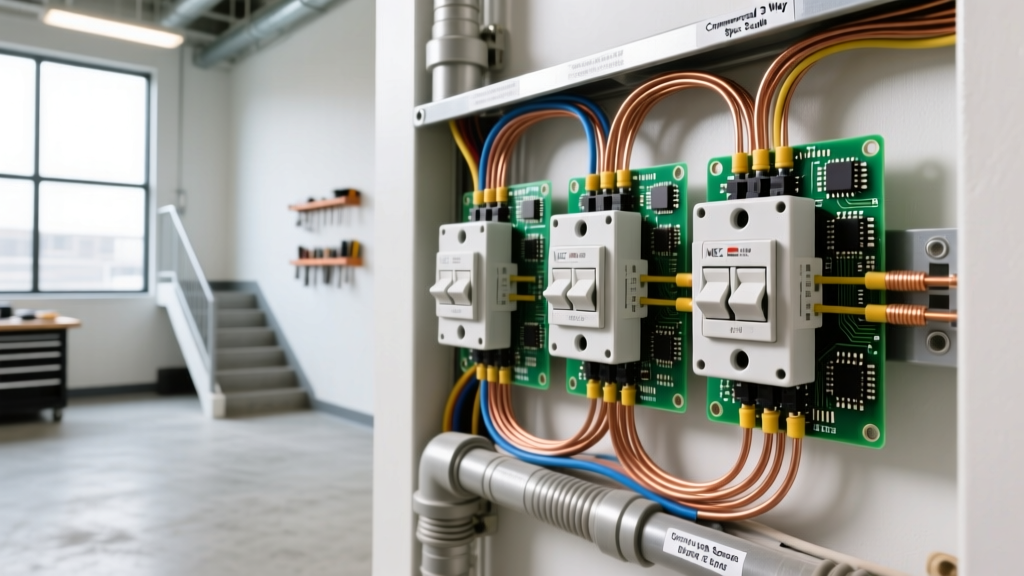
When electrical contractors approach commercial 3 way wiring, the rules of engagement change drastically compared to residential construction. In a home, a 3-way switch is a simple mechanical toggle used to control a hallway or stairwell light from two locations. In a commercial environment—governed by stringent energy codes, 277V lighting systems, and high-traffic durability requirements—manual 3-way wiring is only one piece of a much larger compliance puzzle. Electricians must navigate ASHRAE 90.1 mandates, Title 24 requirements, and NEC Article 404 specifications while ensuring that the hardware can withstand thousands of actuations per year.
While the shift toward relay panels, 0-10V dimming, and wireless mesh networks (like Lutron Vive) has reduced the sheer volume of traditional hardwired 3-way circuits in new commercial builds, manual 3-way configurations remain essential in specific applications. Stairwells, mechanical rooms, egress corridors, and back-of-house retail areas frequently rely on commercial-grade 3-way wiring, often integrated directly with hardwired occupancy or vacancy sensors to meet automatic shutoff codes.
NEC Article 404 and Commercial Lighting Control Mandates
The National Electrical Code (NEC) does not explicitly ban manual 3-way switches in commercial spaces, but it heavily regulates how they are deployed. According to NFPA 70 (NEC), Article 404.2 dictates switch connections and grounding requirements. In commercial 277V circuits, the voltage potential demands rigorous termination practices to prevent arcing and thermal failures.
Furthermore, energy standards like ASHRAE 90.1 and the International Energy Conservation Code (IECC) mandate that commercial lighting must have automatic shutoff capabilities. This means a purely manual 3-way wiring setup is often illegal in spaces like corridors, restrooms, and break rooms unless it is paired with an automatic control device. The modern commercial 3-way circuit almost always involves a hybrid configuration: a spec-grade manual 3-way switch at one end of a corridor, and a commercial-grade 3-way compatible occupancy sensor at the other.
When Manual 3-Way Wiring is Still Required
Despite the push for automation, pure manual 3-way wiring is still required or preferred in several commercial scenarios:
- Egress Stairwells: Fire and building codes often require manual override capabilities for emergency egress lighting paths, ensuring occupants can manually illuminate a stairwell if sensors fail.
- Mechanical and Electrical Rooms: HVAC and electrical rooms rarely require automatic shutoff, making standard 3-way manual wiring ideal for dual-entry control.
- Specific Retail Back-Stock Areas: Where inventory is constantly moving, manual overrides prevent sensors from prematurely shutting off lights on workers.
Spec-Grade vs. Residential: Hardware Differences
Using residential 120V/15A switches in a commercial 277V/20A environment is a catastrophic code violation and a severe safety hazard. Commercial 3 way wiring requires Specification Grade (Spec-Grade) hardware designed for high-voltage DC/AC ratings, heavy-duty mechanical endurance, and secure wire termination.
| Feature | Residential (e.g., Leviton 1453) | Commercial Spec-Grade (e.g., Leviton 1653-2) |
|---|---|---|
| Voltage Rating | 120V AC | 120/277V AC |
| Amperage | 15A | 15A or 20A |
| Horsepower Rating | 1/2 HP (120V) | 2 HP (240V) / Motor rated |
| Terminal Type | Side wiring / Back-stab (push-in) | Back-wiring (screw-clamp) / Side wiring |
| Mounting Strap | Standard steel | Heavy-duty steel with plaster ears |
| Actuation Lifespan | ~10,000 cycles | ~50,000+ cycles (UL tested) |
Notice the terminal type difference. Commercial wiring frequently utilizes stranded THHN/THWN-2 wire pulled through EMT conduit, or stranded conductors within Metal Clad (MC) cable. Residential 'back-stab' push-in terminals are strictly for 14 or 12 AWG solid copper wire. Spec-grade switches feature back-wiring clamps, which allow electricians to securely terminate stranded commercial wire without the strands fraying or loosening under the screw head over time due to thermal expansion and 277V arcing.
Wiring Diagrams: Integrating Commercial Occupancy Sensors
The most complex aspect of modern commercial 3 way wiring is integrating a manual switch with a line-voltage occupancy sensor. Unlike residential sensors, commercial sensors (such as the Lutron Maestro MS-OPS5MH or Wattstopper DT-305) must handle 277V lighting loads and interface with existing traveler wires.
Lutron and Wattstopper 3-Way Sensor Configurations
When replacing one of the 3-way switches with a commercial vacancy/occupancy sensor, the wiring topology changes. The sensor requires a continuous power source, the load, and communication with the remote manual switch.
- Identify the Line and Load: In a standard 3-way circuit, the line and load can be at either switch box. For sensor integration, the sensor must be installed at the box containing either the Line or the Load, depending on the specific manufacturer's schematic. Most commercial sensors prefer the Line connection.
- Repurposing Travelers: The two traveler wires that previously carried the switched loop between the mechanical 3-ways are now repurposed. One traveler becomes the 'Switched Leg' communication wire between the sensor and the remote manual switch, while the other traveler is often capped off or used as a neutral if the circuit allows (though many commercial 277V sensors are 2-wire or 3-wire and do not strictly require a neutral, relying on ground referencing or specialized internal circuitry).
- Grounding: NEC 404.9 requires all commercial switches and sensors to be grounded. Ensure the green grounding screw on the sensor is tied to the EMT conduit ground or the bare/green wire in the MC cable.
Pro-Tip for Commercial Electricians: Always use a non-contact voltage tester and a digital multimeter to map the travelers before disconnecting the old 3-way switches. In older commercial retrofits, previous electricians may not have used standard phase tape (yellow, red, blue for 277V travelers), making line/load identification critical to preventing a dead short across the 277V sensor relay.
Conductor Sizing and Voltage Drop in Long Corridors
Commercial buildings feature sprawling floor plans. A 3-way circuit controlling a 150-foot corridor may have traveler wires exceeding 300 feet in total length. While NEC Article 210.19(A) Informational Note No. 4 recommends keeping voltage drop to 3% for branch circuits, long 3-way traveler runs can introduce significant resistance.
For commercial 20A lighting circuits, 12 AWG THHN is the standard. Let us look at the voltage drop implications on a 277V circuit:
- Formula: VD = (2 x K x I x D) / CM
- K (Copper): 12.9 ohms
- I (Current): 16A (Continuous commercial LED load)
- D (Distance): 150 ft (one way to the remote 3-way)
- CM (12 AWG): 6530 circular mils
Calculating this yields a voltage drop of approximately 9.5V, or 3.4%. This exceeds the recommended 3% threshold, which can cause commercial LED drivers to flicker or fail prematurely. In these commercial 3 way wiring scenarios, electricians must upsize the traveler conductors to 10 AWG THHN to maintain voltage integrity across the long corridor, even if the rest of the branch circuit is 12 AWG.
Troubleshooting Commercial 3-Way Failures
When a commercial 3-way circuit fails, the root cause is rarely the switch itself, provided spec-grade hardware was used. Failures typically stem from installation errors or environmental factors unique to commercial spaces.
Common Failure Modes and Solutions
- Stranded Wire Creep: If stranded MC cable wire was tinned with solder before being placed under a side-wiring screw (a deprecated and often prohibited practice), the solder can cold-flow over time, loosening the connection. Solution: Use spec-grade switches with back-wiring clamps designed for stranded wire, and torque the terminal screws to the manufacturer's specified inch-pound rating.
- Harmonic Overheating: In older commercial buildings with magnetic ballasts or early-generation CFLs, the inrush current on a 277V 3-way circuit can weld the internal contacts of an underrated switch together. Solution: Verify the switch is rated for the specific load type (e.g., ballast or LED driver) and upgrade to a heavy-duty 20A toggle if necessary.
- Sensor Ghosting: When a 3-way occupancy sensor fails to turn off the lights, it is often due to 'ghosting' caused by long parallel traveler wires acting as capacitors, holding enough residual voltage to trick the sensor's internal logic. Solution: Install a bleeder resistor (often provided by manufacturers like Lutron) across the load to dissipate the phantom voltage.
Mastering commercial 3 way wiring requires moving beyond simple residential diagrams. By respecting 277V potentials, adhering to ASHRAE energy mandates, and utilizing proper spec-grade termination techniques, electrical professionals can deliver safe, code-compliant, and durable lighting control systems for any commercial facility.