
The True Cost of Wire Gauge Thickness in 2026
When planning a commercial or residential electrical installation, the physical dimensions of your conductors dictate far more than just ampacity and safety. The wire gauge thickness is the primary driver of your overall material budget, labor hours, and long-term operational efficiency. As copper commodity prices continue to experience market volatility heading into 2026, electrical contractors and advanced DIYers must move beyond simple 'price-per-foot' calculations. Understanding how the American Wire Gauge (AWG) system impacts conduit fill, pulling tension, and voltage drop is essential for accurate cost estimation. This comprehensive guide breaks down the exact financial implications of wire gauge thickness, providing a data-driven framework for your next wiring project.
Decoding AWG: How Thickness Dictates Material Pricing
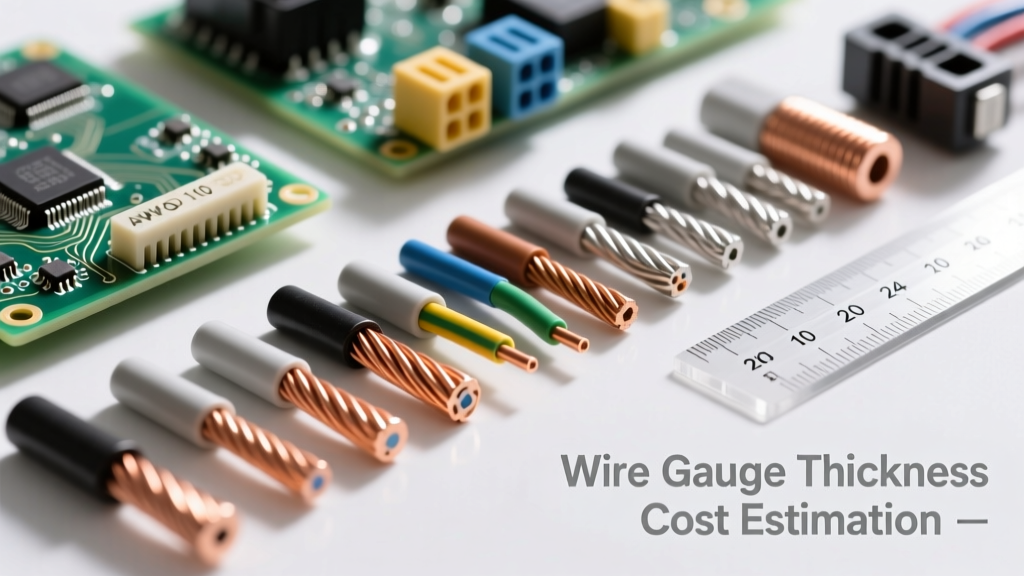
The American Wire Gauge (AWG) system operates on an inverse logarithmic scale: the lower the AWG number, the thicker the wire. This physical thickness directly correlates to the volume of conductive metal used, which is why a 4 AWG wire costs exponentially more per foot than a 14 AWG wire. When estimating costs, you are essentially paying for the cross-sectional area of the copper or aluminum. According to manufacturing data from Southwire, the raw material cost makes up nearly 70% of the final retail price for standard building wire, meaning that fluctuations in global copper markets immediately impact your project's bottom line.
Copper vs. Aluminum: The Upfront Price Gap
For circuits rated above 100 amps, the wire gauge thickness required for copper becomes prohibitively expensive and physically difficult to work with. This is where aluminum enters the cost estimation matrix. Aluminum is significantly lighter and cheaper per pound than copper. However, because aluminum has a higher electrical resistance, you must use a thicker wire gauge (typically two AWG sizes larger) to carry the same current. For example, to safely carry 100 amps, you might use 3 AWG copper, but you would need 1 AWG aluminum. Even with the upsized wire gauge thickness required for aluminum, the material cost is often 40% to 50% lower than its copper equivalent, making it a critical cost-saving measure for heavy feeder lines and service entrances.
2026 Material Cost Matrix: AWG Size vs. Price Per Foot
The following table provides a baseline estimation for 2026 material costs based on standard Cerro Wire and general market averages for standard building wires. Note that prices fluctuate based on regional supply chains and bulk purchasing agreements.
| AWG Size | Diameter (Inches) | Copper THHN ($/ft) | NM-B 2-Wire ($/ft) | Typical Max Breaker |
|---|---|---|---|---|
| 14 AWG | 0.0641 | $0.15 | $0.45 | 15 Amp |
| 12 AWG | 0.0808 | $0.22 | $0.65 | 20 Amp |
| 10 AWG | 0.1019 | $0.38 | $1.10 | 30 Amp |
| 8 AWG | 0.1285 | $0.65 | $1.85 | 40 Amp |
| 6 AWG | 0.1620 | $1.15 | $3.20 | 55/60 Amp |
| 4 AWG | 0.2043 | $1.95 | N/A (Use SER) | 70 Amp |
| 2 AWG | 0.2576 | $3.40 | N/A (Use SER) | 95 Amp |
Hidden Costs: Conduit, Labor, and Voltage Drop
Focusing solely on the cost of the wire itself is a common estimation trap. The wire gauge thickness triggers a cascade of secondary costs that can easily blow a project budget if not accounted for during the bidding phase.
The Conduit Upsize Penalty
The NFPA 70 (National Electrical Code) Chapter 9, Table 1 dictates that conduit fill for three or more conductors cannot exceed 40%. If you decide to increase your wire gauge thickness to mitigate voltage drop on a long run, you may inadvertently exceed the fill capacity of your planned conduit. For instance, three 10 AWG THHN wires fit perfectly within 1/2-inch EMT (Electrical Metallic Tubing). However, if you upgrade to three 6 AWG THHN wires for a 150-foot run to a detached workshop, 1/2-inch EMT is no longer code-compliant. You must upsize to 3/4-inch or even 1-inch EMT. This upsizing increases the cost of the conduit by roughly 40%, requires larger and more expensive fittings, and demands wider, deeper trenching if buried underground in PVC.
Labor Hours and Pulling Tension
Thicker wire is heavier, stiffer, and possesses a higher coefficient of friction when pulled through bends. The labor cost to pull three 14 AWG wires through a finished wall cavity is minimal. Conversely, pulling 2 AWG or 1/0 AWG feeder wire requires specialized pulling lubricants, heavier-duty fish tapes, and potentially two or three electricians working in tandem to manage the pulling tension and prevent damage to the wire insulation. When estimating labor, add a 25% to 40% time premium for any circuit requiring a wire gauge thickness of 4 AWG or larger, especially when navigating multiple 90-degree conduit sweeps.
Long-Term ROI: Why Thicker Wire Saves Money Over Time
While a larger wire gauge thickness increases upfront material and labor costs, it provides a measurable return on investment through reduced voltage drop and lower I²R (heat) losses. The NEC recommends a maximum voltage drop of 3% for branch circuits and 5% for the combined feeder and branch circuit. If you undersize a wire to save $50 on copper, the increased electrical resistance will cause the wire to dissipate energy as heat. Over a 10-year period, running a heavy continuous load (like an EV charger or a commercial HVAC unit) on a minimally sized wire can result in hundreds of dollars in wasted electricity. Upsizing the wire gauge thickness by just one step acts as an energy-efficiency upgrade, lowering the end-user's utility bills and extending the lifespan of the connected equipment by providing cleaner, more stable voltage.
Pro-Tip: Always calculate voltage drop before finalizing your wire gauge thickness for any run exceeding 75 feet. The cost of upsizing the wire during the rough-in phase is always cheaper than replacing a burned-out compressor motor or dealing with tripped breakers caused by severe voltage sag.
Practical Estimation Framework for Electricians
To ensure your 2026 bids are both competitive and profitable, implement this structured estimation framework when evaluating wire gauge thickness requirements:
- Step 1: Calculate Base Ampacity. Determine the minimum wire gauge required by NEC Article 310 based on the load and termination temperature ratings (typically 75°C).
- Step 2: Run Voltage Drop Math. Use a voltage drop calculator. If the drop exceeds 3%, upsize the wire gauge thickness by one or two increments.
- Step 3: Check Conduit Fill. Reference NEC Chapter 9 to ensure your new, thicker wire still fits in the specified raceway. If not, add the cost of larger conduit and fittings to the materials list.
- Step 4: Factor in Labor Multipliers. Apply a labor multiplier for thick wire pulling. If using 4 AWG or larger, account for extra man-hours, heavy-duty pulling compound, and potential mechanical pulling equipment.
- Step 5: Evaluate Aluminum Alternatives. For feeder circuits over 100 amps, price out the equivalent aluminum wire gauge thickness (e.g., XHHW-2 aluminum) to see if the material savings outweigh the cost of larger lugs and anti-oxidant paste.
By treating wire gauge thickness not just as a safety parameter, but as a core financial variable, you can deliver highly accurate estimates that protect your margins while providing clients with safe, efficient, and code-compliant electrical systems.